An Industry Insight from Consultiv Utilities
The care sector has become increasingly focused on energy procurement over the past few years — and rightly so.
Rising wholesale prices, network charges, policy costs, and ongoing economic pressures have elevated energy from a routine operational expense to a board-level concern.
Yet many providers are still looking in the wrong place.
When organisations think about energy risk, they typically focus on one question:
“Are we paying the right rate?”
While contract pricing remains important, some of the most significant financial exposures in care settings have little to do with wholesale markets at all.
Instead, they stem from governance blind spots that often remain unnoticed for years.
Across the sector, specialist reviews continue to uncover billing inaccuracies, contract anomalies, incorrect capacity allocations, and operational inefficiencies that quietly drain resources from organisations already operating under intense financial pressure.
The uncomfortable reality is that many providers do not know these costs exist until someone actively goes looking for them.
For organisations striving to strengthen financial resilience and demonstrate effective leadership under the CQC’s Single Assessment Framework, that should be a concern.
The Shift from Procurement Risk to Governance Risk
Historically, energy management was viewed as a procurement exercise.
Secure a contract, monitor invoices, and renew when necessary.
Today, that approach is increasingly inadequate.
The strongest care providers are recognising that energy performance is influenced not only by market conditions but also by governance structures, accountability, data quality, and operational oversight.
In many cases, the greatest risks are no longer external.
They are internal.
And because they develop gradually, they often remain hidden until they become expensive.
Blind Spot #1: Incorrect Capacity Charges
One of the least understood areas of commercial energy billing is site capacity.
Every electricity connection is assigned an agreed capacity level, determining how much power a site can draw from the network.
The challenge is that many care providers are paying for capacity they no longer need.
Over time, properties evolve.
Extensions are completed, equipment changes are made, occupancy levels fluctuate, and operating profiles shift.
Yet capacity arrangements often remain untouched.
The result can be years of unnecessary charges.
Conversely, some sites operate with insufficient capacity, creating potential risks around network charges and future operational resilience.
Because these costs are embedded within complex invoices, they frequently go unnoticed.
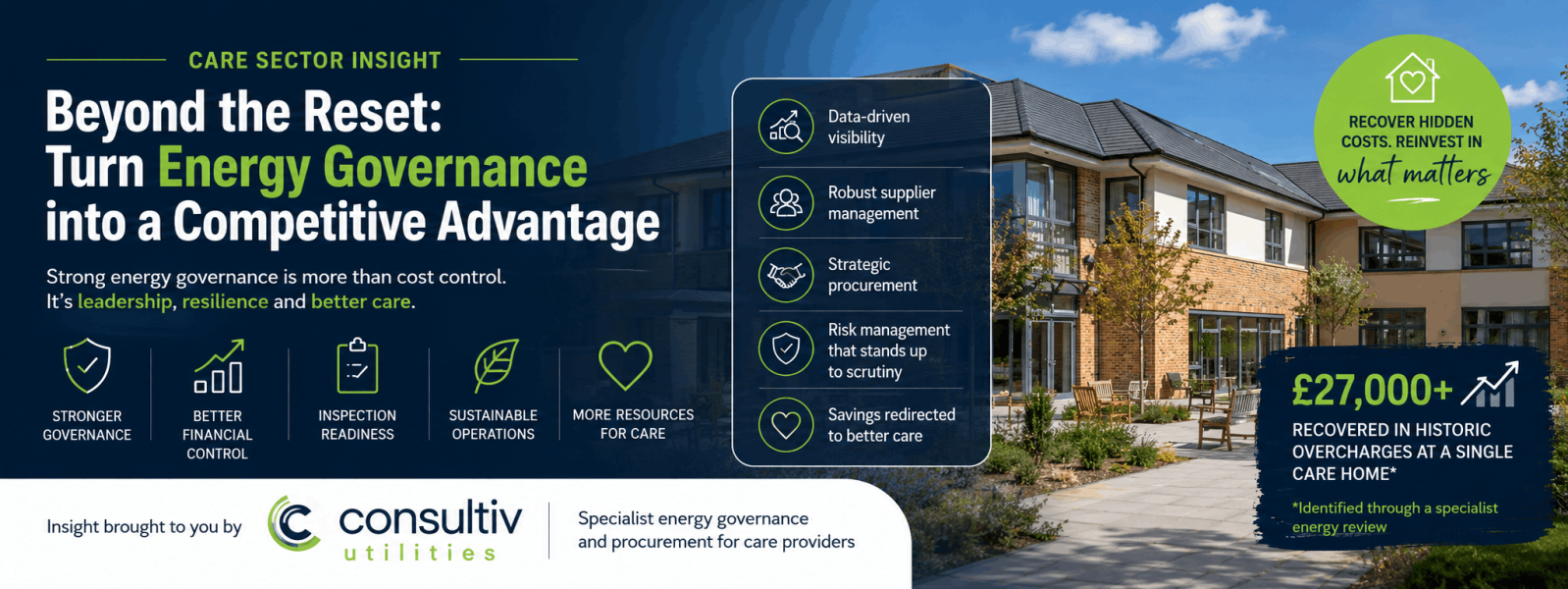
Recent specialist reviews have uncovered substantial historic overpayments linked to capacity issues, including one care home where more than £27,000 was recovered through detailed analysis.
The lesson is simple:
What appears to be a utility bill may actually be a governance issue.
Blind Spot #2: Billing Errors Hidden in Plain Sight
Most providers assume supplier invoices are accurate.
Unfortunately, that assumption is not always justified.
Commercial energy billing remains remarkably complex.
Invoices can include:
- Estimated readings
- Incorrect meter data
- Wrong tariff applications
- Duplicate charges
- Incorrect standing charges
- Legacy contract discrepancies
Individually, these errors may appear insignificant.
Collectively, over multiple years and multiple sites, they can become material.
The challenge for care providers is that finance teams are rarely energy specialists.
Their focus is understandably on ensuring invoices are paid rather than conducting forensic validation of every line item.
This creates a vulnerability.
Organisations with strong governance frameworks increasingly recognise that invoice approval and invoice verification are not the same thing.
Blind Spot #3: The Legacy Contract Trap
Many providers assume their contracts are actively managed.
In reality, some portfolios contain agreements that have rolled over, auto-renewed, or drifted into arrangements that no longer reflect the organisation’s needs.
This is particularly common within multi-site groups where responsibility has changed hands over time.
Sites acquired through mergers or expansion can bring inherited energy arrangements that receive little strategic attention.
The result is often:
- Poorly aligned contract end dates
- Inconsistent procurement strategies
- Reduced purchasing leverage
- Increased administrative burden
The cost of these issues is not always immediately visible.
However, fragmented procurement frequently leads to missed opportunities and weaker long-term outcomes.
Strong providers increasingly view contract management as an ongoing governance process rather than a periodic procurement exercise.
Blind Spot #4: Multi-Site Groups Operating Without Visibility
As care organisations grow, complexity grows with them.
Many groups operate dozens of sites across multiple regions.
Yet energy data often remains fragmented.
Individual homes may manage suppliers independently.
Invoices may be reviewed locally.
Performance data may never reach executive leadership.
This creates a significant challenge.
It becomes difficult to answer basic strategic questions:
- Which sites are performing well?
- Which sites are consuming disproportionately?
- Where are costs increasing fastest?
- Which contracts present the greatest risk?
Without central visibility, decision-making becomes reactive rather than proactive.
Leading operators are increasingly implementing consolidated reporting frameworks that provide estate-wide visibility of consumption, costs, contracts, and risk exposure.
The benefits extend far beyond procurement.
They improve governance, accountability, forecasting, and operational control.
Blind Spot #5: Nobody Truly Owns Energy
Perhaps the most significant blind spot of all is organisational ownership.
In many care organisations, responsibility for energy sits somewhere between:
- Finance
- Operations
- Estates
- Procurement
- Senior leadership
As a result, nobody owns the complete picture.
Finance reviews invoices.
Operations focus on service delivery.
Estates manage maintenance.
Procurement manages contracts.
Each function sees part of the process.
Few see all of it.
This creates a governance gap that can persist indefinitely.
The providers achieving the strongest outcomes have recognised that energy requires clear accountability.
Not because energy is uniquely important, but because it reflects broader organisational discipline.
When ownership is clear, performance improves.
When accountability is shared, risks often remain hidden.
Why This Matters for CQC Well-led Assessments
The CQC is not inspecting energy contracts.
But it is assessing leadership.
It is assessing governance.
It is assessing how effectively organisations identify, monitor, and manage material risks.
Energy increasingly sits within that conversation.
A provider that can demonstrate:
- Effective supplier oversight
- Robust financial controls
- Data-driven decision making
- Proactive risk management
- Clear accountability structures
is demonstrating many of the characteristics associated with strong Well-led performance.
In that sense, energy governance is becoming a useful lens through which broader organisational maturity can be observed.
The Competitive Advantage Most Providers Overlook
The most successful organisations are not necessarily those buying energy at the lowest price.
They are the organisations creating visibility.
Visibility into costs.
Visibility into risks.
Visibility into opportunities.
That visibility enables better decisions.
Better decisions create stronger financial performance.
And stronger financial performance creates more resources that can be invested where they matter most — residents, staff, services, and future growth.
In a sector facing continued workforce pressures, increasing regulatory scrutiny, and tight margins, those advantages compound over time.
Looking Beyond the Invoice
The care sector has made significant progress in recognising the importance of energy procurement.
The next stage of maturity is recognising that some of the biggest opportunities sit beyond procurement altogether.
The organisations pulling ahead are not simply negotiating contracts more effectively.
They are applying governance, accountability, and strategic oversight to one of their highest controllable costs.
In doing so, they are uncovering hidden value, strengthening resilience, and building stronger organisations for the future.
The question for providers is no longer whether energy matters.
The question is whether they have sufficient visibility to know what they might be missing.
Explore Your Organisation’s Energy Governance Position
Many of the issues outlined above remain invisible until a specialist review is undertaken.
Consultiv Utilities works with care providers across the UK to identify hidden risks, validate billing accuracy, strengthen procurement strategies, and improve energy governance frameworks that support both financial resilience and operational excellence.
To learn more about how specialist energy governance support can help your organisation, visit: https://consultivutilities.com/