The Care Circle Network’s UK Care Sector Energy Procurement Reset series has rightly sparked important conversations across the care sector.
For many providers, energy has historically been viewed as a necessary overhead — something to be purchased, monitored, and paid. But that perspective is rapidly becoming outdated.
In 2026, energy is no longer simply a procurement issue. It is a governance issue.
With staffing costs rising, National Insurance increases adding pressure, and regulators placing greater emphasis on leadership, financial stewardship, and organisational resilience, energy has become one of the highest controllable costs capable of influencing both operational performance and regulatory outcomes.
The providers pulling ahead are not necessarily those securing the lowest unit rates. They are the organisations treating energy as a strategic asset.
The Care Circle Reset highlighted why change is necessary. The next challenge is translating awareness into a measurable advantage.
The Regulatory Reality in 2026
The Care Quality Commission’s Single Assessment Framework continues to place significant emphasis on the Well-led domain. Inspectors increasingly expect providers to demonstrate:
- Effective oversight of material financial risks
- Strong governance and accountability structures
- Evidence-based decision making
- Robust supplier management and procurement processes
- Alignment between operational performance and sustainability objectives
Energy touches every one of these areas.
Unlike many sectors, care providers operate around the clock. This 24/7 baseload creates consumption patterns that make procurement decisions, contract management, and billing accuracy highly visible to regulators.
Increasingly, inspectors are not simply interested in whether risks exist — they want to understand how leaders identify, monitor, and manage them.
Energy is becoming one of the clearest indicators of that capability.
Why Leading Providers Are Thinking Differently
The strongest operators no longer view energy solely through the lens of cost reduction. Instead, they see it as a strategic opportunity to strengthen:
- Financial resilience
- Inspection readiness
- Operational efficiency
- Environmental performance
- Stakeholder confidence
In an environment where margins remain tight, every pound lost through poor oversight is a pound unavailable for frontline care.
That reality is changing boardroom conversations across the sector.
Four Pillars of Energy Governance Excellence
1. Governance That Stands Up to Scrutiny
Progressive providers are embedding energy oversight within their wider governance frameworks.
Best practice now includes:
- Quarterly board-level energy performance reporting
- Clearly defined energy KPIs (e.g. cost per resident, consumption trends)
- Formal Energy Risk Registers linked to corporate risk frameworks
- Documented procurement and supplier due diligence processes
- Clear escalation procedures for billing disputes and contract anomalies
These structures not only satisfy CQC expectations but also frequently uncover material hidden costs.
More importantly, they create a culture of accountability around one of the organisation’s largest controllable expenditures.
2. Data-Driven Leadership
Strong leadership depends on accurate, timely information.
Leading providers are leveraging half-hourly consumption data and specialist monitoring platforms to gain visibility across their estates. This enables them to:
- Identify and challenge incorrect capacity charges
- Detect billing discrepancies early
- Benchmark performance across sites
- Understand consumption trends
- Produce auditable evidence of proactive management
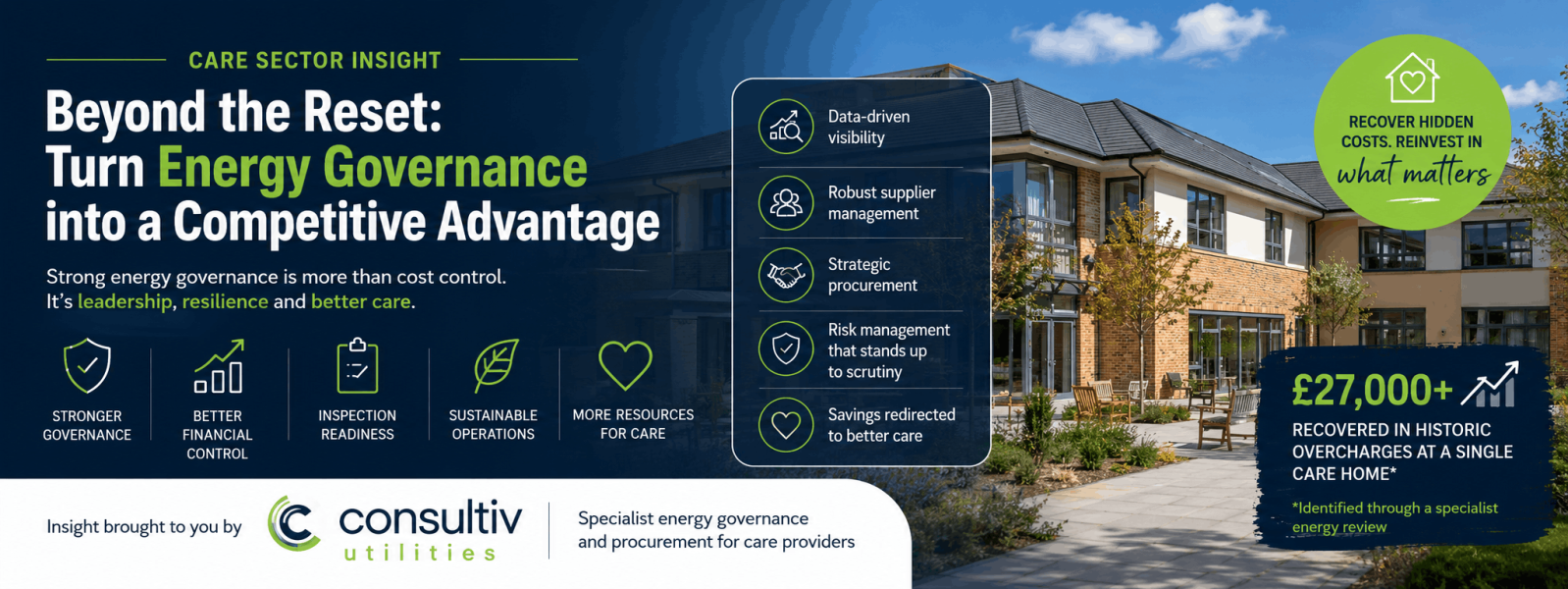
Recent specialist reviews have identified significant recoveries — one single-site example delivered over £27,000 in historic overcharges.
Such outcomes demonstrate what effective data governance can deliver.
Without reliable data, organisations are often managing one of their largest operational expenses with limited visibility. In a governance environment increasingly focused on accountability, that is becoming harder to justify.
3. Procurement Strategies Built for Volatility
Energy markets remain volatile.
Forward-thinking providers are adopting more sophisticated strategies aligned to organisational objectives rather than simply chasing the lowest available price.
Examples include:
- Fixed-price contracts for budget certainty
- Hybrid and capped arrangements for balanced risk
- Portfolio approaches for multi-site operators
- Integration of on-site generation, such as solar PV and battery storage, where commercially viable
With April 2026 policy changes affecting Renewables Obligation costs and ongoing network charge pressures, strategic procurement decisions taken now will have an outsized impact on future performance.
4. Converting Savings into Better Care
The most successful providers go further.
They redirect energy savings into tangible improvements, such as:
- Additional staffing hours
- Enhanced resident wellbeing programmes
- Workforce development
- Estate upgrades
- Future sustainability initiatives
This creates a virtuous cycle: stronger financial control leads to better care outcomes, which reinforces organisational performance, staff confidence, and inspection readiness.
The Hidden Governance Risk Most Providers Still Miss
Many providers assume energy risk begins and ends with contract pricing.
In reality, some of the largest exposures arise elsewhere:
- Incorrect capacity allocations
- Legacy meter issues
- Undetected billing errors
- Auto-renewed contracts
- Misaligned procurement strategies across multi-site groups
These risks often remain invisible because they sit between finance, operations, estates, and procurement functions.
That creates a governance blind spot.
The providers achieving the strongest outcomes are not necessarily buying energy more cheaply. They are creating greater visibility, accountability, and ownership around a cost category that historically lacked board-level attention.
In governance terms, that distinction matters.
A Practical Roadmap for Providers
Organisations ready to move forward should consider this structured approach.
Step 1: Establish the Baseline
Conduct an independent review of:
- Existing contracts
- Billing accuracy
- Consumption patterns
- Governance arrangements
- Procurement processes
Step 2: Identify Governance Gaps
Map current practices against Well-led quality statements and internal risk management requirements.
Step 3: Develop a Long-Term Strategy
Build a 12–36 month plan with:
- Clear ownership
- Measurable KPIs
- Procurement objectives
- Risk management procedures
- Sustainability targets
Step 4: Select the Right Partners
Work with specialists who deeply understand healthcare consumption profiles, energy markets, and the evolving regulatory landscape.
Step 5: Monitor Continuously
Implement real-time dashboards, regular reporting, and board oversight processes that ensure energy remains visible, measurable, and accountable.
The Organisations Pulling Ahead
A clear pattern is emerging.
The strongest performers are not necessarily the largest operators, nor those with the greatest resources.
They are the organisations demonstrating consistent leadership discipline around energy.
They are reducing risk, improving financial performance, strengthening inspection readiness, and creating greater capacity to invest in care.
Increasingly, energy governance is becoming a proxy measure for broader organisational maturity. Providers that can demonstrate effective oversight of utilities often exhibit the same disciplines across workforce planning, supplier management, financial controls, and strategic risk management.
In that sense, energy is no longer simply an operational concern — it is a visible indicator of leadership effectiveness.
In a sector facing sustained workforce pressures, increasing regulatory expectations, and ongoing economic uncertainty, this represents a genuine competitive advantage.
The Future of Well-led Leadership
Five years ago, energy procurement was rarely discussed at the board level.
Today, that approach looks increasingly outdated.
In 2026 and beyond, robust energy governance has become a visible test of organisational leadership.
It reflects how effectively providers manage risk, allocate resources, oversee suppliers, and plan for the future.
The Care Circle Energy Reset has clearly set out the “why”.
The next generation of sector leaders will be defined by how effectively they act on it — transforming governance into resilience, visibility into accountability, and cost control into better care outcomes.
Those who embed strong energy governance today will not simply reduce costs.
They will build stronger organisations, achieve greater financial resilience, improve inspection readiness, and create more resources to deliver outstanding care tomorrow.
In a sector where every resource matters and every leadership decision is scrutinised, that may prove to be one of the most important competitive advantages of all.
Explore Your Organisation’s Energy Governance Position
As energy governance becomes increasingly linked to financial resilience, regulatory confidence, and operational performance, now is the time for providers to assess whether their current approach is delivering the visibility and control that modern care organisations require.
Consultiv Utilities works with care providers across the UK to identify hidden risks, strengthen procurement strategies, improve governance frameworks, and uncover opportunities for cost recovery and long-term savings.
To learn more about how specialist energy governance support can help your organisation, visit: https://consultivutilities.com/