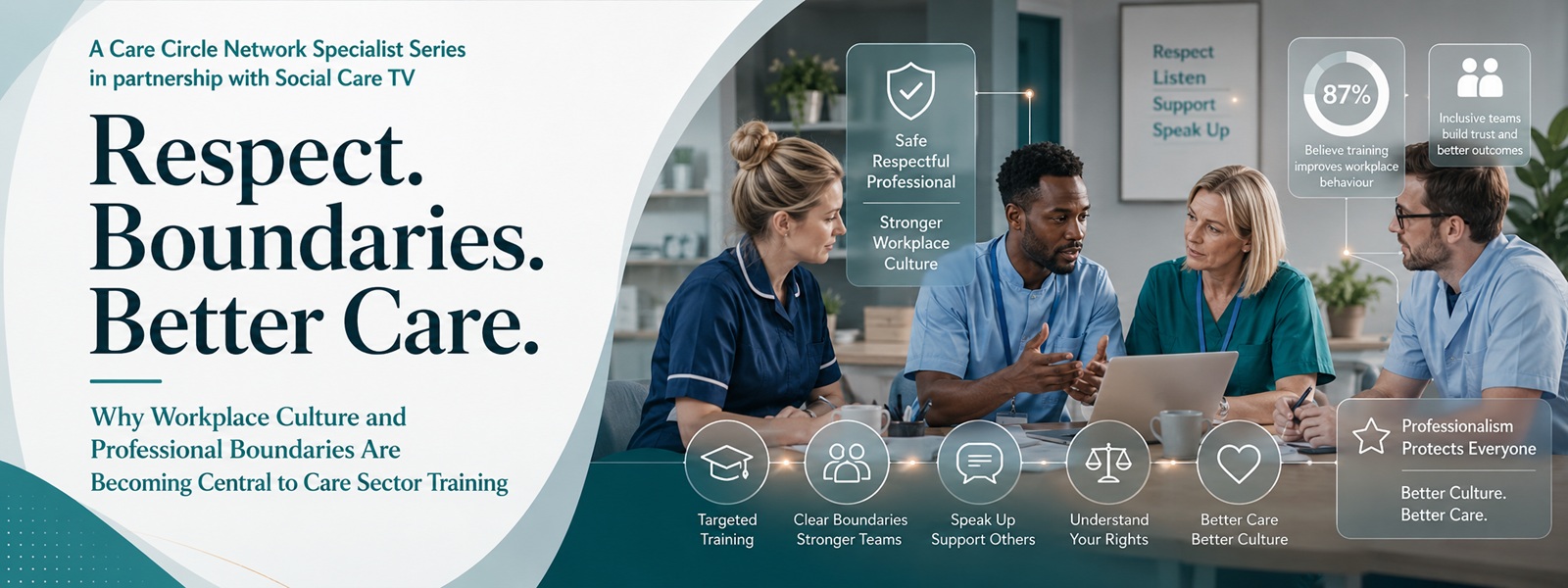
Why Workplace Culture and Professional Boundaries Are Becoming Central to Care Sector Training
In care settings, trust, professionalism and safe boundaries are essential to protecting staff wellbeing, service-user dignity and the quality of care being delivered.
Training around sexual harassment, workplace behaviour and professional conduct is increasingly being treated as part of safeguarding, governance and staff welfare — not simply as an HR issue.
The health and social care sector has always depended heavily on trust, professionalism and close human interaction. Care workers routinely operate in emotionally demanding environments, often supporting vulnerable people through highly personal aspects of daily life.
Yet while compassion and empathy are essential qualities within care settings, there is growing recognition that professional boundaries and workplace behaviour require clearer attention than ever before.
In recent years, the issue of sexual harassment within the workplace has become an increasingly important area of discussion across many sectors, including health and social care. Employers are now under greater pressure not only to respond appropriately when incidents occur, but also to create organisational cultures that actively reduce the likelihood of inappropriate behaviour developing in the first place.
Professional boundaries are now a core part of safer workplace culture, staff wellbeing and care quality.
Why Care Settings Face Particular Challenges
For the care sector, this presents particular challenges. Care environments are often fast-paced, emotionally intense and operationally stretched. Staff may work alone in community settings, operate during unsociable hours or regularly interact with distressed individuals, family members and colleagues under pressure.
In these environments, maintaining safe and professional boundaries is critically important — both for staff wellbeing and for the quality of care being delivered.
As a result, training around sexual harassment and professional conduct is becoming increasingly integrated into wider workforce development programmes. The subject is no longer viewed solely as a human resources issue. Instead, it is increasingly recognised as part of broader safeguarding, governance and staff welfare responsibilities.
From Policy Awareness to Practical Confidence
According to Social Care TV, effective training should help care workers recognise inappropriate behaviour, understand legal protections, respond appropriately to incidents and contribute to safer workplace cultures.
Their dedicated course on sexual harassment explores topics including prevention, bystander intervention, reporting procedures and workplace responsibilities within health and social care settings.
The importance of the issue is reinforced by wider societal and legal developments. UK employers are under increasing expectation to demonstrate that they are taking proactive steps to prevent workplace harassment rather than simply reacting to complaints after the event.
Professional boundaries
Helping staff understand appropriate conduct in emotionally demanding and highly personal care environments.
Reporting pathways
Ensuring workers know how to report concerns and access support when inappropriate behaviour occurs.
Bystander confidence
Supporting colleagues to challenge inappropriate conduct safely and constructively.
Safer culture
Creating workplaces where dignity, respect, inclusion and psychological safety are actively reinforced.
Complex Sources of Risk
Within care environments, the issue can be particularly complex because inappropriate behaviour may originate from multiple sources. Harassment may occur between colleagues, but staff can also experience unacceptable behaviour from service users, visitors or members of the public.
In some situations, workers may struggle to distinguish between challenging behaviour linked to illness or cognitive impairment and conduct that still requires formal management and support procedures.
This complexity means that training increasingly focuses not only on definitions and policies, but also on confidence, judgement and communication. Staff need to understand how to challenge inappropriate conduct safely, how to report concerns and how to support colleagues who may be affected.
Culture, Reporting and Staff Wellbeing
There is also growing recognition that workplace culture plays a major role in whether issues are identified early or allowed to persist. In environments where staff fear repercussions, feel unsupported or believe concerns will be minimised, incidents are often underreported.
Research across multiple sectors has consistently shown that many individuals choose not to report harassment because they worry about damaging professional relationships, affecting career prospects or not being believed.
For health and social care providers, this creates both ethical and operational risks. Poor workplace culture can contribute to higher staff turnover, reduced morale, increased sickness absence and weakened recruitment at a time when many parts of the sector are already experiencing workforce pressures.
Workplace culture cannot be transformed by policy alone. It requires training, leadership, supervision and clear expectations.
Training as Part of a Wider Commitment
Training providers are therefore increasingly framing harassment awareness as part of a wider commitment to dignity, inclusion and psychological safety within care organisations. Courses now often include practical guidance on professional boundaries, respectful communication and intervention techniques for witnesses or managers.
Social Care TV’s online course examines areas including UK law, workplace rights, risk factors, reporting pathways, professional boundaries and the impact harassment can have on individuals and organisations.
The training also introduces practical bystander intervention approaches and explores the distinction between sexual harassment and sexual abuse — an important consideration within health and social care settings.
The Role of Online Learning
The wider shift toward online training platforms has also made this type of learning more accessible. Digital delivery allows providers to roll out consistent training across dispersed teams, care homes and domiciliary care services without the scheduling difficulties associated with traditional classroom sessions.
At the same time, many sector leaders acknowledge that workplace culture cannot be transformed through online modules alone. Training is most effective when reinforced by leadership behaviour, supervision, open communication and clear organisational expectations.
This is particularly relevant as regulatory scrutiny around workforce culture continues to increase. Care providers are now expected not only to maintain safe care practices, but also to demonstrate that staff work within environments that promote dignity, equality and mutual respect.
The Core Message
The conversation around sexual harassment in care settings is therefore part of a much broader shift taking place across the sector. Increasingly, providers are recognising that staff wellbeing, workplace professionalism and care quality are closely connected.
As health and social care continues to evolve, training in areas such as professional conduct, workplace behaviour and safeguarding culture is likely to become an even more significant part of operational management.
For many organisations, the focus is no longer simply on meeting minimum compliance standards, but on creating working environments where both staff and service users feel safe, respected and supported.
Specialist Series Insight
This feature forms part of a care-sector editorial series focused on practical training, safer workplace culture and stronger care quality.
Find out more about workplace conduct training
Social Care TV provides online care-sector training designed to support compliance, professional development and safer workplace cultures.