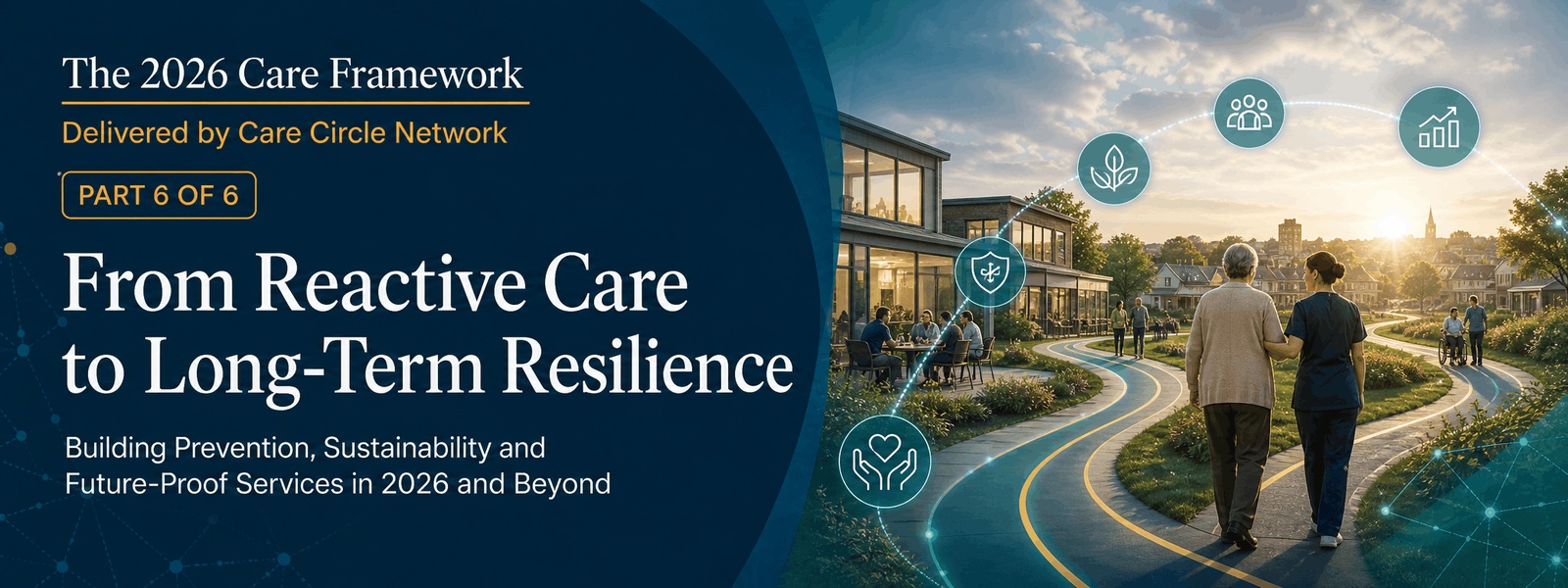
Part 6: Building Prevention, Sustainability and Future-Proof Services in 2026 and Beyond
For many adult social care providers, the past few years have been defined by reaction: filling rota gaps, responding to inspection pressure, managing rising costs, chasing delayed information, supporting exhausted teams and trying to keep services stable through constant change.
In 2026, there is a growing recognition that this cannot be the long-term model. The 10-Year Health Plan, demographic change, workforce challenges and financial constraints all point to the same conclusion: providers who continue to operate only reactively will struggle. Those who begin to shift towards prevention, long-term planning and organisational resilience will be better positioned to adapt, improve and grow stronger over time.
At Care Circle Network, we are seeing a clear divide. Some providers are still firefighting daily crises. Others are beginning to ask different questions: How do we reduce demand on our services over time? How do we build a workforce that stays? How do we make our organisation resilient to future shocks? How do we measure success not just by what we deliver today, but by the long-term outcomes we help create?
Part 6 of The 2026 Care Framework — the final part — focuses on future-proofing and prevention. It is about moving from reactive care to proactive, sustainable models that improve long-term outcomes for residents, reduce pressure on services, and build organisations that can thrive in 2027 and beyond.
Why Future-Proofing Matters in 2026
The challenges facing adult social care are not temporary. Workforce shortages, funding pressures, demographic change and the shift towards prevention and neighbourhood care are structural. Providers who treat 2026 as “just another year” of firefighting are at risk of falling further behind. Those who use 2026 as a turning point can begin building the prevention, resilience and long-term capability needed to protect quality, strengthen teams and remain viable in the years ahead.
Through our work with providers, we see six recurring challenges:
- Constant firefighting — leaders and teams spend so much time responding to immediate crises that they have little capacity for long-term thinking or prevention.
- Short-term focus — contracts, funding and performance measures often reward short-term activity rather than long-term outcomes.
- Limited prevention infrastructure — many providers lack the tools, partnerships or data to identify and intervene early with people at risk of escalation.
- Workforce sustainability gaps — recruitment and retention challenges are treated as operational problems rather than strategic, long-term issues.
- No clear long-term roadmap — many providers do not have a documented vision or plan for what their service will look like in 3–5 years’ time.
- Limited visibility of prevention value — providers may be improving wellbeing or preventing escalation, but lack the data or narrative to evidence the impact.
Part 6 of The 2026 Care Framework addresses these challenges directly.
The Four Pillars of Future-Proofing & Prevention
Future-proofing is not about predicting the future. It is about building the capabilities, relationships and culture that allow organisations to adapt, prevent where possible, and respond effectively when the unexpected happens.
Pillar 1: Prevention as a Core Strategy
The 10-Year Health Plan places strong emphasis on prevention and early intervention. Resilient providers are shifting from simply responding to demand to actively reducing preventable escalation — through better risk identification, early support, lifestyle and wellbeing interventions, and stronger links with primary care and community services.
Prevention does not need to mean launching large new programmes immediately. It can start with identifying where risk is building earlier and taking small, consistent action before people reach the crisis point.
What This Looks Like in Practice:
- Systematic identification of residents or service users at highest risk of escalation (e.g. falls, hospital admission, care package breakdown).
- Proactive interventions — falls prevention programmes, strength and balance classes, medication reviews, social prescribing, carer support.
- Clear measurement of prevention impact — reduced hospital admissions, delayed escalation, improved wellbeing scores.
Pillar 2: Workforce as a Long-Term Asset
The workforce crisis in adult social care is not a short-term problem. Resilient providers treat workforce sustainability as a strategic priority — investing in career pathways, leadership development, wellbeing, flexible working, and a culture that makes people want to stay and grow.
A future-proof service cannot be built on a workforce model that is permanently exhausted, underdeveloped or dependent on constant replacement.
What This Looks Like in Practice:
- Clear career pathways and succession planning — not just for registered managers, but for care workers, team leaders and deputy managers.
- Investment in staff wellbeing and retention — not as a “nice to have”, but as a core business strategy.
- Building internal capability — growing your own leaders, trainers and specialists rather than relying solely on external recruitment.
Pillar 3: Organisational Resilience and Adaptability
The past decade has shown that disruption is no longer exceptional. Pandemics, policy changes, funding shifts and workforce crises have become part of the operating environment. Resilient providers build organisational resilience: the ability to absorb shocks, adapt quickly, and continue delivering safe, high-quality care even when conditions are difficult.
What This Looks Like in Practice:
- Scenario planning and stress testing — regularly asking “what if?” about workforce shortages, funding cuts, regulatory changes or major incidents.
- Strong business continuity plans that are tested, not just documented.
- A culture of learning and adaptation — where the organisation learns from challenges and improves, rather than simply returning to the status quo.
Pillar 4: Long-Term Vision and Measurement
Many providers operate without a clear long-term vision. They know what they are doing this year, but have no documented picture of what they want their service to look like in 2028 or 2030. Resilient providers have a clear long-term vision — and measure progress against it, not just against short-term operational targets.
A long-term vision only becomes useful when it is translated into measurable priorities, reviewed regularly and used to guide decisions.
What This Looks Like in Practice:
- A documented 3–5 year vision for the service — what kind of provider do you want to be? What outcomes do you want to achieve? What will success look like?
- Annual strategic reviews that look beyond the next 12 months.
- Long-term outcome measures — not just occupancy, turnover or CQC rating, but measures of prevention impact, workforce stability, resident wellbeing over time, and organisational adaptability.
Your 30/60/90 Day Action Plan
The aim is not to transform your entire organisation in 90 days. It is to begin shifting from reactive to proactive — building the foundations of prevention, workforce sustainability and long-term thinking.
Days 1–30: Diagnose & Stabilise
- Complete the Future-Proofing Diagnostic — a structured review of your current prevention activity, workforce sustainability, organisational resilience and long-term planning.
- Map your top 3 prevention opportunities — where could early intervention reduce escalation, hospital admission or care package breakdown?
- Review your current workforce data — turnover, retention, career progression, leadership pipeline — and identify the biggest risks.
- Draft a simple 3-year vision statement for your service — what do you want it to look like in 2029, and what needs to change to get there?
Days 31–60: Build & Embed
- Launch one prevention initiative — even if small (e.g. falls prevention programme, carer support group, proactive wellbeing checks).
- Develop a basic workforce sustainability plan — focusing on the top 2–3 retention and development priorities.
- Test your business continuity plan with a tabletop exercise — identify gaps and improve it.
- Share your draft 3-year vision with your team and key partners for feedback.
Days 61–90: Accelerate & Sustain
- Run your first quarterly Future-Proofing Review — assess progress against the four pillars and set priorities for the next quarter.
- Develop a simple 3–5 year strategic roadmap — including prevention, workforce, resilience and long-term outcomes.
- Present your future-proofing progress to your board or senior team — with clear actions and measures.
- Establish annual strategic planning and review processes so long-term thinking becomes part of normal governance, not a one-off exercise.
Five Practical Indicators to Track Quarterly
These are designed to be realistic for providers of all sizes:
- Prevention impact — changes in falls, hospital admissions, care package escalations or other avoidable incidents where proactive support may have made a difference.
- Workforce stability — 12-month retention rate, leadership pipeline strength, and staff wellbeing scores.
- Organisational resilience — how quickly the service recovers from incidents or disruptions, and whether lessons learned are implemented.
- Long-term outcome progress — measurable movement towards your 3–5 year vision (even if early stage).
- Strategic planning discipline — has the organisation conducted a formal review of long-term direction in the past 12 months?
Final Word
The providers best placed to thrive beyond 2026 will not be those who simply survive each crisis. They will be those who use 2026 as a turning point — to build prevention, workforce sustainability, organisational resilience and a clear long-term vision.
The 2026 Care Framework has taken you through six interconnected areas: leadership and culture, financial resilience, regulatory confidence, digital and operational excellence, integrated neighbourhood care, and now future-proofing and prevention. Together, they form a complete approach to navigating 2026 and building services that can thrive in the years ahead.
The storm may not disappear overnight. But with the right framework, providers can move through it with greater clarity, confidence and control — and build services that are not just surviving, but genuinely future-proof.
Thank You
Thank you for completing the 2026 Care Framework.
Across six parts, you have worked through the leadership, financial, regulatory, digital, partnership and long-term planning disciplines that will shape care provider resilience in 2026 and beyond.
The next step is to turn insight into action — one priority, one improvement and one decision at a time.
Next Steps
To access the Part 6 tools and receive the full Framework summary toolkit, email enrol@carecirclenetwork.co.uk with the subject line: Part 6 Future-Proofing & Prevention.
Please let us know if you would like:
- Future-Proofing Diagnostic + 3-Year Vision Template
- Full Series Summary Toolkit (all six parts)
- Moderated Care Circle Community access
The 2026 Care Framework Delivered by Care Circle Network