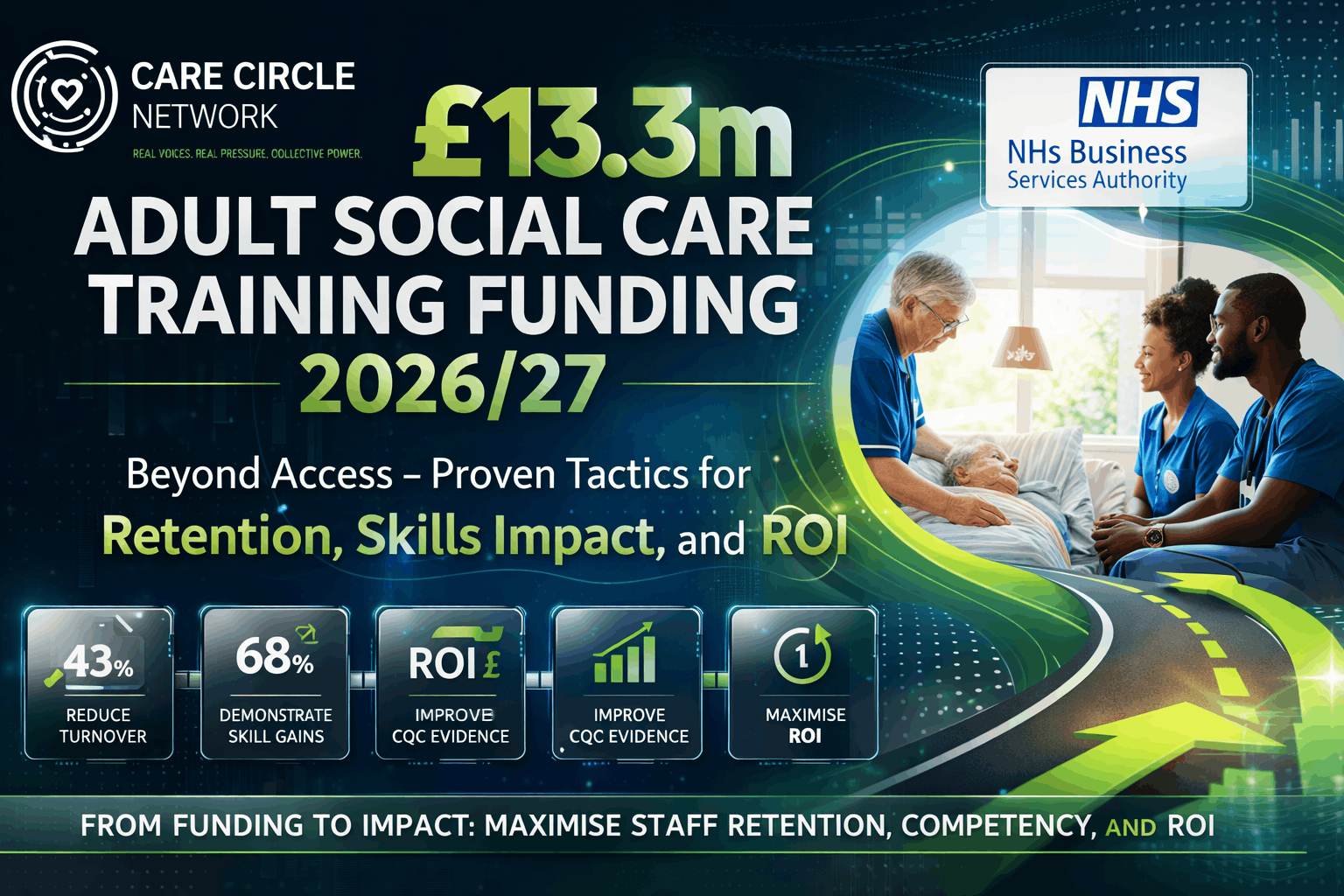
One week after the funding went live, fresh analysis of 109 recent CQC inspection reports reveals training and competency gaps in 43% of services — rising to 68% in Requires Improvement and Inadequate ratings, frequently driving down Safe and Well-led judgements. Here’s exactly how leading providers are converting the £13.3 million into lower turnover, demonstrable workforce capability, stronger CQC evidence, and clear financial return.
Last week, we explained why the real opportunity with the newly live £13.3m Adult Social Care Training Funding 2026/27 is not simply accessing the money, but deliberately turning it into workforce capability, retention, and measurable impact.
One week on, the picture has sharpened. Care Circle Network’s analysis of 109 CQC inspection reports published in the last 14 days shows that gaps in mandatory and specialist training appear in 43% of all reports. In services rated Requires Improvement or Inadequate, this figure climbs to 68%, and these gaps are repeatedly cited as contributing factors to weaknesses in the Safe and Well-led domains.
Training is rapidly becoming one of the most visible vulnerabilities in the 2026 CQC framework — yet it remains one of the quickest areas to strengthen when funding, governance, and measurement are aligned.
The Funding Landscape – Quick Recap for Action
As detailed last week, the package includes:
- Up to £10m through the Learning and Development Support Scheme (LDSS) — now administered by NHS Business Services Authority (NHSBSA). This supports non-regulated staff, deputy and registered managers, and agency workers.
- Up to £2.3m for the Assessed and Supported Year in Employment (ASYE).
- Up to £1m for the User-Led Organisations fund.
Funding is ring-fenced and limited — claims close once each pot is exhausted. Providers who move from “access” to strategic deployment this month will gain a clear edge in recruitment, retention, quality ratings, and operational resilience.
Why Access Alone Falls Short in 2026
Under the evolving CQC Adult Social Care Assessment Framework, inspectors look beyond training records. They want evidence that learning translates into competent, consistent practice, reflective supervision, reduced incidents, and a genuine learning culture — particularly in Safe (protection from avoidable harm) and Well-led (governance, leadership, and continuous improvement).
High-quality training linked to outcomes also directly tackles retention pressures. Replacing a single care worker can cost providers between £4,000 and £7,870+ when recruitment, agency cover, training, and lost productivity are factored in. Staff who receive relevant, career-progressing development stay longer and deliver better care.
Proven Tactics: Turning £13.3m into Measurable Results
1. Prioritise Training Against Your Actual CQC and Operational Risks. Map every course directly to the draft 2026 quality statements and your latest inspection feedback or internal audit. High-impact priorities in 2026 include:
- Oliver McGowan Mandatory Training on Learning Disability and Autism (now explicitly supported and a statutory expectation).
- Medication management, safeguarding, dementia, positive behaviour support, and leadership modules.
- Move beyond completion certificates to competency demonstration: post-training observations, reflective supervision notes, and practice audits.
Tip: Create a simple “Training-to-CQC Alignment Matrix” (template below) and review it quarterly at the senior management level. This single document strengthens Well-led evidence significantly.
2. Design Retention-Focused Development Pathways Use the funding to build visible career ladders rather than isolated courses. Examples that work:
- Care worker → Senior care worker → Deputy manager pathway, funded via LDSS-eligible qualifications.
- “Train the Trainer” models to multiply internal capability and reduce future external training costs.
- Public recognition of achievements (team events, digital badges, additional leave days) to reinforce belonging.
Providers implementing structured pathways alongside the NLW rise are seeing the strongest reductions in turnover and agency reliance.
3. Measure Skills Impact and Calculate ROI from Day One. Leading providers treat training as an investment with a clear return. Track these metrics:
| Metric | Baseline (pre-training) | 3 Months Post | 6 Months Post | Target |
|---|---|---|---|---|
| Staff Turnover Rate | e.g. 32–35% | <25% | ||
| Medication / Falls Incidents | e.g. 12 per month | <5 | ||
| Staff Confidence Score (survey) | e.g. 62% | >85% | ||
| Training-Related CQC Actions | e.g. 4 issues | 0 | ||
| Agency Hours / Cost | e.g. baseline monthly spend | -20%+ |
Simple ROI Formula (net of LDSS reclaim): ( Savings from reduced turnover + reduced incidents + avoided regulatory costs ) – Net training cost = ROI
Real-world benchmarks show well-executed programmes delivering £4–£11 return for every £1 invested through lower turnover and improved quality.
4. Embed Strong Governance for Well-led Evidence
- Place training oversight on the board or senior management agenda with monthly/quarterly impact reports.
- Use digital training matrices that show live competency status, expiry dates, and reflective learning logs.
- Turn incidents and complaints into shared reflective practice sessions — this demonstrates a proactive learning culture that inspectors actively look for.
Provider Spotlights – What’s Working Now
- A medium-sized residential group used LDSS funding for Oliver McGowan and dementia training linked to supervision. They reduced medication errors by over 40% within four months and strengthened Safe domain evidence in their most recent inspection feedback.
- A home care provider tied funded leadership modules to career progression for senior carers. Turnover dropped 18% in six months, agency spend fell, and they reported clearer Well-led narratives during CQC engagement.
(Replace or expand with real anonymised or named examples from your network for even greater impact.)
Practical Implementation Checklist (April–May 2026 Window)
- Confirm your ASC-WDS submission is up to date (mandatory for eligibility).
- Register and begin claims promptly via NHSBSA — funding is first-come, first-served.
- Prioritise high-impact, eligible courses and set impact tracking from the first cohort.
- Schedule post-training observations, team debriefs, and reflective supervision.
- Review progress against metrics at 3 and 6 months; adjust and report to the board.
- Document everything — this becomes your Well-led evidence base.
Downloadable Templates (offer these as PDFs on the site):
- Training-to-CQC Alignment Matrix
- Training Impact & ROI Tracker
- Post-Training Observation & Reflection Form
Final Thoughts…
The £13.3m funding is a limited-time leadership opportunity. Providers who continue treating it as a simple reimbursement exercise risk missing the bigger prize: a more skilled, confident, and loyal workforce that delivers better care, achieves stronger CQC ratings, and improves financial sustainability.
Those who act strategically this month — aligning funding to risks, measuring impact, and building a visible learning culture — will stand out as employers of choice and CQC-ready organisations