In our detailed review of 18 recent CQC inspection reports across care homes, nursing homes and specialist services, every single service received a Requires Improvement or Inadequate rating for Well-led. This is no coincidence. It reflects a broader industry challenge highlighted in the CQC’s State of Care 2024/25 report: despite pockets of innovation and dedicated leadership, governance and oversight failures continue to undermine quality and safety in adult social care.
At Care Circle Network, we don’t just observe these patterns — we analyse them deeply across our member services and support providers through real transformations. The data is clear: weak Well-led is the most consistent drag on overall ratings, often linked to breaches of Regulation 17 (Good Governance). Yet the reverse is also true — services that strengthen leadership and governance frequently move from Requires Improvement to Good (or even Outstanding) within 12–18 months. Only a small minority of providers currently achieve Outstanding in Well-led nationally, but those that do demonstrate what’s possible when governance becomes a living system, not a paperwork exercise.
Here’s the sharp market intelligence, the recurring pitfalls we see repeatedly, and — most importantly — a practical, battle-tested playbook to turn Well-led into your strongest asset ahead of your next inspection or as part of ongoing quality improvement.
The Industry Context: Pressures Fueling Well-Led Challenges
Adult social care operates under intense strain:
- Demand continues to rise, with new requests for support up 4% year-on-year and 8% since 2019/20. Growth is particularly sharp among working-age adults (14% higher per 100,000 population since 2019/20).
- Workforce shortages persist, with vacancy rates significantly higher than in other sectors, driving reliance on agency staff and making consistent leadership and supervision harder.
- The CQC is evolving its approach. Following consultation, 2026 brings sector-specific frameworks, a return to clearer Key Lines of Enquiry (KLOEs), and detailed rating characteristics that describe exactly what Outstanding, Good, Requires Improvement and Inadequate look like in practice. Scoring models are being simplified, with professional judgement “in the round” at the key question level. Governance will be judged more on outcomes and sustained change than on volume of audits.
Under these pressures, weak governance creates a vicious cycle: risks go unnoticed, audits miss real issues, lessons from incidents or previous inspections are not embedded, and the same problems recur. The result? Safe and Well-led become the joint-weakest areas, triggering enforcement and limiting overall ratings.
Common Well-Led Mark-Downs: What We See Across Inspections
From our analysis and consistent with sector-wide findings, six recurring themes dominate — nearly all tied to Regulation 17 breaches:
- Ineffective governance and quality assurance systems — Processes exist on paper but fail to identify or respond to risks in real time. CQC often notes: “Governance systems were not effective in recognising and responding to risks.”
- Weak or non-robust audits — Audits are incomplete, outdated, or fail to detect the shortfalls inspectors find. They rarely lead to measurable, sustained improvement.
- Lack of a learning culture — Incidents are recorded, but trends are not analysed; previous CQC findings are not fully actioned or embedded.
- Leadership instability or limited visibility — Absence of a permanent registered manager, poor handovers, or managers not sufficiently “on the floor.”
- Gaps in staff voice and open culture — Teams do not always feel able to speak up, and feedback from staff, residents or relatives does not consistently drive visible change.
- Inadequate oversight of staffing, training and records — Supervisions, appraisals and training matrices fall behind, with poor systems to assure compliance.
These issues rarely stand alone. They directly impact Safe (e.g., medicines, risk assessments) and cascade across other key questions.
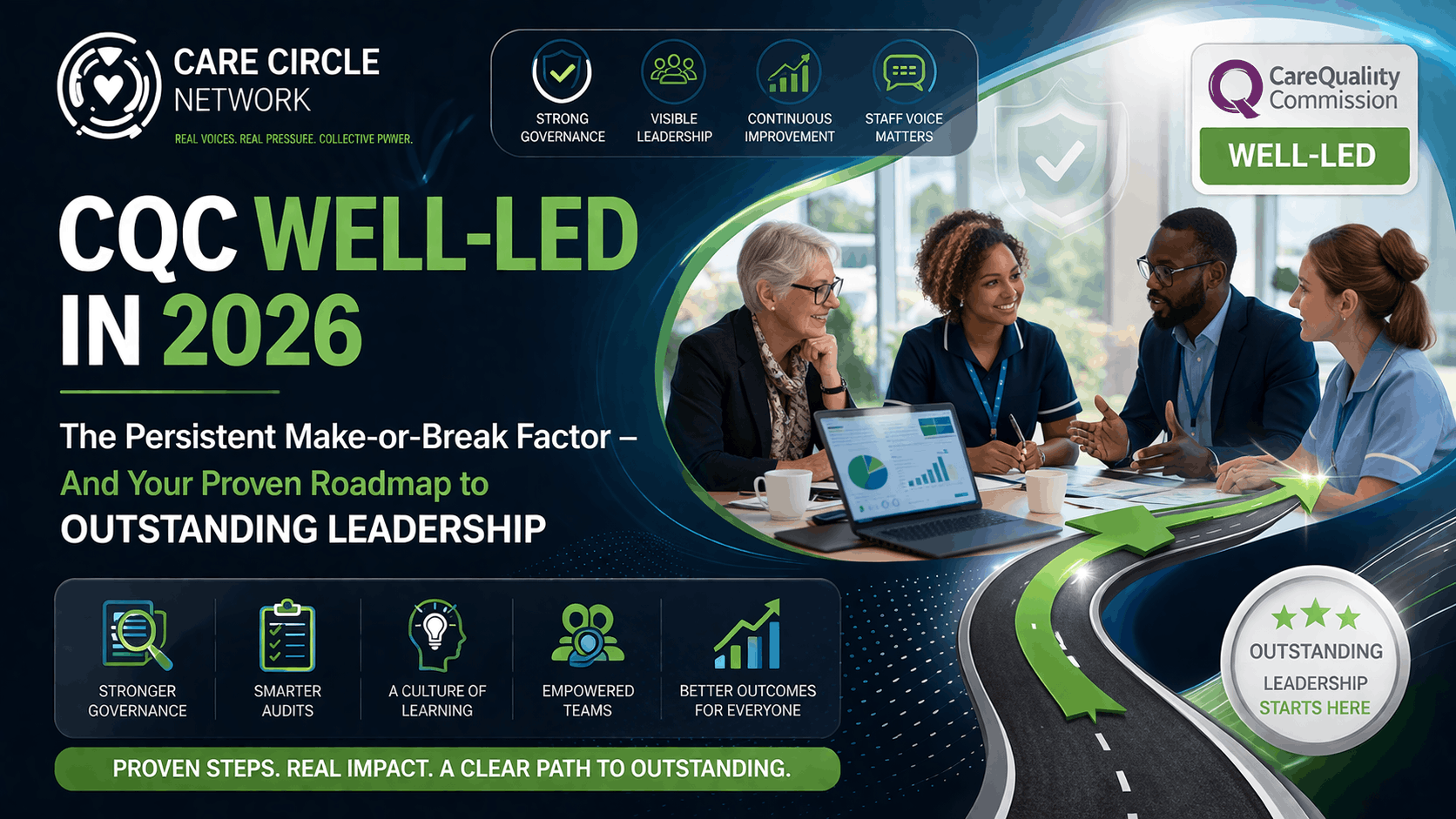
The Positive Path: Turning Well-Led into Outstanding – A 6-Step Roadmap
The services we support that achieve rapid improvement treat governance as dynamic and outcome-focused. They align with the emerging 2026 rating characteristics: visible leadership, data-driven decisions, genuine learning, and evidence that systems deliver better lives for people using the service.
Here is our practical 6-step roadmap, refined from real provider journeys in our network:
1. Strengthen governance as a live system (not a static folder). Create a simple, visible governance dashboard (digital or spreadsheet) with clear owners, deadlines and outcome measures for every risk area. Hold monthly senior reviews that analyse trends from incidents, complaints, audits and feedback. Ensure every action plan has a “verification step” to confirm the change has stuck. Quick win: Map your current processes against the forthcoming 2026 KLOEs and rating characteristics.
2. Transform audits into improvement engines. Shift from tick-box to risk-based, themed audits (e.g., medicines, care plans, environment) with explicit success criteria and SMART action plans. Always close the loop: review impact at the next cycle. Pro tip: Run quarterly “mock inspection” sessions using external peer review or our network toolkits. Focus on what changes because of the audit — this is what 2026 inspectors will probe.
3. Build a genuine learning and improvement culture. Introduce short, blame-free debriefs after incidents or restrictive practices. Share “what we learned and what we changed” summaries at every team meeting and display them for residents/families. Publicly celebrate improvements, however small. Outcome we see: Higher staff retention and proactive issue-raising.
4. Ensure visible, stable and supportive leadership. Prioritise a permanent (or stable long-term) registered manager with a structured handover. Increase “floor time” — managers joining handovers, speaking directly with residents and staff. Run regular listening sessions (anonymous options available) and act visibly on what you hear. Leadership insight: Services with consistently registered managers embed improvements faster.
5. Empower your whole team and flatten communication. Appoint staff “champions” for key areas (dementia, nutrition, safeguarding, equity). Use anonymous surveys for staff, residents and relatives — then publish “you said, we did” updates. Link recognition and career pathways to quality contributions. Result: A workforce that owns quality, reducing reliance on top-down enforcement.
6. Leverage technology, external insight and peer support. Adopt compliance platforms that keep policies, training matrices and evidence live and inspection-ready. Commission periodic independent Well-led reviews. Benchmark against Outstanding examples and join networks for shared templates and learning. Forward-looking: Prepare now for 2026’s emphasis on data security, equity outcomes and sustained impact.
Red Flags vs Green Flags: Quick Self-Assessment Table
| Area | Common Red Flag (Requires Improvement/Inadequate) | Green Flag (Path to Good/Outstanding) |
|---|---|---|
| Governance | Issues only spotted by inspectors | Live dashboard + monthly trend reviews |
| Audits | Volume-focused, no sustained change | Risk-based with verified outcomes |
| Learning | Incidents recorded but no trend analysis | Blame-free debriefs + visible “we changed” |
| Leadership | Invisible or unstable management | Regular floor time + listening actions |
| Staff Culture | Fear of speaking up | Champions + “you said, we did” |
Your Positive Outcome Starts Today
Providers who invest in these areas don’t just improve their CQC rating — they reduce enforcement risk, boost staff retention, enhance resident outcomes and position themselves as system partners in an evolving landscape.
At Care Circle Network, we’ve witnessed these transformations firsthand: services moving from repeated Requires Improvement in Well-led to confident, evidence-rich Good or Outstanding ratings. Our community offers governance health-checks, mock inspections, peer benchmarking, and practical toolkits designed specifically for the 2026 framework.