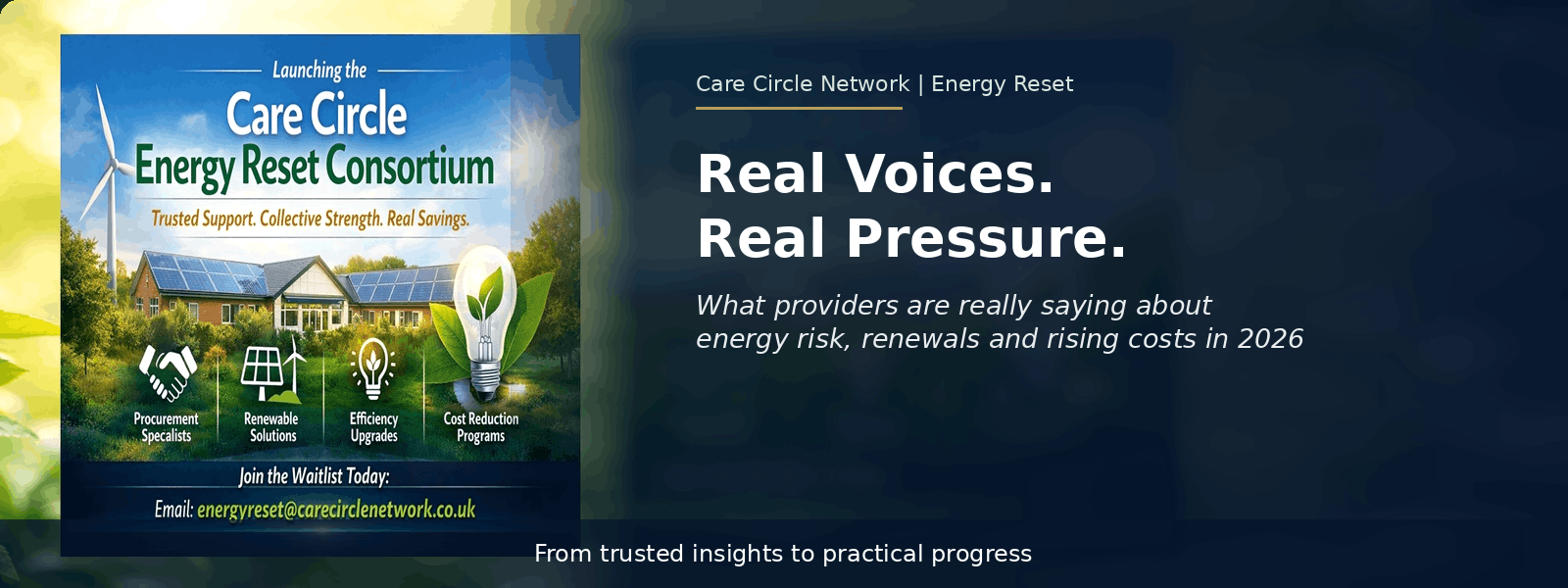
The Care Circle Energy Reset Consortium was not launched because energy had suddenly become a new issue in care. It was launched because months of provider engagement, sector signals and operational feedback were all pointing in the same direction: energy had stopped feeling like a background overhead and started feeling like one of the sector’s most exposed, least predictable and least confidently managed cost pressures.
Some pressures in care arrive loudly.
Others build more gradually, until the pattern becomes too clear to ignore.
Energy has become one of those issues.
Not simply because providers are facing higher bills, but because the wider conversation around energy now sounds different from the one the sector was having even a year ago. What is coming through more consistently is a sense that this is no longer just a facilities cost to review when contracts come up. It is a source of uncertainty. A source of timing pressure. A source of avoidable loss where oversight is weak. And, increasingly, a source of operational strain for providers trying to run stable services in an unstable market. Care England’s March language reflects that shift directly, describing energy as a “core strategic issue” that can determine whether a service remains financially viable.
That is the backdrop to why Care Circle launched the Energy Reset Consortium.
Not as an abstract initiative. And not as a new layer of commentary around a familiar issue.
But as a response to a pattern the sector itself was already describing: that energy had become harder to read, harder to control and harder to navigate with confidence at the very point when many providers could least afford that lack of clarity. Your launch piece framed that clearly, positioning the Consortium as the practical next step after sustained provider engagement with the Energy Reset series.
The tone of the conversation has changed
One of the clearest signs that energy has moved into a different category of concern is the language now being used around it.
Care England recently said that many providers feel “at the mercy of a complex and opaque market,” with contracts often poorly understood, pricing structures unclear and advice inconsistent. That matters because it tells us something important. Energy is no longer being discussed purely as an overhead to be reviewed at renewal time. It is now being spoken about in the same breath as viability, operational control and financial resilience.
Once a cost category starts to be discussed in those terms, it deserves a more strategic response than routine contract management alone.
That does not mean every provider suddenly needs to become an energy specialist. It does mean the issue can no longer be treated as something safely left to the margins of the operating model. For busy care organisations, the more realistic question is how to put the right level of structure, oversight and support around it without adding further burden to already stretched teams. That is where the quality of the partner around the contract starts to matter. The right broker or specialist can bring expertise, timing discipline and market visibility that operations teams simply do not have the time to build internally. The real issue is not whether outside support is used. It is whether the support is aligned, transparent and genuinely suited to the realities of care.
What providers are experiencing on the ground
Public provider responses help explain why this shift is happening.
In recent Lincolnshire provider consultation material, one provider said its electricity and gas costs for one home had risen from £8,500 a year to more than £20,000 over five years. Another said utilities had increased by 94% from the previous financial year, with contracts due to expire later in the year and new quotes already indicating a further 10% increase. A separate provider response recorded energy increases of 132%.
These are not abstract complaints about difficult market conditions.
They are the kind of numbers that change behaviour inside a care business. They affect renewal choices, investment confidence, cash flow planning and how much room is left elsewhere in the model. Once energy reaches that level of exposure, the issue is no longer simply whether prices are high. It becomes a question of what volatility is doing to confidence, planning and the ability to make calm decisions at the right time.
The deeper issue is not just cost — it is confidence
What stands out in much of the sector discussion is that the frustration is not solely about energy being expensive.
It is also about energy being difficult to feel fully in control of.
That distinction matters.
Because a provider can often absorb a difficult market more confidently when the route through it feels clear. The pressure becomes much harder when billing is more difficult to scrutinise, when renewal windows come around too quickly, when quotes vary widely, or when operators know they should be taking a more active approach but do not always have the internal time or visibility to do that properly. Care England’s recent material says exactly that: the market can feel opaque, and millions of pounds have been lost through incorrect billing, hidden charges and lack of oversight in energy contracts.
That changes the character of the issue.
Because the problem is no longer only that prices are high. It is that many providers do not feel they have enough visibility, enough leverage or enough sector-shaped support around one of their biggest controllable costs. And once confidence starts to weaken around a cost line like that, the consequences reach far beyond energy itself.
Renewals are becoming one of the clearest fault lines
This is especially visible around contract renewals.
For many providers, the issue is not only whether they are getting a competitive rate. It is whether the renewal process itself is happening early enough, clearly enough and strategically enough to avoid last-minute decision-making. Care England’s own tender feedback has highlighted how easily providers can end up with unsuitable structures, non-inclusive quotes, pass-through charges, hidden clauses or contracts that do not reflect the operational profile of care. It also notes that many providers rely heavily on broker advice and guidance and do not challenge it.
That is not a criticism of seeking specialist support. In many cases, it is the opposite.
Specialist support is often essential. But where support is not care-specific enough, not transparent enough, or not integrated into a broader renewal strategy, providers can still find themselves carrying more uncertainty than they expected. The challenge, then, is not whether to use a broker or consultant. It is how to make sure the relationship genuinely improves clarity, timing and outcomes rather than simply moving complexity somewhere else.
This becomes even more pronounced across multi-site groups, where different homes may sit on different contract end dates, supplier terms and usage profiles. At that point, the problem is no longer just one of tariff comparison. It becomes a matter of whether the organisation has enough oversight to create a coherent energy position at all.
The Middle East has intensified an existing problem
Recent instability in the Middle East has sharpened this feeling further.
Care England’s event notice for its 1 April webinar says escalating tensions in the region are already driving sharp increases in global gas prices, creating “immediate and significant financial risk” for adult social care. Its March energy articles make the same point more broadly: geopolitical instability is amplifying volatility and pushing additional uncertainty into provider decision-making.
That is important to frame properly.
The current geopolitical picture has not created the sector’s underlying energy challenge. What it has done is make an already sensitive area feel even more exposed. It has intensified the sense that providers are operating in a market where outside forces can quickly affect renewal confidence, cost certainty and planning assumptions.
In that sense, global instability has not changed the nature of the problem so much as made the existing weakness harder to ignore.
Why this matters especially for independent and mid-sized providers
One of the more revealing comments in the public provider responses came from a national organisation that said it benefited from economies of scale, helping to mitigate some of the gas and electricity pressures that had risen significantly in recent years. That single point says a great deal.
Because it highlights something many smaller and mid-sized providers already understand instinctively:
the market tends to reward scale, structure and specialist oversight.
Larger groups are often better placed to centralise contracts, review spend across multiple sites, and create a more deliberate renewal strategy. Independent and mid-sized providers may be facing many of the same market conditions with less internal buying power, less time to interrogate every clause or renewal pathway, and less ability to build a fully aligned portfolio-wide approach.
That does not make them weaker businesses. But it does mean they are often carrying more exposure in a market that increasingly rewards confidence, timing and visibility.
Why Care Circle launched the Energy Reset Consortium
This is the point at which the launch of the Consortium becomes important.
The Energy Reset series was created because energy had clearly become a growing pressure point across the care sector. But over time, the response to that series made something else just as clear: providers were not only looking for commentary on the issue. They were looking for a more practical, more trusted route to act on it.
That is why the Consortium was launched.
Not to replace the insight, but to sit naturally beyond it.
The editorial had already surfaced the pressure. The sector feedback was increasingly confirming the same themes. The next step was to create something more structured for providers who recognised the issue in their own organisation and wanted earlier access to a clearer route forward.
In that sense, the Consortium did not come before the need.
It came because the need had already become too visible to remain sitting at insight alone.
A practical next step for providers feeling the same pressure
If the issues raised in this feature feel familiar, there is now a clear next step.
Care Circle Network is opening a free waitlist for care providers who want early access to the Care Circle Energy Reset Consortium as it develops.
Those joining the waitlist will be among the first to receive:
- an early preview of aligned specialists
- insight into the planned 2026/27 access and commercial structure
- a copy of the Care Circle Energy Reset Guide, where not already received
To join the Care Circle Energy Reset Consortium waitlist and register your interest, email:
energyreset@carecirclenetwork.co.uk
Final word
We created the Energy Reset series because energy had become a growing pressure point across the care sector.
We are now developing the Consortium because the wider conversation has made something else increasingly clear: providers want a more structured, more trusted and more practical route to respond.
Simple. Transparent. Sector-led.
If energy is now becoming one of care’s biggest controllable challenges, it may also become one of its clearest areas of advantage for providers that act early, choose the right support, and bring more oversight to one of the most important costs in the model.
Join the waitlist today — and take the next step from energy pressure to practical progress.