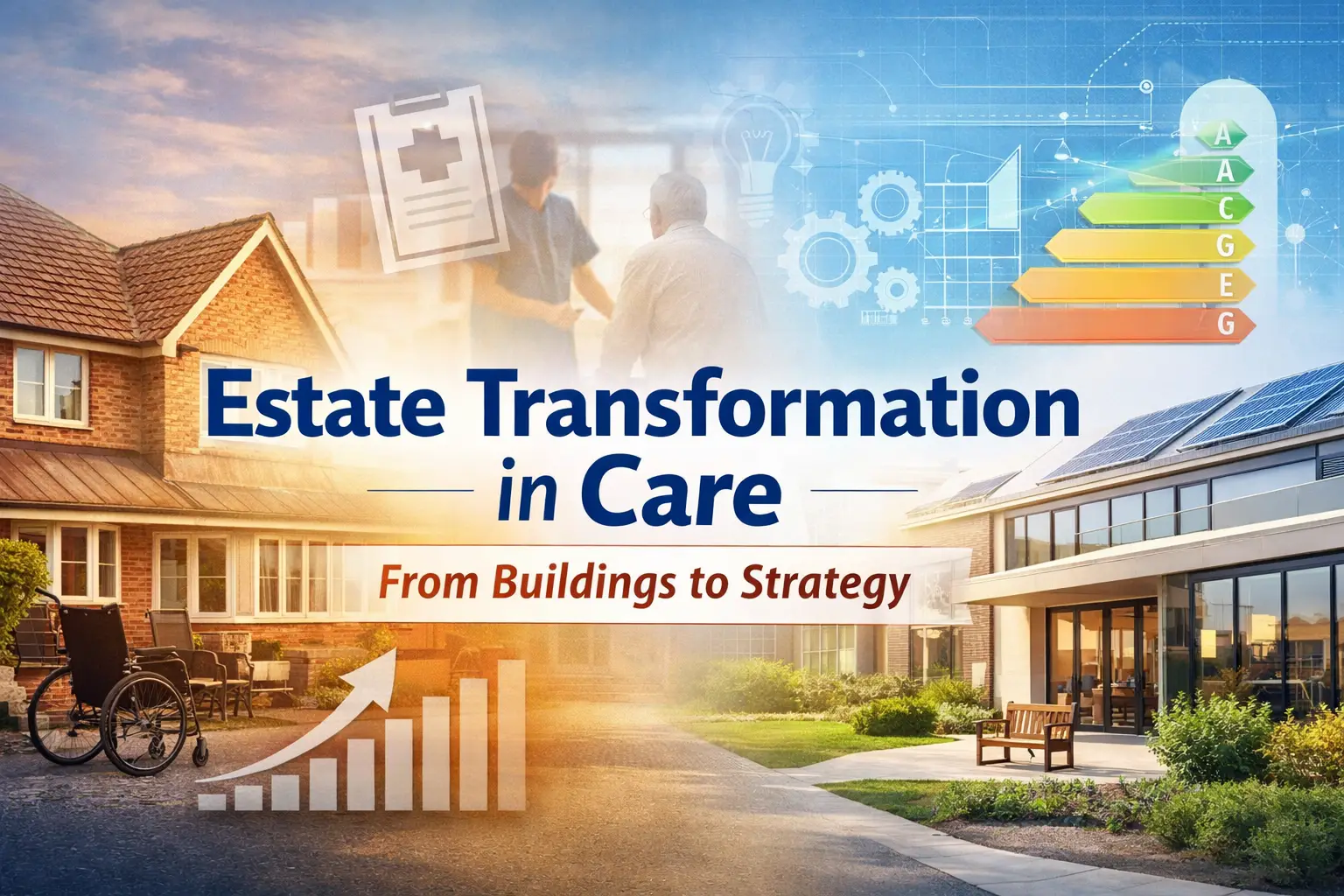
Part 2 of the Care Circle Network’s Estate Transformation Series
The UK care sector operates within one of the most diverse and complex property landscapes in the country.
As explored in Part 1, some care environments have been purpose-built to modern standards — supporting resident wellbeing, energy efficiency and clinical delivery — while others continue to operate from buildings developed decades ago, long before today’s expectations around sustainability, connectivity and care provision were established.
That variation is now becoming a defining factor.
Because the estate is no longer just a backdrop to care delivery.
It is becoming central to how care is delivered, experienced and regulated.
A Shift in What the Care Estate Needs to Deliver
Across the wider healthcare system, a clear direction is emerging.
Care is moving closer to communities, with a growing emphasis on:
• integrated care delivery
• reduced reliance on hospital settings
• improved access and responsiveness
• more coordinated, localised services
For care providers, this has direct implications.
The buildings in which care is delivered must now support:
• higher levels of clinical interaction
• digital connectivity and communication
• energy efficiency and cost control
• safe, adaptable and compliant environments
From Physical Asset to Operational Lever
Historically, an estate has often been viewed as a fixed asset — something to maintain, rather than actively manage.
That is changing.
Providers are increasingly recognising that estate plays a direct role in:
• operational efficiency
• staff workflow and productivity
• resident experience and outcomes
• cost control and financial sustainability
In practical terms, the condition and performance of a building can either support or restrict the delivery of care.
Where the Pressure Is Emerging
Across the sector, several pressures are converging at once:
• ageing buildings requiring ongoing maintenance or upgrade
• rising energy costs impacting operational budgets
• increasing expectations around sustainability and EPC performance
• growing demand for digitally-enabled care environments
• regulatory focus on safety, quality and governance
At the same time, the ability to build new care homes remains constrained — making the effective use and improvement of existing estate more critical than ever.
This is creating a shift in mindset.
Rather than asking “Do we need a new building?”, providers are increasingly asking:
“How do we make our existing estate fit for the future?”
Four Immediate Priorities for Care Providers
As providers across the Care Circle Network engage with estate transformation, several clear priorities are emerging:
1. Understanding estate performance
Assessing how buildings perform across energy, layout, utilisation and compliance.
2. Identifying upgrade opportunities
Pinpointing where targeted improvements can deliver immediate operational and financial benefit.
3. Aligning estate with care delivery models
Ensuring environments support modern care pathways, clinical interaction and staff efficiency.
4. Planning phased transformation
Developing a structured approach to improvement, rather than one-off or reactive changes.
Where This Is Creating Immediate Demand
Across the Care Circle Network, estate transformation is already moving from discussion into action.
A growing number of providers engaging with this series are now reviewing their buildings in detail — assessing performance, identifying inefficiencies and exploring where targeted improvements can deliver measurable impact.
Many of the questions being raised relate to:
• how to improve energy performance without major capital projects
• how to modernise environments while maintaining occupancy
• how to align estate with evolving care and regulatory expectations
• how to prioritise investment across multiple sites
As part of that process, providers are also beginning to consider which specialist organisations they may need to work with — whether in relation to energy, facilities, refurbishment, connectivity or wider estate strategy.
A Sector Moving From Reactive to Planned Transformation
One of the most important shifts taking place is how estate decisions are made.
Historically, many changes have been reactive — driven by:
• maintenance issues
• compliance requirements
• immediate operational pressures
Now, there is a move toward more structured, forward-looking planning.
Providers are beginning to take a more strategic view — recognising that incremental improvements, when planned effectively, can deliver significant long-term value.
The Bigger Picture: Estate as a Foundation for Care Delivery
As care delivery continues to evolve, the role of the physical environment is becoming more significant.
Buildings are no longer just where care takes place.
They are becoming:
• enablers of clinical care
• drivers of operational efficiency
• contributors to resident wellbeing
• indicators of governance and leadership
This shift is subtle — but important.
Looking Ahead
Estate transformation is not a single project.
It is an ongoing process of adaptation — aligning buildings with the needs of residents, staff and the wider healthcare system.
For providers, the focus is now on understanding where they are today — and identifying the practical steps that can move them forward.
Those who take early action to assess and improve their estate will be better positioned to operate efficiently, sustainably and confidently in the years ahead.
Sector Insight Invitation
As part of the Care Circle Network’s ongoing Estate Transformation Series, we are inviting insight from organisations supporting care providers in areas such as:
• energy efficiency and decarbonisation
• facilities management and maintenance
• refurbishment and retrofit solutions
• digital infrastructure and connectivity
• estate strategy and optimisation
These contributions help ensure the series reflects both the realities providers are navigating and the expertise available to support the sector.
Organisations working alongside care providers in these areas are welcome to share perspectives that may support services as they review and evolve their estate.