Why Fixed Electricity Charges Are Becoming a Hidden Margin Pressure for Care Providers
And what care homes should check now.
From April 2026, another pressure has landed on electricity bills — one that many providers may not yet fully understand.
Executive Summary
Care home operators have spent the past few years trying to regain control of energy costs after a period of extreme volatility. Many have already reviewed tariffs, reduced consumption, tightened budgets and looked for efficiency gains wherever possible.
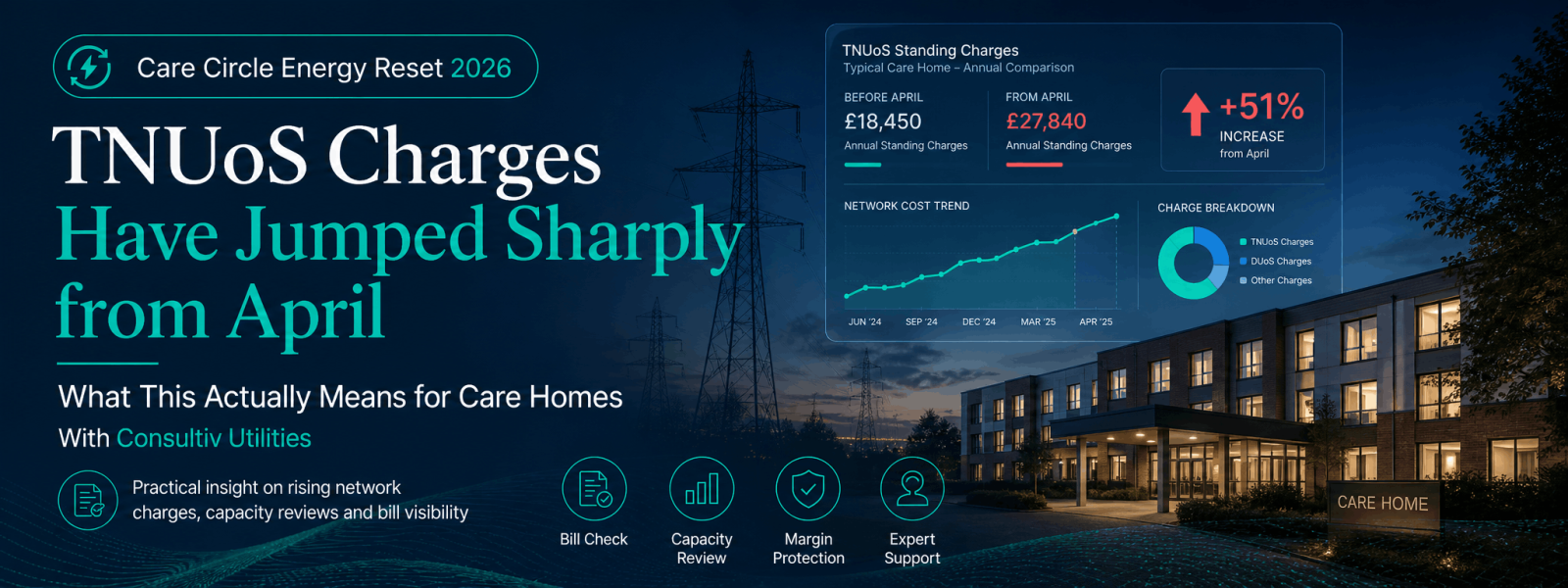
But Transmission Network Use of System charges, known as TNUoS, have risen sharply for 2026/27, with average increases widely reported at around 60% and some customer bands facing significantly higher rises.
These are network-related charges, not normal wholesale energy costs. For many care homes, they appear as fixed daily charges linked to meter type, voltage level and agreed supply capacity.
Even providers who have worked hard to reduce consumption may still see their bills rise.
In Plain English: What TNUoS Actually Is
TNUoS is the charge that pays for the upkeep of the national high-voltage electricity grid — the major transmission infrastructure that brings power from generators to local networks.
It is a pass-through cost on your bill, collected by your supplier on behalf of the National Energy System Operator.
From April 2026, the way these charges are calculated changed. The biggest impact is on the fixed daily standing charge, charged per meter, per day.
These charges are now banded according to your site’s voltage level and agreed supply capacity, measured in kVA. The higher your band, the higher the daily fee — and it applies whether you use a lot of electricity or very little.
Why Care Homes Are Particularly Exposed
Care homes run 24/7. Unlike many commercial premises, they cannot simply shift activity away from peak hours or reduce essential usage without affecting resident comfort, safety or service delivery.
Essential Systems
Heating, lighting, lifts, medication fridges, nurse call systems and clinical equipment all depend on reliable electricity.
Daily Operations
Laundry, catering and resident support services create continuous operational demand.
Capacity Exposure
Many sites sit in low-voltage half-hourly capacity bands that are now seeing higher fixed charges.
Margin Pressure
Fixed charges can rise even where providers have already reduced consumption.
Most sites are on low-voltage half-hourly tariffs with capacity typically in the 80–500 kVA range — exactly the bands where many providers are now seeing the impact of higher fixed charges.
Example Impact for Typical Care Home Bands
The table below shows what the jump can look like for typical care home-relevant bands.
| Example Band | Previous Annual Standing Charge | New Annual Standing Charge | Indicative Increase |
|---|---|---|---|
| LV1: 0–80 kVA | ~£1,427 | ~£2,657 | +£1,230 per meter/year |
| LV2: 80–500 kVA | ~£2,383 | ~£5,260 | +£2,877 per meter/year |
These figures are indicative examples only. The actual impact will depend on your region, meter type, voltage level, agreed capacity and contract terms.
Even homes that have improved energy efficiency are seeing these fixed charges rise. Cutting consumption helps the unit-rate part of the bill, but it does very little to reduce a fixed TNUoS standing charge if your site remains in the same capacity band.
For care providers, this is not a technical billing issue. It is a margin protection issue.
Four Practical Checks Care Homes Should Make Now
1. Check Your Latest Invoice
Look for standing charge, TNUoS, transmission or non-commodity charge lines. If the wording is unclear, ask your supplier or broker to identify where the change is appearing.
2. Review Agreed Supply Capacity
Many sites are paying for a higher kVA than they actually need. Any reduction must be based on actual demand profile and operational safety.
3. Get Bills Properly Checked
Climate Change Levy, VAT status, incorrect pass-through charges, meter details and billing errors should all be reviewed.
4. Speak to a Specialist Early
Fixed charges can quietly become part of the new cost base before anyone has challenged whether they are correct.
Why Capacity Reviews Matter
Where it is safe and appropriate, a capacity adjustment may help reduce the daily charge and protect costs in future years.
However, capacity should never be reduced without proper analysis. Cutting capacity too far can create operational risk, especially in environments where care delivery depends on reliable electricity every day.
A specialist review can help establish whether the increase is unavoidable, whether the banding is correct, and whether practical steps exist to reduce exposure.
Where Consultiv Utilities Can Help
As the featured energy expert within Care Circle Network’s Energy Reset series, Consultiv Utilities is offering readers a practical capacity review and bill health-check to help providers understand whether the April TNUoS changes have been applied correctly — and whether any immediate savings or recovery opportunities exist.
One care home they worked with recently recovered £27,000 in overcharges through a thorough capacity and contract review. That money went straight back into improving care for residents.
Free Capacity Review and Bill Health-Check
Care Circle Network readers can request a free capacity review and bill health-check through Consultiv Utilities.
Speak directly to Donna Kennedy, Sales Team Manager
Phone: 0191 622 6529
Email: Donna.Kennedy@consultivUtilities.com
Mention Care Circle and your review will be prioritised.
Visit Consultiv UtilitiesNext Week in the Energy Reset Series
How one care home turned a TNUoS-sized headache into a £27,000 saving — and how CCL and VAT relief could help you too.