Adult social care providers are operating between two regulatory approaches.
CQC continues to assess services under its current framework of five key questions, quality statements, six evidence categories and numerical scoring.
At the same time, a new sector-specific adult social care framework is being tested. The proposed approach retains Safe, Effective, Caring, Responsive and Well-led, but brings back structured key lines of enquiry and rating characteristics describing what care may look like at each rating level.
CQC’s consultation on the draft frameworks closed on 12 June 2026. A structured programme of piloting and evaluation is running between June and October, with final evaluation planned for November. Pilot assessments operate alongside the current approach, carry no legal standing and do not alter a provider’s rating or regulatory status.
This creates an understandable question for providers:
Which framework should we prepare for?
The strongest answer is neither—and both.
Providers should understand the regulatory approach currently in force and remain alert to the direction CQC is taking.
But they should not build their quality systems around changing terminology.
The fundamental standards remain.
The five key questions remain.
People’s experiences remain central.
CQC can still gather evidence on and off site, undertake planned or responsive assessments and expand an assessment where concerns emerge. Adult social care providers must also continue completing an annual Provider Information Return.
The goal should therefore be stronger than inspection preparation.
It should be to create a service in which good care, effective leadership and measurable improvement are visible every day—regardless of which framework CQC uses to examine them.
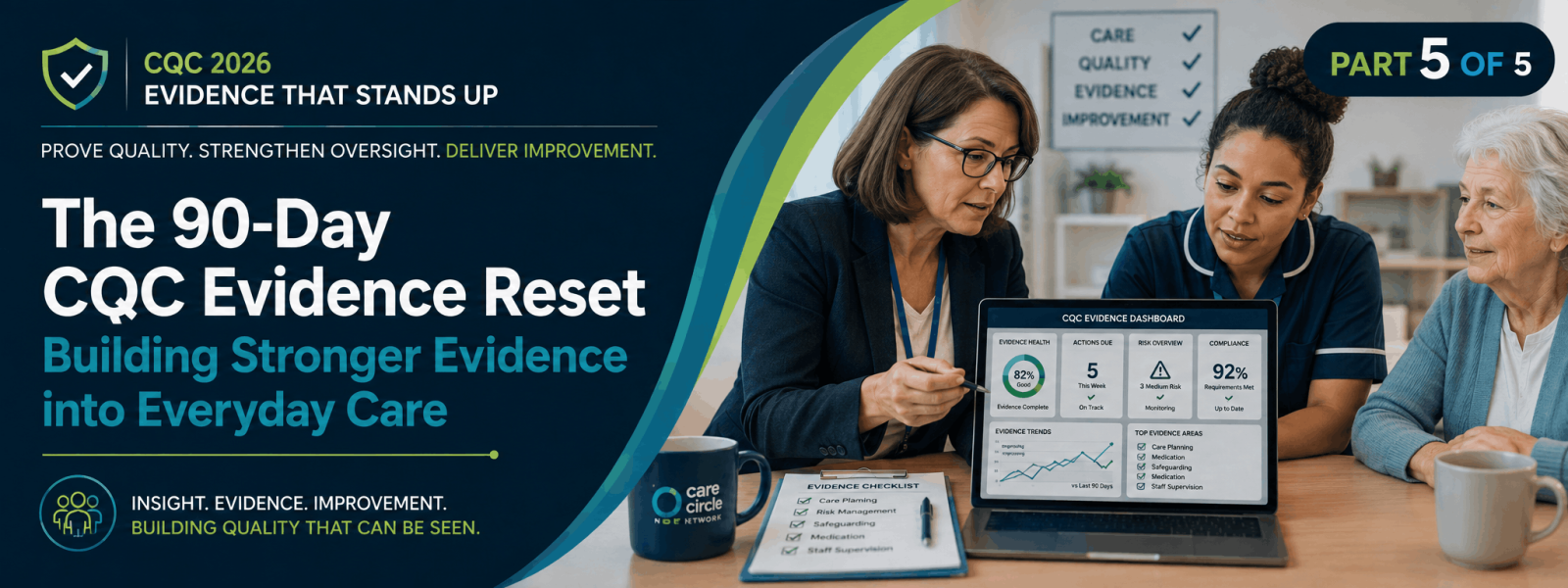
That is the purpose of the 90-day CQC Evidence Reset.
Why a Reset Is Needed Now
CQC is increasing its regulatory activity.
The regulator has said it remains on track to publish reports for at least 9,000 assessments across all sectors by September 2026.
Within adult social care, its priorities include:
- services presenting urgent or emerging risks;
- very-high-risk services that have not been assessed since registration;
- services registered for more than a year without an assessment;
- and services with ratings more than six years old.
CQC is also rolling out a proportionate approach for some services rated Good across all five key questions, where a registered manager is in place, the rating is more than six years old and current intelligence shows no significant risk or ongoing enforcement. That approach places greater emphasis on people’s experiences and outcomes, supported by observation and targeted record review.
This matters for two reasons.
First, regulatory contact is becoming more likely for services with old ratings, no previous assessment or concerning intelligence.
Second, even lower-risk services may be assessed through a more focused process that goes directly to people’s experiences, observed practice and targeted evidence.
A large compliance folder may therefore offer less protection than providers imagine.
A provider needs to know:
- what people are experiencing;
- what staff are saying;
- where risks are developing;
- whether processes work;
- what outcomes are being achieved;
- and whether leaders can prove that identified weaknesses have improved.
Those are not inspection-day questions.
They are everyday leadership questions.
What the 90-Day Evidence Reset Is—and Is Not
The Evidence Reset is not a promise that a provider will achieve a particular rating.
No consultant, platform or training organisation can guarantee CQC’s judgement.
It is not an exercise in rewriting every policy.
It is not about producing a document against every line of regulatory guidance.
And it is not a three-month attempt to make a struggling service appear stronger than it is.
The reset is a disciplined process through which a provider:
- sees the service more clearly;
- identifies the evidence gaps that create the greatest risk;
- improves the underlying practice;
- connects information that currently sits in different systems;
- and demonstrates whether the resulting action made care better.
The outcome should be a service that is easier to understand, manage and improve.
CQC readiness should follow naturally.
Evidence Must Be a Product of Care, Not a Parallel Activity
Providers often experience evidence as additional work.
Employees deliver care—and then record evidence that the care was delivered.
Managers lead services—and then assemble evidence that leadership occurred.
Quality teams review performance—and then prepare a separate presentation of that performance for CQC.
Some documentation will always be necessary.
But where evidence exists entirely outside everyday work, it becomes expensive, fragile and difficult to trust.
The strongest evidence is generated by the operation of the service.
For example:
- a care plan records what matters to the person;
- daily records show how those preferences were respected;
- staff can explain the approach;
- observation confirms it;
- the person describes having choice;
- and reviews show that the support remains effective.
No separate “person-centred evidence document” is needed.
The evidence already exists across experience, practice, records and outcomes.
The provider’s task is to connect it.
CQC currently organises assessment evidence into six categories:
- people’s experience;
- feedback from staff and leaders;
- feedback from partners;
- observation;
- processes;
- and outcomes.
A meaningful reset uses those six perspectives to examine the real service.
It does not create six new filing systems.
The Evidence Health Test
Before beginning the 90-day programme, every important item of evidence should be tested against eight questions.
Is it current?
An excellent audit from last year may no longer describe the service.
Changes in:
- people’s needs;
- management;
- staffing;
- premises;
- technology;
- ownership;
- or commissioning
can quickly make evidence outdated.
Is it relevant?
Evidence should help answer a meaningful quality question.
A large volume of information can create distraction when it does not relate to current risks, experiences or outcomes.
Is it representative?
Does the evidence include:
- different people;
- different shifts;
- different services;
- agency and permanent staff;
- people with communication differences;
- and those who may find it harder to complain?
Positive feedback from the easiest people to hear from cannot represent everyone.
Is it connected?
Does the audit connect to the action plan?
Does the incident connect to learning?
Does training connect to assessed competence?
Does feedback connect to a decision?
Does the decision connect to an outcome?
Is it verifiable?
Can another person understand where the conclusion came from?
A statement that “staff understand safeguarding” is less reliable than evidence from:
- supervision;
- discussion;
- observation;
- scenario testing;
- and appropriate responses to actual concerns.
Has it been acted upon?
Information without response is not assurance.
Leaders should be able to explain what happened after a risk, concern or weakness became visible.
Is it outcome-linked?
What changed for the person receiving care?
A completed action should not be confused with a better outcome.
Is it accessible?
Can the appropriate leader retrieve and explain the evidence without depending entirely on one manager’s memory?
If evidence disappears when one person is absent, the provider’s governance remains vulnerable.
Days 1–30: See the Service Clearly
The first month should be diagnostic.
It is not the time to launch multiple new systems or commission a complete policy rewrite.
The objective is to establish an honest, evidence-based view of the service.
Week 1: Establish Ownership and Scope
The reset needs a senior sponsor.
Depending on the organisation, this may be:
- the owner;
- nominated individual;
- quality director;
- operations director;
- or another sufficiently senior leader.
The registered manager should be central to the review, but they should not be expected to complete it alone.
Agree:
- which service or services are included;
- who will lead each part;
- which information will be reviewed;
- how people and staff will be involved;
- which risks require immediate escalation;
- and how progress will reach the board or provider leadership.
For larger groups, beginning with one service or one evidence theme may be more effective than launching a provider-wide exercise immediately.
For smaller providers, the complete organisation may be manageable within one review.
The scope should be ambitious enough to matter and focused enough to complete.
Week 2: Listen Before Reviewing Documents
Start with people’s experiences.
CQC defines this evidence category broadly, including the experiences of people using the service and those supporting or representing them.
Review:
- complaints;
- compliments;
- survey responses;
- family feedback;
- residents’ or service-user meetings;
- advocacy information;
- care reviews;
- informal concerns;
- and evidence adapted for people who do not use conventional verbal or written communication.
Speak directly with a representative group of people where possible.
Ask:
- Do you feel safe?
- Do staff know what matters to you?
- Are you involved in decisions?
- Can you raise a concern?
- Do staff arrive when expected?
- Is support consistent?
- Has anything changed recently?
- What would make the service better?
The wording and communication approach should be adapted to the person.
The purpose is not to generate a favourable satisfaction percentage.
It is to understand what care feels like.
Identify whose voice is missing
The review should specifically consider people who:
- communicate non-verbally;
- have advanced dementia;
- require advocacy;
- lack regular family involvement;
- use English as an additional language;
- have sensory impairments;
- or may be reluctant to criticise a service on which they depend.
A provider cannot claim to understand people’s experiences when the least-heard voices remain absent.
Week 3: Test Workforce Understanding and Observed Practice
Feedback from staff and leaders is one of CQC’s six evidence categories. Observation is another.
Reviewing both together reveals whether employees:
- know what is expected;
- feel confident performing their roles;
- understand individual needs;
- can raise concerns;
- and receive sufficient support from management.
Speak with:
- new starters;
- experienced staff;
- night workers;
- agency workers;
- senior carers;
- support staff;
- and managers.
Ask practical questions rather than testing people’s ability to repeat policy wording.
For example:
- What would you do if this person refused their medicine?
- How does this individual communicate pain?
- Which risks require immediate escalation?
- What has changed following the most recent incident?
- Who would you contact if you disagreed with a senior decision?
- How do you know this person has consented?
- What is the current priority for improving this service?
Then observe selected areas of practice.
This might include:
- handovers;
- medicines support;
- mealtimes;
- interactions;
- call-bell response;
- community visits;
- use of equipment;
- infection prevention;
- record completion;
- or support during periods of distress.
Observation should be constructive.
The goal is to understand the working reality, not to catch employees out.
Week 4: Map Processes, Outcomes and Governance
CQC’s process evidence focuses on whether arrangements are effective, not simply whether they exist. Outcome evidence concerns the effect of care processes on individuals.
Review the provider’s main systems:
- care planning;
- risk assessment;
- medicines;
- safeguarding;
- complaints;
- incidents;
- recruitment;
- training;
- supervision;
- audits;
- maintenance;
- infection control;
- business continuity;
- and information governance.
For each area, ask:
- What should happen?
- What evidence shows that it happens?
- What do people and staff say?
- What do audits or observations show?
- What outcome is being achieved?
- What happens when the process fails?
This is also the point at which provider-level governance should be tested.
Regulation 17 requires effective systems for assessing, monitoring and improving the quality and safety of services, managing risk, maintaining accurate records and seeking and acting on feedback.
Leaders should establish whether:
- significant risks have named owners;
- audit findings lead to action;
- overdue actions are challenged;
- boards receive service-level evidence;
- registered managers are supported;
- and provider decisions reflect their effect on care.
The End-of-Month Evidence Map
At the end of the first 30 days, the provider should have one clear evidence map.
For each significant area, it should show:
- what the provider believes;
- the evidence supporting that belief;
- any conflicting evidence;
- the level of risk;
- what remains unknown;
- and whether action is required.
The map should distinguish between four positions.
Strong and assured
Evidence is current, consistent and supported by people’s experiences and outcomes.
Positive but insufficiently evidenced
Practice may be good, but leaders cannot yet demonstrate it reliably.
Known weakness with improvement underway
The issue has been identified, action is owned and progress is being monitored.
Significant or unresolved risk
Evidence suggests that people may be unsafe, experience poor outcomes or receive inconsistent care.
This final category should receive immediate attention rather than waiting for the second month.
Days 31–60: Close the Gaps That Matter
The second month is about improvement.
Providers should resist trying to correct every minor weakness at once.
An extensive action plan can create the appearance of control while spreading management capacity too thinly.
Select no more than three priority evidence gaps.
They should be chosen according to:
- risk to people;
- frequency;
- scale;
- regulatory significance;
- effect on outcomes;
- and the organisation’s ability to make meaningful progress.
Priority 1: Correct Unsafe or Inconsistent Practice
Immediate quality and safety risks come first.
These may include:
- medicines errors;
- inadequate safeguarding responses;
- weak moving-and-handling practice;
- insufficient staffing;
- unsafe premises;
- poor infection control;
- delayed clinical escalation;
- or unlawful restrictions.
The provider should:
- protect affected people;
- obtain appropriate specialist input;
- clarify responsibility;
- correct guidance;
- support or reassess staff;
- and increase monitoring until assurance improves.
The action should address credible causes.
A repeated medicines problem may not be solved by assigning another training course where the real issue is:
- contradictory records;
- poor handover;
- inadequate staffing;
- or an unsuitable system.
CQC’s learning-culture expectations emphasise openness, investigation, learning and changes that improve care for others.
The action plan must therefore move beyond the person or event immediately involved.
Priority 2: Connect Fragmented Evidence
Many providers have information but cannot see the complete story.
For example:
- an incident is recorded in one system;
- the care plan is updated elsewhere;
- training is assigned on another platform;
- the family communication is held in email;
- and the audit action remains in a spreadsheet.
The risk is not only administrative inefficiency.
A vital stage may be missed because no single person can see whether the complete response occurred.
Create clear connections between:
Concern → investigation → action → owner → completion → remeasurement → outcome
The solution may involve:
- simplifying the existing process;
- agreeing one action tracker;
- improving system integration;
- introducing a quality-management platform;
- or assigning one person to maintain the complete evidence chain.
Technology can help.
But the provider should define the problem before selecting the product.
The objective is not to digitise fragmentation.
It is to remove it.
Priority 3: Strengthen People’s Voice
A provider may discover that feedback is:
- infrequent;
- inaccessible;
- heavily family-led;
- limited to annual surveys;
- or disconnected from decision-making.
Improvement might include:
- regular accessible conversations;
- independent advocacy;
- adapted feedback tools;
- observation-based approaches;
- resident or service-user forums;
- family listening sessions;
- digital feedback;
- and a clearer “you said, we did” process.
The most important evidence is not that people were asked.
It is that leaders understood what they said and changed something as a result.
Priority 4: Improve Workforce Competence Evidence
Training completion does not prove competence.
Where evidence is weak, providers should identify the responsibilities that carry the greatest risk and establish how capability will be assessed.
This may include:
- medicines;
- moving and handling;
- safeguarding;
- delegated healthcare;
- positive behaviour support;
- end-of-life care;
- mental capacity;
- or use of specialist equipment.
A credible competence process may combine:
- learning;
- discussion;
- supervised practice;
- direct observation;
- scenario testing;
- feedback;
- and periodic reassessment.
The objective is not a larger training matrix.
It is greater confidence that people are being supported by employees who can perform the role safely.
Priority 5: Restore Action Ownership
An action without a clear owner is a request.
An action without a deadline is an intention.
An action without remeasurement is an assumption.
For every material improvement, record:
- the original evidence;
- the risk;
- the required action;
- the named owner;
- the deadline;
- the implementation evidence;
- the success measure;
- and the review date.
Senior leaders should challenge actions that remain open repeatedly.
They should also challenge actions marked complete without evidence that the original problem improved.
Days 61–90: Prove and Embed Improvement
The final month is where many improvement programmes weaken.
Activity has taken place.
Policies have been updated.
Training has been delivered.
Meetings have been held.
The temptation is to declare success and move to the next priority.
But CQC evidence becomes stronger only when the provider can demonstrate the effect.
Remeasure the Original Weakness
Return to the evidence that triggered the action.
Where the problem involved medicines, examine:
- repeated error types;
- MAR accuracy;
- competence;
- refusals;
- omitted doses;
- and people’s experience.
Where it involved communication, examine:
- complaints;
- callback times;
- family feedback;
- handovers;
- and outstanding messages.
Where it involved staffing, examine:
- rota stability;
- agency use;
- overtime;
- missed care;
- employee feedback;
- and continuity.
Where it involved care planning, examine:
- record accuracy;
- staff knowledge;
- people’s involvement;
- observed practice;
- and outcomes.
The success measure should relate directly to the original risk.
Test Across Different Conditions
Improvement should not be confirmed only:
- during weekdays;
- when the registered manager is present;
- with permanent staff;
- or in one location.
Test whether the change holds across:
- nights;
- weekends;
- agency cover;
- periods of high demand;
- new starters;
- and different services.
A process that works only when the strongest manager is on duty is not fully embedded.
Ask People Whether They Experienced the Change
Leaders may believe communication has improved because a new process was introduced.
Families may still be waiting for calls.
Employees may believe a new care plan is clearer.
The person may still feel that staff do not understand their preferences.
Remeasurement must include experience.
Ask:
- Has anything felt different?
- Is the original concern resolved?
- Do you feel safer?
- Are staff more consistent?
- Is communication clearer?
- What still needs to improve?
This connects management action to the outcome that matters.
Bring the Evidence Back to Governance
The provider’s board, owner or nominated individual should review:
- the original evidence gap;
- the action taken;
- any barriers;
- the remeasurement;
- people’s feedback;
- and the remaining risk.
Governance, management and accountability arrangements should enable providers to act on reliable information about risk, performance and outcomes.
Senior leaders should decide whether the action is:
- complete and sustained;
- improving but requiring further monitoring;
- ineffective and needing redesign;
- or revealing a wider provider-level problem.
This closes the governance loop.
Standardise What Worked
Where improvement is successful, determine whether it should be:
- included in induction;
- added to supervision;
- built into audits;
- replicated across services;
- incorporated into policy;
- included in the Provider Information Return;
- or reported routinely to the board.
Adult social care providers are required to submit a PIR annually, explaining changes and how the service remains Safe, Effective, Caring, Responsive and Well-led.
A provider that maintains current improvement evidence throughout the year will find the PIR easier and more meaningful to complete.
It will be describing a process it already understands rather than reconstructing a year of activity close to the deadline.
What Providers Should Not Do
Do not create an inspection-only evidence room
Evidence separated from everyday governance becomes outdated quickly.
Do not rewrite every policy automatically
First establish whether the weakness lies in the document, employees’ understanding, implementation or oversight.
Do not self-rate without evidence
Describing a service as Outstanding or Good does not make the judgement more credible.
Start with what people experience and what the evidence shows.
Do not depend entirely on the registered manager
A strong manager remains essential, but owners, directors and nominated individuals must retain organisational visibility.
Do not buy technology before defining the problem
A system should improve information, action, assurance or outcomes—not merely add another platform.
Do not treat training as the universal answer
Training cannot correct weak rotas, inaccessible records, inadequate equipment or unclear responsibility.
Do not wait for the final assessment framework
The pilot programme continues through October, but the fundamental standards and current regulatory approach remain active now.
What Should Providers Expect from CQC Evidence Partners?
The Evidence Reset creates a meaningful role for organisations supplying:
- quality-management systems;
- digital care records;
- eMAR;
- incident-management platforms;
- resident and family feedback;
- workforce and competence systems;
- auditing;
- policy support;
- mock assessments;
- governance dashboards;
- regulatory consultancy;
- clinical review;
- and leadership development.
But specialist support should solve a defined problem.
A credible partner should be able to explain:
- which evidence gap it addresses;
- how the solution fits the provider’s service model;
- what work it removes from managers;
- how employees will use it;
- what information becomes more visible;
- how actions will be followed through;
- and what measurable outcome should improve.
That outcome may be:
- better audit follow-through;
- more representative feedback;
- reduced medicines errors;
- clearer competence evidence;
- faster identification of risk;
- fewer overdue actions;
- stronger board oversight;
- improved regulatory confidence;
- or more time available for direct care.
The supplier should not simply help the provider produce more evidence.
It should help the organisation understand and improve care.
A Proportionate Approach for Smaller Providers
A small provider does not need a dedicated compliance department or complex data infrastructure.
It does need a repeatable way of understanding quality.
A proportionate evidence system may include:
- one monthly governance meeting;
- one service-level quality dashboard;
- one risk register;
- one action tracker;
- current audits;
- accessible feedback;
- clear competence records;
- and documented evidence that actions were reviewed.
The people involved may be only:
- the owner;
- nominated individual;
- registered manager;
- and an external specialist where required.
The standard is not determined by the size of the organisation.
The system simply needs to be proportionate, effective and capable of keeping people safe.
The 90-Day Evidence Reset at a Glance
Days 1–30: See clearly
- establish ownership;
- listen to people;
- speak with staff and partners;
- observe practice;
- review processes and outcomes;
- test governance;
- identify contradictions;
- and select the most important gaps.
Days 31–60: Improve deliberately
- protect people;
- correct unsafe practice;
- connect fragmented evidence;
- strengthen feedback;
- assess competence;
- assign action owners;
- and introduce targeted external support where needed.
Days 61–90: Prove and embed
- remeasure the original weakness;
- test across different shifts and services;
- ask people whether they experienced improvement;
- report back to governance;
- retain evidence;
- standardise what worked;
- and continue monitoring.
Simple does not mean easy.
It means focused.
Ten Questions Care Leaders Should Be Asking
- What evidence gives us the greatest confidence in the quality of our service?
- What important evidence is missing, outdated or contradictory?
- Whose experience are we not hearing?
- Does observed practice match our policies and care plans?
- Can employees explain recent learning and service priorities?
- Do audits lead to action and remeasurement?
- Can every significant concern be followed through to an outcome?
- Does the nominated individual have direct visibility of risk and improvement?
- Which evidence depends too heavily on one manager’s knowledge?
- What can we prove is better today than it was 90 days ago?
The final question is the most important.
A provider should be able to answer it clearly.
What Does Continuous CQC Readiness Look Like?
Continuous readiness does not mean behaving as though an inspector may arrive every morning.
It means leaders understand the service without requiring an inspection to reveal it.
A continuously ready provider:
- knows where its risks sit;
- listens to people;
- supports staff to speak honestly;
- tests whether policies work;
- connects incidents with learning;
- follows actions through;
- understands outcomes;
- supports managers;
- and keeps senior leadership informed.
It does not claim perfection.
It can explain its weaknesses as confidently as its strengths.
It can show:
- when a problem was identified;
- what was done;
- what remains unresolved;
- who owns the next action;
- and how people are being protected in the meantime.
That is more credible than a service presenting only positive evidence.
Building Quality That Can Be Seen
Across this five-part series, one message has remained constant.
Evidence is not paperwork created for CQC.
It is the visible account of what care feels like, how the organisation operates and what difference leadership makes.
The assessment framework may change.
Quality statements may be replaced by new key lines of enquiry.
Rating characteristics may return.
Scoring may disappear.
Pilots will be evaluated and further guidance will follow.
But the purpose of evidence will remain stable.
People need confidence that services are safe.
Employees need clarity about what good practice requires.
Managers need reliable information.
Boards and nominated individuals need visibility.
And regulators need enough evidence to reach fair, consistent judgements.
The strongest providers will not spend the next period waiting for CQC to finalise every detail.
They will use it to improve what is already within their control.
They will listen more carefully.
They will connect information more effectively.
They will close actions properly.
They will invest where a genuine gap exists.
And they will measure whether their decisions improved people’s lives.
A 90-day evidence reset will not solve every quality challenge.
But it can create something extremely valuable:
A clearer view of the service.
A more disciplined response to weakness.
Stronger support for managers.
More credible organisational oversight.
And evidence that is produced naturally through better care.
CQC readiness should never be a separate performance prepared for the regulator.
It should be the result of running a service that understands itself every day.
That is evidence that stands up.
Frequently Asked Questions
What is a CQC evidence reset?
A CQC evidence reset is a focused review of how a provider understands, records and improves quality. It examines people’s experiences, staff and partner feedback, observation, processes, outcomes and governance, then prioritises the gaps carrying the greatest risk.
Is CQC currently using the new sector-specific framework?
No. As of 4 August 2026, the draft sector-specific method is being piloted alongside the current assessment approach. Pilot judgements have no legal standing and do not affect ratings or regulatory status. The pilot and testing programme runs from June to October, with final evaluation planned for November.
What assessment framework applies now?
CQC’s current provider guidance retains the five key questions and four-point ratings scale and assesses services against quality statements. Evidence is grouped into six categories and may be gathered on or off site.
What are CQC’s six evidence categories?
They are people’s experience, feedback from staff and leaders, feedback from partners, observation, processes and outcomes.
Does a provider need a separate evidence folder for every CQC requirement?
No. Evidence should be proportionate to the service and generated through everyday care and governance. Providers should focus on whether evidence is current, representative, connected and capable of demonstrating outcomes.
Is completing an action enough to prove improvement?
No. Providers should return to the original concern and remeasure whether risk, practice, experience or outcomes improved before closing a significant action.
What should be prioritised during the first 30 days?
Providers should establish ownership, gather people’s and staff experiences, observe practice, review processes and outcomes, test governance and identify the small number of evidence gaps creating the greatest risk.
How can suppliers help?
Specialist suppliers can support feedback, incident management, digital records, auditing, competence, governance and regulatory improvement. Their value should be judged by the specific gap they close and the measurable outcome they improve.
Editorial sources
This feature has been developed using evidence available by 4 August 2026, preserving the integrity of its backdated publication position.
- Care Quality Commission, Piloting, Testing and Evaluation of New Assessment Method, published 4 June 2026.
- Care Quality Commission, Priorities for Delivering More Assessments and Tackling Aged Ratings, published 26 May 2026.
- Care Quality Commission, Our March Update, published 24 March 2026.
- Care Quality Commission, Draft Sector-Specific Assessment Frameworks, consultation closed 12 June 2026.
- Care Quality Commission, Assessing Quality and Performance.
- Care Quality Commission, Evidence Categories.
- Care Quality Commission, Regulation 17: Good Governance.
- Care Quality Commission, Governance, Management and Sustainability.
- Care Quality Commission, Learning Culture.
- Care Quality Commission, Provider Information Return for Adult Social Care Services.