Adult social care creates an enormous amount of information.
Every day, providers record:
- incidents;
- accidents;
- medicines errors;
- safeguarding concerns;
- complaints;
- compliments;
- missed or delayed care;
- falls;
- changes in health;
- staff concerns;
- family feedback;
- audit findings;
- and near misses.
Each record tells leaders that something happened.
But recording what happened is only the beginning.
The real test is whether the organisation can explain:
- why it happened;
- what it learned;
- what changed;
- whether the change reached the people delivering care;
- and whether the risk, experience or outcome improved afterwards.
This is the difference between evidence being collected and evidence being used.
CQC’s learning-culture expectations describe a service in which safety concerns are listened to, events are thoroughly investigated and reported, and lessons are used to identify and embed better practice. The regulator explicitly connects learning from incidents and complaints with changes that improve care for others.
That final requirement is crucial.
An incident may be investigated correctly.
A complaint may receive a detailed response.
A safeguarding referral may be submitted.
A medicines action plan may be completed.
But if the same weakness remains in practice, the provider has completed a process without achieving improvement.
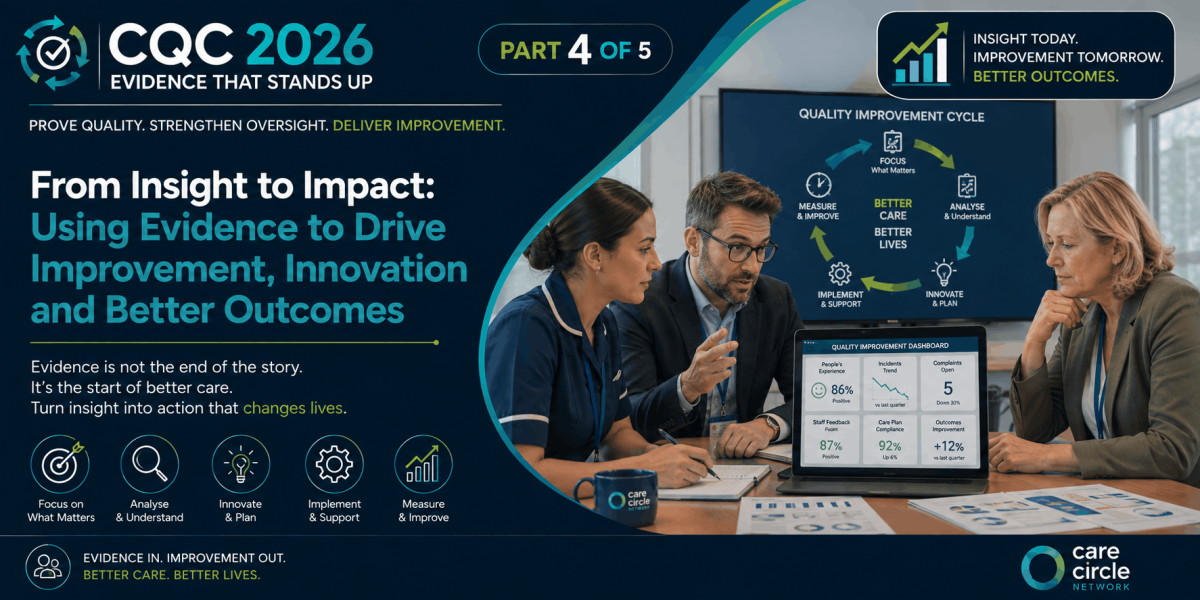
Evidence is not the end of the story. It is the starting point for better care.
The Difference Between Recording, Learning and Improving
These three activities are related, but they are not the same.
Recording
Recording creates an account of the event.
It may establish:
- what happened;
- when and where it happened;
- who was involved;
- the immediate effect;
- and the action taken at the time.
Accurate recording matters.
Without it, the organisation cannot understand the event properly, demonstrate transparency or identify repeated patterns.
But the record alone does not explain the cause.
Learning
Learning requires the provider to examine what sits beneath the event.
It asks:
- Why was the risk not prevented?
- Was important information available?
- Did employees understand it?
- Was the system difficult to use?
- Was staffing sufficient?
- Was the employee competent?
- Did workload, fatigue or distraction contribute?
- Had something similar happened before?
- Could the same problem exist elsewhere?
Learning moves beyond the visible error.
Improvement
Improvement occurs when the learning changes something.
That could involve:
- revising a care plan;
- improving a handover;
- reassessing competence;
- changing equipment;
- introducing additional clinical input;
- redesigning a process;
- strengthening staffing;
- improving technology;
- or changing provider-level oversight.
Even then, the provider has one further responsibility.
It must check whether the change worked.
A completed action is not necessarily an effective action.
The Complete Improvement Cycle
A strong improvement process can be expressed through ten connected stages:
- Recognise the concern
- Protect the person
- Report and record
- Communicate openly
- Investigate proportionately
- Understand the causes
- Decide and assign action
- Implement and support the change
- Share learning
- Remeasure the outcome
When any stage is missing, assurance weakens.
An organisation may investigate well but fail to share the learning.
It may assign actions but fail to check implementation.
It may train employees but fail to assess competence.
It may make an apology but fail to explain what will prevent recurrence.
It may reduce one visible risk while overlooking the wider system that created it.
The complete cycle turns an event into an opportunity to make care safer for others.
Stage 1: Recognise the Concern
Not every important signal arrives through a formal incident report.
A developing concern may first appear as:
- a change in someone’s behaviour;
- an unusually detailed complaint;
- several low-level medicines discrepancies;
- repeated lateness;
- a family asking the same question several times;
- a staff member expressing uncertainty;
- an increase in falls;
- missing signatures;
- a person withdrawing from an activity;
- or a pattern of care being delivered differently on particular shifts.
The provider’s ability to learn depends on its ability to notice.
This requires employees to understand what should be reported and to feel safe doing so.
CQC’s learning-culture guidance expects people and staff to be encouraged and supported to raise concerns without being blamed or treated negatively. It also emphasises using concerns to identify and manage risks before more serious safety events occur.
A low number of reported incidents is not automatically evidence of a safe service.
It may indicate that:
- staff are uncertain what to report;
- reporting takes too long;
- near misses are dismissed;
- employees fear blame;
- or managers resolve issues informally without creating organisational visibility.
The strongest services do not celebrate low reporting in isolation.
They examine whether people are genuinely safe and whether the reporting culture is open enough to reveal risk.
Stage 2: Protect the Person First
Quality improvement begins with immediate care, not administration.
When something goes wrong, the provider’s first responsibility is to protect the person and address any immediate harm or risk.
Depending on the event, that may mean:
- seeking emergency assistance;
- contacting a prescriber or clinician;
- providing first aid;
- increasing observation;
- separating a person from a potential source of harm;
- replacing unsafe equipment;
- preserving relevant evidence;
- informing safeguarding partners;
- or changing the immediate staffing arrangement.
Regulation 12 requires providers to assess and manage risks and prevent avoidable harm. Regulation 13 requires effective systems that protect people from abuse and improper treatment.
The organisation should not allow the pressure to complete notifications or documentation to distract from the person’s needs.
However, immediate protection should not become the only response.
Removing one defective item, arranging one urgent appointment or moving one employee may address the immediate situation while leaving the underlying risk untouched.
The next question must be:
What allowed this to happen?
Stage 3: Report and Record What Actually Happened
An incident report should create a reliable starting point for investigation.
It should distinguish between:
- known facts;
- observations;
- assumptions;
- and information that still requires confirmation.
The record should explain:
- what happened;
- the sequence of events;
- who was present;
- the immediate response;
- any harm or potential harm;
- who was informed;
- and what further action was required.
Judgemental or vague language weakens the evidence.
For example:
“The resident was difficult and refused medication.”
provides less useful information than:
“The person turned their head away, pushed the medication cup towards the employee and said ‘no’ on three occasions. The employee stopped the attempt and contacted the senior.”
The second account helps the provider understand the person’s communication and the response.
Good recording should not be written primarily to defend the organisation.
It should enable somebody who was not present to understand what happened accurately enough to make a safe decision.
Stage 4: Communicate Openly and Apply the Duty of Candour
Openness is not optional when care goes wrong.
CQC describes the duty of candour as a general obligation to act openly and transparently with people receiving care. Where an event meets the legal definition of a notifiable safety incident, the provider must follow the specific process required by Regulation 20.
That process includes:
- informing the relevant person as soon as reasonably practicable;
- giving an accurate account of the known facts;
- explaining what further enquiries will take place;
- offering an apology;
- following the conversation in writing;
- providing updates;
- and keeping a written record of the communication.
The duty should not be reduced to determining whether a statutory threshold has been reached.
Providers should operate with openness even where the specific notifiable-safety-incident procedure does not apply.
People and families should not have to discover an error through:
- a care record;
- another employee;
- a later invoice;
- unexplained bruising;
- missing medication;
- or a change in behaviour.
Candour is part of the relationship between the provider and the person.
A sincere apology does not by itself establish learning.
But refusing or delaying an explanation can deepen the harm and damage trust long after the original event.
Stage 5: Investigate Proportionately
Not every event requires the same level of investigation.
A minor documentation omission that is identified and corrected immediately may not require the same process as:
- serious injury;
- suspected abuse;
- repeated medicines errors;
- unexplained deterioration;
- a significant complaint;
- or a failure involving several people.
The response should be proportionate to:
- the actual harm;
- the potential harm;
- the likelihood of recurrence;
- the number of people who may be affected;
- the seriousness of the system weakness;
- and the history of similar concerns.
But proportionate does not mean superficial.
A short investigation can still be rigorous.
It should establish:
- what happened;
- what should have happened;
- where the difference occurred;
- what factors contributed;
- and what action is required.
The investigation should also consider the person’s perspective.
A process can appear technically correct while still failing to understand the emotional or practical impact on the person receiving care.
Stage 6: Look Beyond Individual Error
One of the greatest barriers to improvement is ending the investigation with:
Staff did not follow the policy.
That may be true.
It may also be incomplete.
The provider should ask why the policy was not followed.
Possible contributory factors include:
- unclear instructions;
- contradictory records;
- insufficient induction;
- lack of assessed competence;
- fatigue;
- staffing pressure;
- interruptions;
- inaccessible equipment;
- poorly designed digital systems;
- weak supervision;
- missing clinical information;
- environmental conditions;
- or a culture in which unsafe shortcuts had become normal.
CQC’s medicines guidance specifically identifies human factors including fatigue, environmental conditions and staffing levels as possible contributors to medicines errors. It advises providers to maintain an open and fair-blame approach, encourage prompt reporting and operate robust systems for sharing learning and changing practice.
This does not remove individual accountability.
Deliberate misconduct, neglect or reckless behaviour must be addressed appropriately.
But a provider that attributes every incident to one employee may repeatedly remove people without correcting the system that influenced their behaviour.
A learning culture asks both:
- What was the person responsible for?
- What was the organisation responsible for?
Complaints Are Quality and Safety Intelligence
Complaints are sometimes treated as reputational threats.
Leaders may focus on:
- answering within the timescale;
- defending the service;
- resolving the relationship;
- and closing the complaint.
Those steps may be necessary.
But a complaint is also evidence.
Regulation 16 requires providers to operate an effective, accessible system for receiving, recording, handling and responding to complaints. Complaints must be thoroughly investigated, with necessary and proportionate action taken where failures are identified.
A complaint may reveal:
- poor communication;
- delayed care;
- inconsistency between staff;
- weak consent practice;
- missed personal preferences;
- unexplained charges;
- poor access to managers;
- unreliable handovers;
- or a family’s growing loss of confidence.
One complaint should be understood on its own facts.
Several complaints with similar themes should be understood as a pattern.
The danger of treating every complaint separately
Imagine three complaints received over two months:
- one family says nobody returned a call;
- another says they were not told about a health change;
- a third says employees gave conflicting information.
Each complaint may be answered individually.
But together, they indicate a possible weakness in communication, handover or responsibility.
The governance question is not:
Did we respond to all three?
It is:
What common weakness do all three reveal?
A strong complaint response should show:
- The concern was acknowledged.
- The person was supported to explain their experience.
- Relevant evidence was reviewed.
- The findings were communicated honestly.
- Appropriate action was agreed.
- Wider implications were considered.
- The change was checked.
- Learning was shared without breaching confidentiality.
This is how complaints become improvement evidence rather than correspondence files.
Safeguarding Must Lead to Safer Systems
Safeguarding concerns require immediate, person-centred action and appropriate partnership working.
But safeguarding learning should not end when the referral is submitted or the external process closes.
Providers need to ask:
- What conditions allowed the concern to arise?
- Were warning signs present earlier?
- Did the person have an accessible way to communicate?
- Were restrictions being normalised?
- Was staffing or competence a factor?
- Did records contain enough guidance?
- Had staff raised similar concerns?
- Were previous actions effective?
- Could other people be affected?
Regulation 13 requires providers to protect people from abuse and improper treatment and to operate effective systems preventing those harms.
A safeguarding outcome may confirm that an allegation was not substantiated.
That does not necessarily mean there is nothing to learn.
The process may still reveal:
- unclear boundaries;
- weak documentation;
- poor family communication;
- inadequate supervision;
- uncertainty about consent;
- or a need to strengthen the person’s communication support.
The objective is not only to determine whether abuse occurred.
It is to understand how the person’s safety, rights and confidence can be strengthened.
Medicines Incidents: From Error Count to Safer Practice
Medicines incidents provide one of the clearest examples of why quality improvement needs more than a completed investigation.
A medicines error may occur during:
- prescribing;
- preparing;
- dispensing;
- administering;
- monitoring;
- or giving medicines advice.
The event may involve:
- an omitted dose;
- the wrong time;
- incorrect recording;
- the wrong medicine;
- a missed review;
- unsuitable storage;
- failure to follow a PRN protocol;
- or delayed escalation after refusal.
The provider should examine the complete system.
The individual factors
- Did the employee understand the medicine?
- Had competence been assessed?
- Were they working within their role?
- Were they tired or distracted?
The information factors
- Was the MAR accurate?
- Was the care plan current?
- Was the PRN protocol clear?
- Were recent prescribing changes communicated?
The operational factors
- Was staffing sufficient?
- Were interruptions common?
- Was the medicine round rushed?
- Were agency workers properly prepared?
The system factors
- Did the eMAR generate appropriate alerts?
- Was the storage arrangement safe?
- Did audits identify previous weaknesses?
- Was learning shared across shifts and services?
CQC advises adult social care providers to report and review near misses as well as incidents, maintain accurate medicines-related safeguarding records and operate processes that share learning across the organisation.
Recent CQC adult social care assessments have positively recognised services where medicines incidents were clearly reported, reviewed and used for organisational learning. Other reports have highlighted governance activity identifying increases in medicine-recording errors and prompting further action.
The important metric is not only the number of medicines errors.
It is whether:
- reporting is open;
- harm is reduced;
- recurring causes are addressed;
- competence improves;
- and people receive medicines safely.
Near Misses Are Free Learning—If Providers Use Them
A near miss is an event that did not cause harm but had the potential to do so.
Examples might include:
- the wrong medicine being selected but identified before administration;
- an employee noticing incorrect moving-and-handling equipment before use;
- a missed visit being detected before the person was left without essential care;
- or a safeguarding concern being recognised before a restrictive practice became established.
Near misses are valuable because they reveal weaknesses before somebody is harmed.
CQC’s medicines guidance encourages the recording and review of near misses because they can identify useful areas for improvement.
But staff will report them only when they believe:
- the process is worthwhile;
- managers will respond;
- the event will not be used automatically to punish them;
- and learning will be shared constructively.
A service reporting no near misses should ask whether it has achieved exceptional safety—or whether people have stopped noticing, reporting or discussing them.
Feedback Should Include More Than Complaints
Improvement evidence can come from:
- people receiving care;
- families;
- staff;
- advocates;
- professionals;
- commissioners;
- and community partners.
Formal complaints often represent only the concerns people felt able and willing to escalate.
Other signals may appear through:
- informal comments;
- repeated questions;
- low participation;
- missed appointments;
- changes in mood;
- reluctance to accept particular staff;
- staff-supervision discussions;
- compliments containing a hidden comparison;
- or professional concerns about responsiveness.
For example:
“The new team is much better at telling me what is happening.”
is a compliment.
It may also indicate that communication was previously poor.
The provider should hear both parts.
Feedback tools, surveys and digital platforms can widen access.
But technology will not create a listening culture by itself.
People need to believe:
- their views are welcomed;
- support is available;
- criticism will not affect their care;
- and the organisation will explain what happened next.
The strongest feedback evidence is not the response rate.
It is visible influence.
Action Plans Need to Describe Change, Not Intention
Weak action plans often contain statements such as:
- remind staff;
- discuss at the team meeting;
- update the policy;
- arrange training;
- monitor going forward.
These actions may be appropriate.
But they are difficult to assure because they do not define the required result.
A stronger action should specify:
- the exact weakness;
- the action required;
- the responsible person;
- the deadline;
- the evidence of implementation;
- the measure of success;
- and the review date.
Weak action
Staff to be reminded to complete repositioning records.
Stronger action
The deputy manager will observe repositioning documentation across all shifts for seven days, provide direct feedback to employees with gaps and reassess understanding. Weekly audits will then be completed for four weeks. The action will close only when records show sustained compliance and no person has missed planned repositioning.
The stronger action tells leaders:
- who is responsible;
- what will happen;
- how long it will continue;
- and what evidence will support closure.
Training Is Not Always the Answer
Training is one of the most common responses to incidents and complaints.
Sometimes it is exactly what is needed.
But repeated training can become an automatic action that avoids examining the real problem.
Before arranging training, leaders should ask:
- Was knowledge genuinely missing?
- Was the instruction available and clear?
- Had competence previously been assessed?
- Was the employee able to apply the learning in the working environment?
- Was the process realistic within the available time?
- Did equipment or technology contribute?
- Was management oversight adequate?
An employee may understand the correct process but be unable to follow it because:
- the system repeatedly freezes;
- travel time is insufficient;
- records contradict each other;
- equipment is unavailable;
- or workload is excessive.
Training cannot fix every operational weakness.
The correct solution may involve:
- job redesign;
- system improvement;
- additional staffing;
- equipment;
- specialist advice;
- clearer accountability;
- or simplification of the process.
Providers should expect training and consultancy partners to diagnose the capability gap rather than assume that another course is automatically required.
Sharing Learning Across the Organisation
A service may investigate an incident thoroughly and still fail to create wider improvement if the learning remains local.
Providers should decide:
- who needs to know;
- what they need to understand;
- how the learning will be communicated;
- and how confidentiality will be protected.
Learning may need to reach:
- the immediate team;
- night staff;
- agency workers;
- other service managers;
- clinical leads;
- senior leadership;
- the nominated individual;
- or every location within the group.
The communication method should reflect the significance of the event.
This may include:
- individual supervision;
- a team discussion;
- a learning bulletin;
- practice observation;
- revised care guidance;
- a competence assessment;
- a provider-wide alert;
- or a governance review.
CQC has positively recognised services where incidents, concerns and complaints were recorded, reviewed and used to support learning and improvement.
Sharing learning should not mean sending an email and assuming it has been embedded.
Leaders need to establish whether people understood it and changed their practice.
Measurement Turns Action into Assurance
The final stage is to establish whether improvement occurred.
Providers should select measures that relate directly to the original concern.
Following a medicines incident
Measure:
- repeated error types;
- omitted doses;
- MAR accuracy;
- competence;
- audit findings;
- and people’s experience of medicines support.
Following a communication complaint
Measure:
- response times;
- missed callbacks;
- family feedback;
- handover quality;
- and repeated complaints.
Following a safeguarding concern
Measure:
- completion of agreed actions;
- the person’s sense of safety;
- staff understanding;
- use of restrictive practice;
- supervision;
- and any recurrence.
Following repeated falls
Measure:
- frequency;
- time and location;
- injury;
- mobility;
- equipment use;
- clinical review;
- and whether the person feels unnecessarily restricted.
The provider should avoid choosing a measure merely because it is easy to produce.
The measure needs to answer:
Is the original risk, experience or outcome better?
From Insight to Innovation
Innovation does not always mean adopting advanced technology or creating an entirely new model of care.
It may mean finding a more effective way to solve a recurring problem.
Evidence might reveal a need for:
- electronic medicines administration;
- better incident-management software;
- accessible feedback tools;
- falls-monitoring technology;
- mobile access to care records;
- stronger lone-worker protection;
- workforce scheduling;
- digital competence assessment;
- or better governance reporting.
But the product should follow the evidence.
A provider should not introduce technology and then search for a problem it might solve.
The sequence should be:
- Identify the recurring weakness.
- Understand its cause.
- Define the outcome required.
- Consider the available options.
- Choose the proportionate intervention.
- Test the effect.
- Scale only where evidence supports it.
This gives specialist suppliers a more meaningful role.
They are not simply selling systems into a regulated market.
They are helping providers remove specific barriers to safer, stronger and more person-centred care.
The most credible partners will explain:
- which problem their solution addresses;
- what implementation requires;
- what burden it removes;
- how employees will use it;
- how it improves visibility;
- and what measurable outcome should change.
A Practical Incident-to-Improvement Example
Consider a person who misses an evening medicine.
The event
The omission is identified the following morning.
Immediate response
The employee contacts the appropriate clinician, checks the person’s wellbeing and follows the advice given.
Openness
The person and their representative are informed, supported and given an accurate explanation. The provider considers whether the statutory duty-of-candour process applies.
Investigation
The provider establishes that:
- the medicine had recently changed;
- the amended MAR was available;
- the care-plan guidance remained outdated;
- the evening worker relied on the care plan;
- and the handover did not mention the change.
Causes
The event was not simply an employee forgetting.
It involved:
- inconsistent records;
- weak change communication;
- and insufficient handover.
Action
The provider:
- corrects the care plan;
- checks all recent medicine changes;
- introduces one documented process for communicating amendments;
- briefs relevant employees;
- reassesses medicine competence;
- and reviews how digital and paper records are synchronised.
Wider learning
Other locations are asked to confirm how medication changes are communicated.
Remeasurement
The provider audits new prescriptions and care-plan alignment for six weeks, confirms employee understanding and monitors whether similar incidents recur.
This is evidence that stands up.
The incident has moved from an individual event to organisational improvement.
A Practical Complaint-to-Improvement Example
A relative complains that their calls are repeatedly not returned.
The initial response
The complaint is acknowledged, investigated and answered.
The deeper review
Leaders compare the complaint with:
- call logs;
- previous informal feedback;
- staff discussions;
- rota pressure;
- and manager availability.
They discover that several employees record messages in different places and nobody has clear responsibility for checking completion.
The action
The provider introduces:
- one central communication log;
- named ownership for each response;
- an escalation route for urgent clinical concerns;
- and daily review of incomplete actions.
The outcome
Response times improve.
Families receive clearer updates.
Employees report less uncertainty about responsibility.
Repeated communication complaints reduce.
The organisation has done more than answer the complainant.
It has improved the system for everyone.
What Should Boards and Nominated Individuals Review?
Leaders should not receive only a total incident number.
They need enough analysis to understand what that number means.
Governance reports should include:
- incident types;
- severity;
- repeat events;
- services or shifts affected;
- medicines trends;
- safeguarding concerns;
- complaints;
- near misses;
- duty-of-candour activity;
- overdue investigations;
- outstanding actions;
- repeated causes;
- and evidence of remeasurement.
Regulation 17 requires providers to operate effective governance and assurance systems that assess, monitor and improve quality and safety.
Boards and nominated individuals should ask:
- Which event created the greatest risk?
- What patterns are developing?
- Are similar incidents occurring across services?
- What action is repeatedly overdue?
- Are investigations identifying system causes?
- Has learning reached night, weekend and agency staff?
- What evidence confirms that completed actions worked?
- Are people and families satisfied with our openness?
- Is the same failure appearing through complaints, incidents and audits?
- Where would external specialist support improve the outcome?
These questions move governance from activity reporting to improvement oversight.
A 30-Day Evidence-to-Impact Review
Providers can apply the improvement cycle to one priority area over 30 days.
Week 1: Select the evidence
Choose one subject with sufficient concern or repeated activity.
Examples include:
- medicines omissions;
- falls;
- communication complaints;
- safeguarding referrals;
- missed calls;
- care-plan quality;
- or staff competence.
Bring together all relevant information.
Week 2: Analyse the causes
Review:
- people’s experience;
- staff feedback;
- records;
- environmental and workforce factors;
- previous actions;
- and any contradiction between policy and practice.
Identify the most credible causes.
Week 3: Implement focused action
Choose a small number of changes linked directly to the causes.
Define:
- ownership;
- deadlines;
- support required;
- implementation evidence;
- and measures of success.
Week 4: Test the early effect
Review whether:
- practice changed;
- employees understood;
- the person’s experience improved;
- the original risk reduced;
- and any further action is required.
Thirty days may not establish sustained improvement.
It will show whether the organisation has begun moving from insight to impact.
Ten Questions Care Leaders Should Be Asking
- Are employees confident reporting incidents and near misses?
- Do investigations look beyond the actions of one individual?
- Are complaints analysed alongside incidents and audit findings?
- Does safeguarding learning continue after the external referral closes?
- Are medicines errors examined for human and system factors?
- Do action plans define how improvement will be measured?
- Is learning shared across shifts, teams and locations?
- Does training address an identified capability gap?
- Can leaders prove that completed actions changed practice?
- What measurable difference has recent learning made to people receiving care?
These questions reveal whether the organisation has a learning culture—or simply a reporting system.
What Does Evidence-Driven Improvement Look Like?
Evidence-driven improvement is:
Open
People, families and staff receive honest communication.
Curious
Leaders ask why, rather than stopping at the visible error.
Fair
Individual accountability and organisational responsibility are considered together.
Connected
Incidents, complaints, safeguarding, audits and feedback are analysed collectively.
Focused
Actions relate directly to credible causes.
Supported
Employees receive the time, tools, learning and leadership required to change practice.
Shared
Learning reaches everyone who may encounter the same risk.
Measured
Actions close only when the provider has evidence of improvement.
Person-centred
The ultimate test is whether care became safer, more reliable or more responsive for people.
That is how evidence begins to create impact.
Better Care Is the Outcome—Not More Evidence
The purpose of an incident system is not to produce more incident reports.
The purpose of a complaints process is not to close more complaints.
The purpose of an audit is not to complete more audits.
The purpose of learning is to make care better.
CQC’s expectations are clear: concerns should be heard, safety events investigated, complaints used constructively and lessons translated into changes that improve care for other people.
That requires providers to move beyond evidence collection.
A strong organisation can show:
- how it recognised a concern;
- how it protected the person;
- how it remained open;
- how it understood the causes;
- how it changed the system;
- and how it knows the change worked.
This is not about creating a perfect service in which nothing ever goes wrong.
That would not be credible.
It is about creating an organisation that responds intelligently when it does.
A service with an effective learning culture does not hide difficulty.
It uses difficulty to improve.
It does not view complaints as threats.
It views them as evidence.
It does not treat near misses as irrelevant because no harm occurred.
It recognises the opportunity to prevent harm.
It does not complete action plans merely to satisfy a deadline.
It follows them through to people’s experiences and outcomes.
The strongest evidence is not a completed form.
It is a safer medicine round.
A person who feels heard.
A family that receives an honest explanation.
An employee who knows how to prevent recurrence.
A manager who can see the pattern.
And a board that can prove its decisions made care better.
That is the journey from insight to impact.
Frequently Asked Questions
What does CQC mean by a learning culture?
CQC describes a learning culture as one based on openness, honesty and safety, where concerns are listened to, events are thoroughly investigated and lessons lead to changes that improve care for others.
Is reporting an incident enough for CQC?
No. Providers should investigate incidents appropriately, understand contributory factors, take action, share learning and demonstrate that the response improved safety or care.
What does Regulation 16 require for complaints?
Providers must have an effective and accessible complaints system. Complaints must be thoroughly investigated and necessary, proportionate action taken where failures are identified.
What is the duty of candour?
The duty of candour requires providers and registered managers to act openly and transparently with people receiving care. A specific statutory process applies where an event meets the definition of a notifiable safety incident.
Should care providers record medicines near misses?
Yes. CQC advises providers to record and learn from near misses because they can reveal weaknesses before harm occurs.
Is retraining always the correct action after an incident?
No. Training is appropriate where knowledge or competence is missing, but providers should also consider workload, staffing, equipment, system design, communication, supervision and human factors.
How can providers prove that improvement occurred?
Providers should define the intended outcome when the action is agreed, then remeasure relevant practice, risk, recurrence, people’s experience or care outcomes before closing the action.
What should boards review about incidents and complaints?
Boards should receive analysis of severity, recurrence, causes, service-level variation, overdue investigations, duty-of-candour activity, actions and evidence that completed changes improved care.
Editorial sources
This feature has been developed using information available by 29 July 2026, preserving the integrity of its backdated publication position.
- Care Quality Commission, Learning Culture.
- Care Quality Commission, Regulation 12: Safe Care and Treatment.
- Care Quality Commission, Regulation 13: Safeguarding Service Users from Abuse and Improper Treatment.
- Care Quality Commission, Regulation 16: Receiving and Acting on Complaints.
- Care Quality Commission, Regulation 17: Good Governance.
- Care Quality Commission, Regulation 20: Duty of Candour.
- Care Quality Commission, Reporting Medicine-Related Incidents.
- Care Quality Commission, adult social care assessment findings on incident, complaint and medicines learning published during 2026.