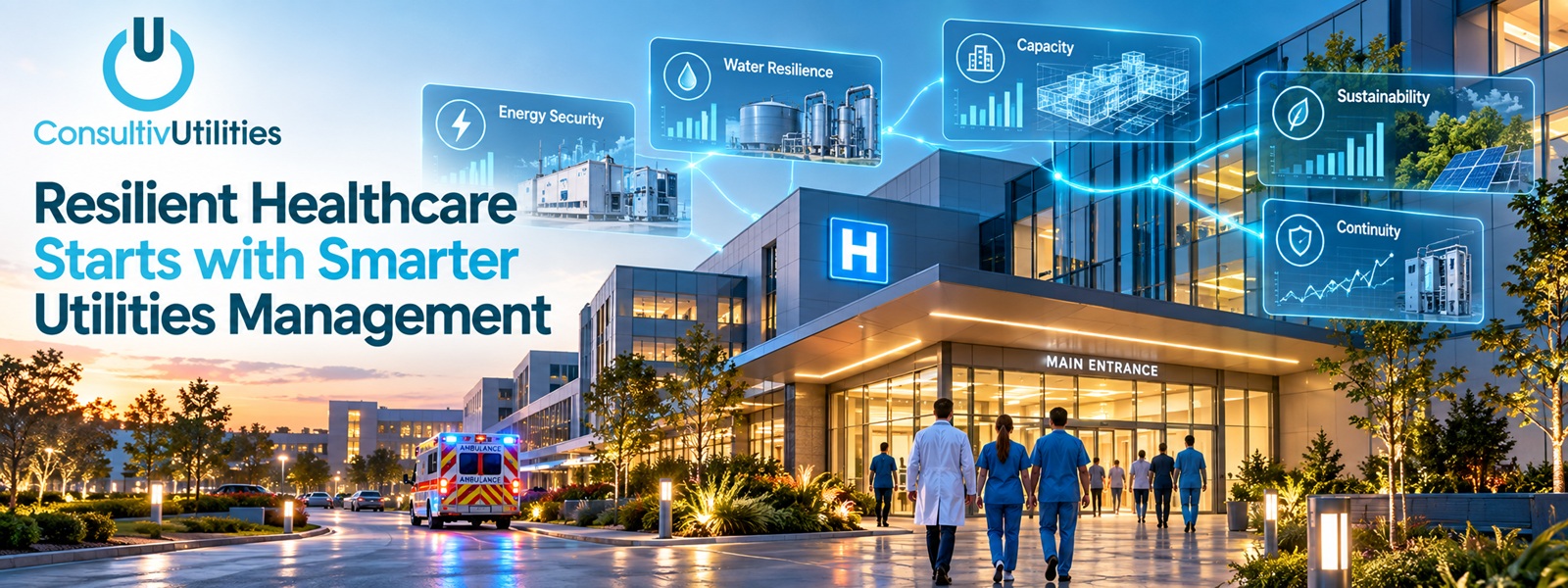
Resilient Healthcare Starts with Smarter Utilities Management
Energy and utilities are moving beyond the facilities department and becoming an increasingly important part of strategic estate planning.
Energy and utilities now influence some of the biggest strategic challenges facing healthcare organisations — from controlling operating costs and protecting business continuity to expanding estates, meeting sustainability objectives and preparing infrastructure for future demand.
For boards, finance teams, procurement leaders and estates professionals, utilities are therefore becoming much more than an overhead.
They are a strategic asset that needs to be actively managed.
Why Utilities Belong on the Strategic Agenda
Healthcare buildings have demanding and often highly specialised requirements.
Clinical equipment, heating, ventilation, lighting, refrigeration, IT infrastructure and essential building services can create significant and sometimes continuous utility demand. Different facilities can also have very different requirements depending on their size, operating model and the services they provide.
At the same time, organisations are having to consider energy costs, carbon reduction, changing regulation and the implications of future expansion.
This makes utilities increasingly relevant to board-level planning.
What will our estate require in five years? How exposed are we to changes in energy markets? Can existing infrastructure support future growth? Where can consumption be reduced?
These are no longer purely technical facilities questions. They can directly affect budgets, investment decisions and organisational resilience.
Business Continuity Starts with Resilient Infrastructure
Reliable utilities are fundamental to healthcare delivery.
A commercial office may be able to tolerate a short disruption to certain building services. A healthcare environment may have far less flexibility.
Power, heating, water and other essential services underpin everything from patient comfort and clinical equipment to communications and day-to-day building operations.
Utilities strategy therefore needs to form part of wider business-continuity planning.
Understanding consumption across the estate is an important starting point. Monitoring can highlight unusual demand, identify changes in building performance and give estates teams greater visibility of how individual locations are operating.
Resilience is not simply about responding when something goes wrong. It is about understanding vulnerabilities before they become operational problems.
Preparing for Tomorrow’s Healthcare Estate
The utility requirements of a healthcare organisation rarely remain static.
New facilities may open. Existing buildings may be extended or refurbished. Additional clinical equipment may be introduced. Operating hours can change and new technology can increase electricity demand.
At the same time, sustainability programmes may introduce solar generation, battery storage, electric vehicle charging and more sophisticated building-management systems.
Each decision can affect the estate’s future utility profile.
This is why expansion planning and utilities planning should increasingly happen together.
Before adding capacity, estates teams need to understand existing demand, infrastructure constraints and how future requirements could change consumption.
The same principle applies to sustainability. New technologies should form part of a coordinated strategy that considers consumption, procurement, generation, efficiency and the organisation’s longer-term objectives rather than treating every project as an isolated initiative.
Managing Future Cost and Risk
A long-term strategy also gives healthcare organisations greater control over their exposure to energy markets.
Waiting until a contract approaches its expiry date can leave procurement teams with limited time to evaluate the organisation’s changing requirements.
Taking a longer view means considering future consumption, contract structures, budgets and organisational appetite for risk much earlier.
Consultiv Utilities supports organisations with energy procurement, account management, consumption insight and wider utility strategy. For healthcare organisations, the important principle is that procurement should reflect the future direction of the estate rather than simply historic usage.
If the organisation is expanding, reducing consumption, investing in renewable generation or changing how facilities operate, tomorrow’s utility requirements may look very different from today’s.
Building a Long-Term Utilities Strategy
An effective utilities strategy should bring together several areas that have historically been considered separately.
Procurement, consumption monitoring, estate planning, efficiency, sustainability, infrastructure and financial risk all need to inform one another.
For a multi-site healthcare organisation, this also means gaining visibility across the entire portfolio rather than making decisions one building at a time.
The objective is not simply to purchase energy at a competitive rate. It is to build an estate that is better informed, more adaptable and more resilient.
Through its partnership with Care Circle Network, Consultiv Utilities works with healthcare organisations looking to take a more strategic approach to energy, water, waste, procurement, energy management and sustainability.
As healthcare estates continue to evolve, organisations that take a longer-term view of their utilities will be better placed to understand future demand, manage commercial risk and plan infrastructure investment with greater confidence.
Utilities may operate behind the scenes, but their importance to the resilience of healthcare could hardly be more visible.
Start Building Your Long-Term Utilities Strategy
Whether you operate an individual healthcare facility or a complex multi-site estate, Consultiv Utilities can help you review where you are today and consider what your organisation may need tomorrow.
Speak to Consultiv Utilities