A targeted care-sector review has highlighted where low-carbon heating grant support could have the strongest practical impact
Energy costs remain one of the most persistent operational pressures facing care providers. Heating and hot water are not optional costs in a care setting. They are fundamental to resident comfort, daily care delivery, laundry, kitchens, hygiene, infection control and the smooth running of the home.
That is why the Boiler Upgrade Scheme deserves serious attention from care providers operating the right type of property.
At Care Circle, we have carried out a detailed care-sector property and funding review to understand where this scheme could be most relevant. This work has combined care-location data, service-type intelligence, bed-count analysis, property-level indicators and EPC-matched information to identify the providers where this opportunity is most likely to matter in practice.
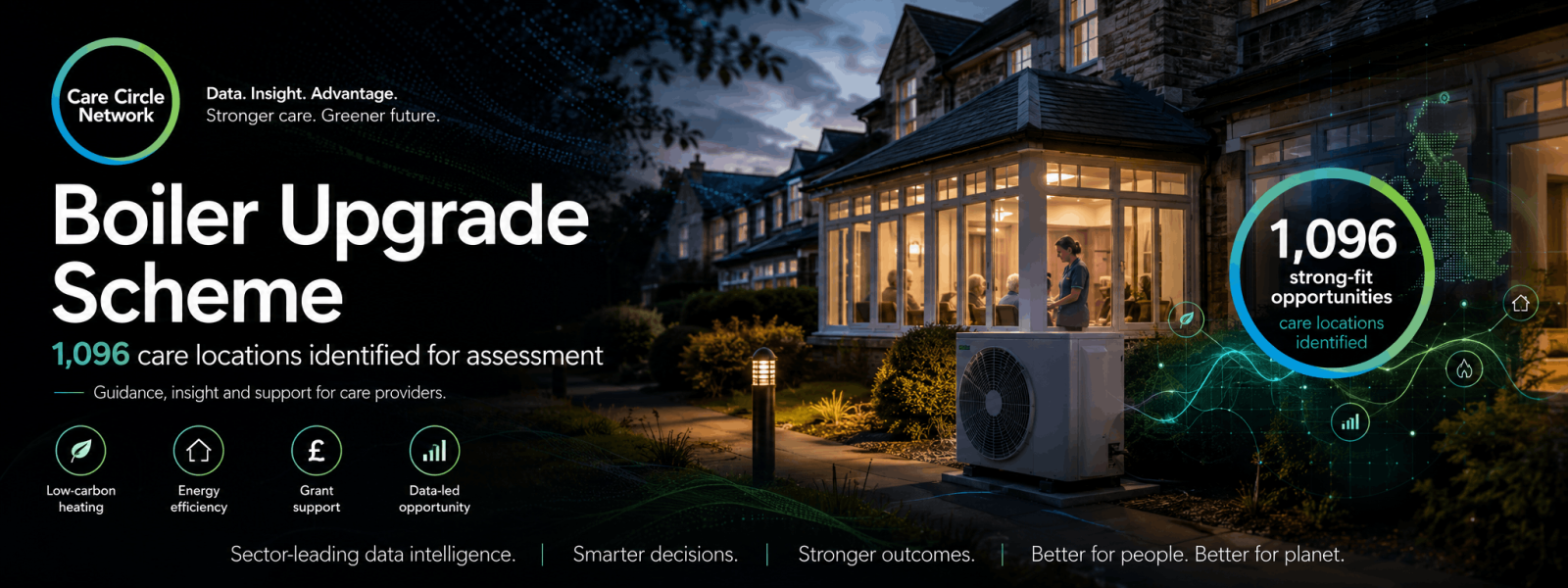
As a result, we have identified 1,096 care locations that fit the profile for Boiler Upgrade Scheme assessment and are now positioned as clear opportunities for further guidance, eligibility review and installer-led assessment.
This is not a broad message to the whole care sector.
It is a targeted, data-backed piece of work designed to ensure the right insight reaches the right provider types.
Why this matters now
The Boiler Upgrade Scheme provides upfront government grant support towards replacing existing fossil-fuel heating systems with eligible low-carbon alternatives, including heat pumps and, in certain circumstances, biomass boilers.
The scheme currently offers support of up to £7,500 towards eligible air-source or ground-source heat pump installations, and up to £5,000 towards eligible biomass boilers. It applies to homes and small or medium non-domestic buildings in England and Wales.
For the care sector, this creates a practical opportunity.
Many smaller care settings operate from converted residential properties, older buildings or specialist homes where ageing heating infrastructure, energy costs and long-term property planning are already live issues.
Where the building profile is right, the Boiler Upgrade Scheme can support a provider in moving away from older gas, oil, LPG or electric heating systems and towards a more sustainable, future-ready heating solution.
What Care Circle has done
Care Circle has taken a more detailed approach than simply raising awareness of a grant.
We have reviewed the care market to understand where this scheme could genuinely be relevant, then narrowed the opportunity down to the provider types and property profiles where the conversation is strongest.
Our analysis has looked across:
- CQC-verified care locations
- Bed numbers
- Smaller care-home profiles
- Nursing and non-nursing status
- Dementia and older-person care settings
- Children’s residential homes
- Specialist residential care environments
- Property-level EPC indicators
- Regional and local authority opportunity areas
- Provider portfolio opportunities
This work allows us to move beyond generic guidance and support providers with more relevant, targeted insight.
The purpose is simple: to make sure editorial, guidance and awareness around this funding route lands with the care providers where it resonates most and where it has the strongest chance of turning into a real assessment.
The 1,096 care locations identified
Through this review, Care Circle has identified 1,096 care locations that stand out as strong-fit opportunities for further Boiler Upgrade Scheme assessment.
These are care settings where the combination of care type, property profile, service model and available property indicators suggests the scheme should be reviewed seriously.
The strongest opportunity groups include:
- Smaller residential care homes
- Dementia and older-person care settings
- Children’s residential homes
- Specialist residential care properties
- Smaller non-nursing homes
- Care settings operating from residential-style buildings
- Providers where heating replacement, energy cost control and property improvement are already relevant issues
This is the group we will now be supporting with further insight and guidance.
The aim is not to tell every care provider they are eligible. The aim is to give the right providers a clear, informed starting point and encourage them to explore whether the scheme can support their next heating upgrade.
Why are smaller care settings leading this opportunity
One of the clearest findings from our work is that smaller care settings are where the most practical opportunity sits.
Smaller homes, particularly those operating from converted residential properties or lower-complexity care buildings, are often better placed for initial Boiler Upgrade Scheme assessment because they are more likely to have:
- A simpler heating setup
- A single main building
- Lower overall heating demand
- Less complex plant-room requirements
- More manageable hot-water demand
- A clearer decision-making route
- An older heating system is already due for review
This makes the scheme especially relevant for small residential care homes, children’s homes, dementia care settings and specialist care environments where the building is closer to a large domestic property than a complex commercial care facility.
Larger nursing homes and complex multi-building sites may still need to review heating and energy performance, but they may require a more detailed commercial decarbonisation route.
For smaller providers, the Boiler Upgrade Scheme can be a much more immediate and practical conversation.
The current heating type is central
The scheme is especially relevant where a provider is replacing an existing fossil-fuel or eligible electric heating system.
That means care settings currently using older gas, oil, LPG or electric heating should be reviewing whether their property could qualify for a grant-supported low-carbon heating replacement.
This point is important.
The Boiler Upgrade Scheme is not a grant to install another traditional boiler. It is designed to support the move away from older heating systems and towards eligible low-carbon heating technologies.
That makes the current heating type one of the first questions providers should ask.
A care provider should be reviewing:
- What heating system is currently in place?
- Is the system ageing or due for replacement?
- Who owns the property?
- Is landlord consent required?
- Could the building support a low-carbon heating system?
- Is the property suitable for assessment by an MCS-certified installer?
These are the questions Care Circle wants to help providers understand before they miss a funding route that could be relevant to them.
What the positive outcome could look like
For the right care setting, the Boiler Upgrade Scheme could support several positive outcomes.
It can help reduce the upfront cost of replacing ageing heating infrastructure. It can support longer-term energy planning. It can help providers move away from older fossil-fuel systems. It can improve the conversation around sustainability, resilience and property improvement.
For smaller care providers, this is especially important.
Many do not have internal estates teams, sustainability leads or dedicated energy managers. They are still facing rising costs and ageing buildings, but often without the same support available to larger care groups.
This is where Care Circle can play a valuable role.
By identifying the provider types where the opportunity is strongest, we can help make the scheme easier to understand, easier to assess and easier to act on.
Care Circle is here to support providers
Care Circle will now be sharing further insight with the care locations identified through this work.
This will include practical guidance on:
- How the Boiler Upgrade Scheme works
- Why smaller care settings are particularly relevant
- What current heating systems matter
- What providers should check before speaking to an installer
- How property ownership affects the process
- What an MCS installer will need to assess
- Why not every care home will be suitable
- What alternative routes larger or more complex homes may need to consider
This is about more than awareness.
It is about helping providers understand where they stand and giving them a clearer route into the right conversation.
A wider call to care providers
Although Care Circle has identified 1,096 care locations that fit this opportunity especially well, other care providers should also take notice.
If your care setting operates from a smaller property, uses older gas, oil, LPG or electric heating, and is already reviewing energy costs or heating replacement, this is the right time to assess whether the Boiler Upgrade Scheme could support your plans.
The care sector cannot afford to overlook practical funding routes simply because the guidance is too general or the opportunity has not been explained in the right context.
This is why Care Circle has carried out this work.
We want to ensure that insight, editorial content and practical guidance reach the providers where it can make the biggest difference.
Final word
The Boiler Upgrade Scheme is not a blanket solution for every care home.
But for a clearly defined group of smaller care providers, it is a serious funding route that should be reviewed now.
Care Circle has identified 1,096 care locations that fit the profile for this opportunity and will now be supporting those providers with further insight, guidance and awareness.
This gives the sector something more valuable than a general grant announcement.
It gives providers clarity.
It gives them direction.
And for the right care settings, it gives them a practical starting point to explore whether grant-backed low-carbon heating support can help reduce costs, improve resilience and support longer-term property planning.
Care providers who operate smaller care homes, children’s homes, dementia care settings or specialist residential properties should now review whether their current heating system could qualify for Boiler Upgrade Scheme support.
Care Circle will be sharing further insight with the providers already identified through our analysis.
Other care providers who would like to understand whether their property could benefit from this scheme are also encouraged to get in touch.
We are here to help providers understand the opportunity, assess the right questions and take the next step with confidence.