
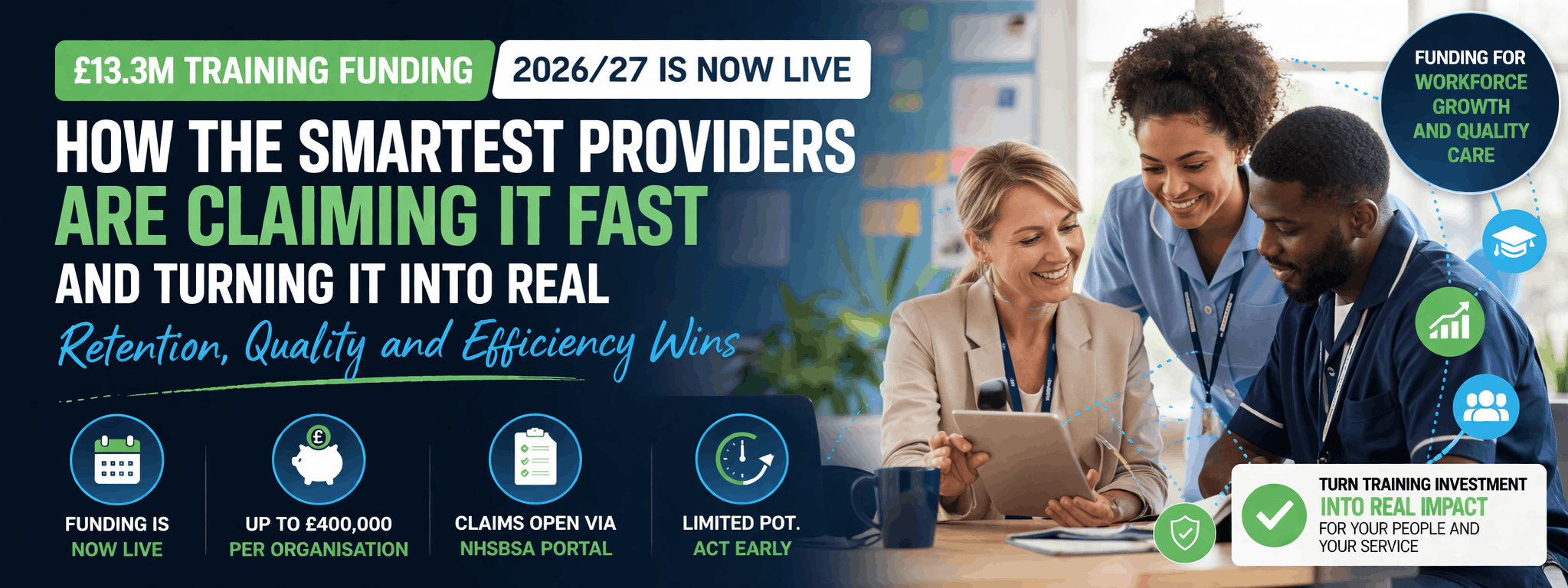
In our recent article, we explored which providers would treat the returning £13.3 million adult social care training package as a genuine strategic opportunity — rather than simply another reimbursement scheme.
One week into the new financial year, that question has already become more urgent.
From 1 April 2026, the funding is officially live. Claims are open. The clock has started.
But early conversations across the sector suggest a familiar pattern is emerging.
The immediate risk is not missing the funding — it’s using it in a way that delivers limited impact.
What’s Changed: Funding Is Now Live — and Time Matters
The 2026/27 package includes:
- Up to £10 million for the Learning & Development Support Scheme (LDSS)
- £2.3 million for the Assessed and Supported Year in Employment (ASYE)
- £1 million for User-Led Organisations
Administration has now moved to the NHS Business Services Authority (NHSBSA), with:
- A £400,000 annual cap per organisation (or group)
- Claims submitted via the NHSBSA online portal
- Eligibility for training paid between 1 April 2026 and 31 March 2027
- A three-month claims window for most activity
Oliver McGowan Mandatory Training remains explicitly fundable, with clear reimbursement rates.
The structure is clearer. The process is live.
The differentiator now is speed and clarity of approach.
The pot is limited — and, as seen in previous schemes, early engagement typically determines who benefits most. Providers delaying decisions risk finding themselves constrained later in the year.
The Shift Leaders Are Making: From Training Spend to Workforce Capability
The strongest providers are already reframing this.
This is no longer about:
- Courses completed
- Hours delivered
- Certificates issued
It is about:
- Workforce capability
- Consistency of care
- Measurable improvements in outcomes
Providers who treat this as a transactional reimbursement exercise will see limited return.
Those who treat it as a strategic investment in their workforce are already seeing early advantage.
What Smart Providers Are Doing Differently Right Now
1. Turning NLW Pressure into Retention Strength
With the National Living Wage now at £12.71, protecting margins while retaining staff is critical.
Leading providers are using funding to:
- Build progression pathways for senior carers and team leaders
- Reinforce pay differentials with development opportunities
- Increase staff loyalty at a time of rising cost pressure
The result: retention improves as capability grows.
2. Aligning Training Directly to the New CQC Framework
Following the 24 March draft framework release, providers are mapping training against:
- The 24 Key Lines of Enquiry (KLOEs)
- Clearer rating characteristics
- Areas such as:
- Well-led
- Workforce culture
- Equity and person-centred care
This turns training into:
visible, structured evidence for future inspection and commissioner conversations
3. Building Digital and TEC Confidence Across Teams
Providers are using funding to support:
- Digital care planning
- Remote monitoring
- Telecare systems
- Smarter rostering
Even small improvements in staff confidence are being delivered:
- Better use of time
- Reduced inefficiencies
- Improved response and care quality
4. Prioritising High-Impact Compliance Areas
Many providers are fast-tracking:
- Oliver McGowan Mandatory Training
- Safeguarding
- Equality and human rights
Not just to meet requirements — but to:
demonstrate commitment to safe, inclusive, high-quality care
5. Linking Training to Real Outcomes (Where the Real Value Sits)
This is where the strongest providers are separating themselves.
They are not just delivering training — they are asking:
- Has this improved staff confidence?
- Has this reduced incidents or complaints?
- Has this improved the consistency of care?
For example, one provider we spoke to this week is using funding to fast-track senior carer development — linking it directly to reduced agency usage and improved shift stability within the first month.
This is the shift: from activity → to impact.
The April–May 2026 Strategic Action Window
This Week
- Register on the NHSBSA portal and confirm eligibility
- Identify one high-impact priority area (e.g. leadership, TEC, Oliver McGowan)
- Review any April training already delivered for claim eligibility
By End of April
- Submit initial claims
- Build a clear 12-month plan within the £400,000 cap
- Align training directly to:
- NLW retention strategy
- CQC draft framework readiness
By End of May
- Deliver at least one funded cohort
- Measure early indicators:
- staff confidence
- retention signals
- reduced agency reliance
- Create a short Training Investment Summary for:
- board visibility
- commissioner conversations
This Is the Strategic Window
The funding is now live — but the real differentiator will not be access.
It will be executed.
Providers who act early and use this strategically will:
- Strengthen workforce capability
- Improve retention
- Create visible, evidence-led quality
Those who treat it as a transactional reimbursement exercise will see far more limited returns.
Final Thoughts…
The £13.3 million training funding package is now live, but its real value lies not in access, but in how effectively it is used. As expectations shift toward continuous, evidence-led care, providers must move beyond viewing training as a compliance requirement and instead use it as a lever for workforce capability, retention, and measurable improvement. Those who act early, align training with strategic priorities, and track its real-world impact will not only maximise the funding available — they will strengthen their services for the long term. This is not just a funding opportunity; it is a leadership opportunity to build more resilient, capable, and high-quality care.