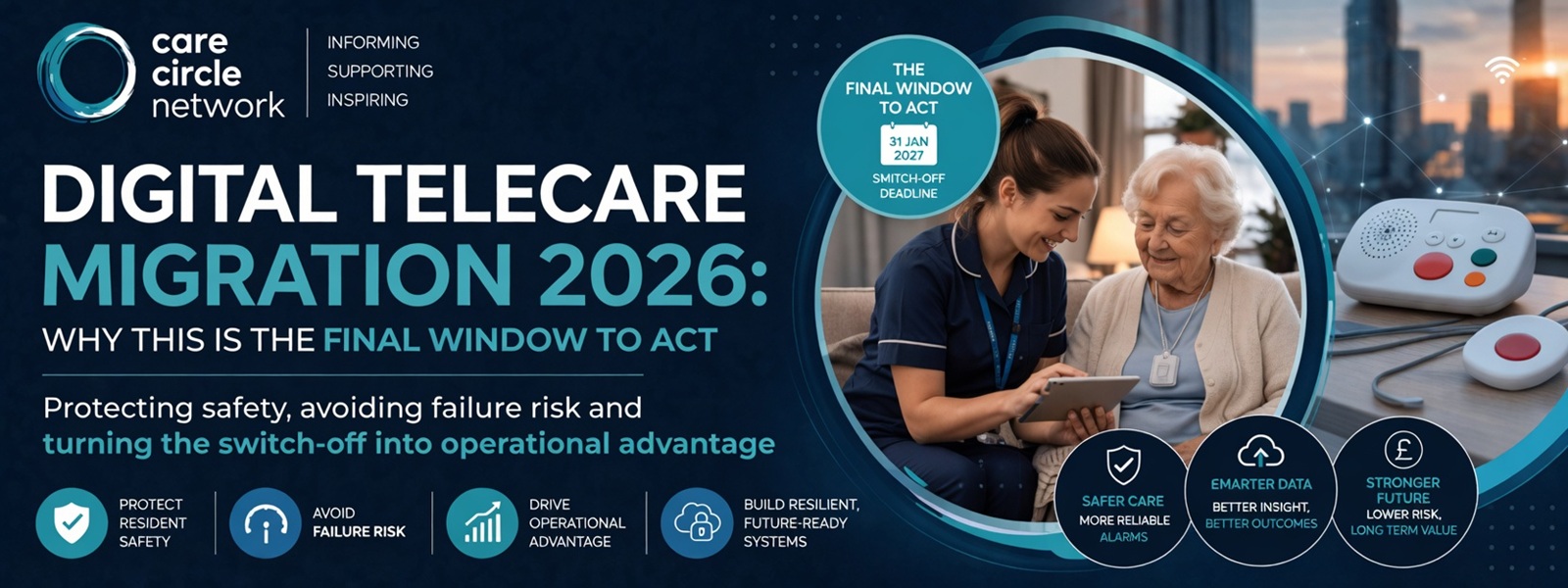
— And How Smart Providers Are Protecting Safety, Avoiding Failure Risk and Turning the Switch-Off into Operational Advantage
In our recent features, we highlighted why analogue dependency must now sit firmly on the leadership agenda and why providers should be reviewing telecare alarm and connectivity readiness as a priority.
The conversation has now moved again.
With the updated Fixed Telecoms Modernisation Charter published in late March 2026, and the 31 January 2027 switch-off deadline unchanged, this is no longer about awareness or initial review.
2026 is the final operational window.
Across the sector, the strongest providers are no longer asking “Are we ready?”
They are asking:
“How do we execute this safely, confidently, and without disruption?”
The Reality Emerging Right Now: Migration Risk Is No Longer Theoretical
As providers begin to move from planning to live migration, a clearer picture of the real-world challenges is emerging.
Across provider networks, sector bodies and supplier discussions, several consistent issues are being reported:
- First Time Call Failures (FTCFs) — alarms failing to connect reliably on the first attempt
- Device compatibility gaps — legacy telecare equipment not performing as expected on digital lines
- Power resilience risks — digital systems failing during outages without an appropriate battery backup
- Connectivity variability — reliance on broadband or Wi-Fi creates inconsistent performance
These are not edge cases.
They are the predictable realities of transitioning from analogue to digital infrastructure.
At the same time, Openreach and industry partners are clear:
- Over 3 million premises have already been migrated
- Technical barriers are considered resolved
- Messaging has shifted to “no time left to stall”
The risk now is not whether migration will happen — it is how well it is executed.
Why This Matters More Than It First Appears
This is not simply a technology upgrade.
It is a safety, safeguarding and leadership issue.
A failed alarm call is not an inconvenience — it is a potential risk to:
- Resident safety
- Response times
- Family confidence
- Regulatory standing
From a CQC perspective, this sits directly within:
- Safe (risk management and protection)
- Well-led (oversight, planning and assurance)
There is also a growing liability and insurance dimension.
As digital migration becomes an established requirement, providers will increasingly be expected to:
- Demonstrate due diligence
- Evidence testing and validation
- Show clear oversight of system risks
In simple terms:
This is moving from “infrastructure upgrade” to “core governance responsibility”.
The Shift Forward: From Readiness to Execution
The sector has now moved through two phases:
- Awareness — understanding the switch-off and its implications
- Readiness — reviewing devices, systems and dependencies
We are now firmly in Phase 3:
Execution — where decisions, testing and implementation define outcomes
This is where the strongest providers are separating themselves.
The Three Levers Smart Leaders Are Using in April 2026
1. Test Before You Transition — Not After
Leading providers are not assuming systems will work — they are proving it.
Practical actions:
- Conduct end-to-end testing of telecare devices on digital lines
- Simulate real-world scenarios (including peak usage and failure conditions)
- Validate first-time call reliability, not just connectivity
The shift is simple:
If it hasn’t been tested in real conditions, it isn’t ready.
2. Build Power and Connectivity Resilience Into Your Model
Digital systems introduce new dependencies.
Smart providers are addressing this early:
- Installing battery backup solutions for critical devices
- Reviewing broadband reliability and failover options
- Ensuring telecare systems are not dependent on a single point of failure
This is not over-engineering — it is essential risk management.
3. Align Telecare Migration with Wider Operational Strategy
The providers pulling ahead are not treating this in isolation.
They are aligning migration with:
- TEC rollout — integrating digital telecare into broader care technology
- Cyber resilience — ensuring secure, protected digital systems
- Workforce efficiency — reducing reactive workload through better systems
This is where migration becomes more than compliance — it becomes improvement.
The April–June 2026 Execution Window
This is the most important operational window providers have.
This Month:
- Confirm full inventory of telecare devices and analogue dependencies
- Engage suppliers to validate compatibility and migration pathways
- Begin controlled testing of digital setups
By End of April:
- Complete initial live environment testing
- Identify and resolve any failure points
- Confirm power resilience and backup arrangements
By Early Summer:
- Move into phased migration plans
- Ensure staff confidence and understanding of new systems
- Begin evidencing outcomes for governance and CQC alignment
From Risk to Advantage: The Opportunity Within Migration
While the risks are real, so is the opportunity.
Providers who execute this well are already seeing:
- Faster and more reliable response times
- Improved visibility of care through digital data
- Stronger evidence for CQC and commissioners
- Reduced long-term operational friction
In other words:
This is not just about replacing analogue — it is about upgrading how care is delivered, monitored and improved.
This Is the Leadership Moment
The analogue switch-off is no longer a future event.
It is an active, unfolding operational change.
The providers who delay will face:
- Compressed timelines
- Increased risk
- Reactive decision-making
The providers who act now will:
- Protect residents and services
- Strengthen governance and assurance
- Position themselves ahead of regulatory and commissioning expectations
Final Thoughts….
Digital telecare migration has moved beyond planning and into execution. While the technical pathway is now clear, the real differentiator lies in how well providers manage the transition in practice. The risks — from connectivity failures to power resilience — are real, but so too is the opportunity to strengthen safety, improve response times, and provide stronger evidence of quality. Providers who act decisively in this final window will not only avoid disruption but will embed stronger, more resilient systems that support both care delivery and leadership oversight. This is no longer just about switching systems — it is about shaping the future of safe, connected care.