In our recent articles, we explored the shift to continuous assessment and the move away from inspection as a periodic event. The CQC 2026 rebuild is now moving from direction into detail.
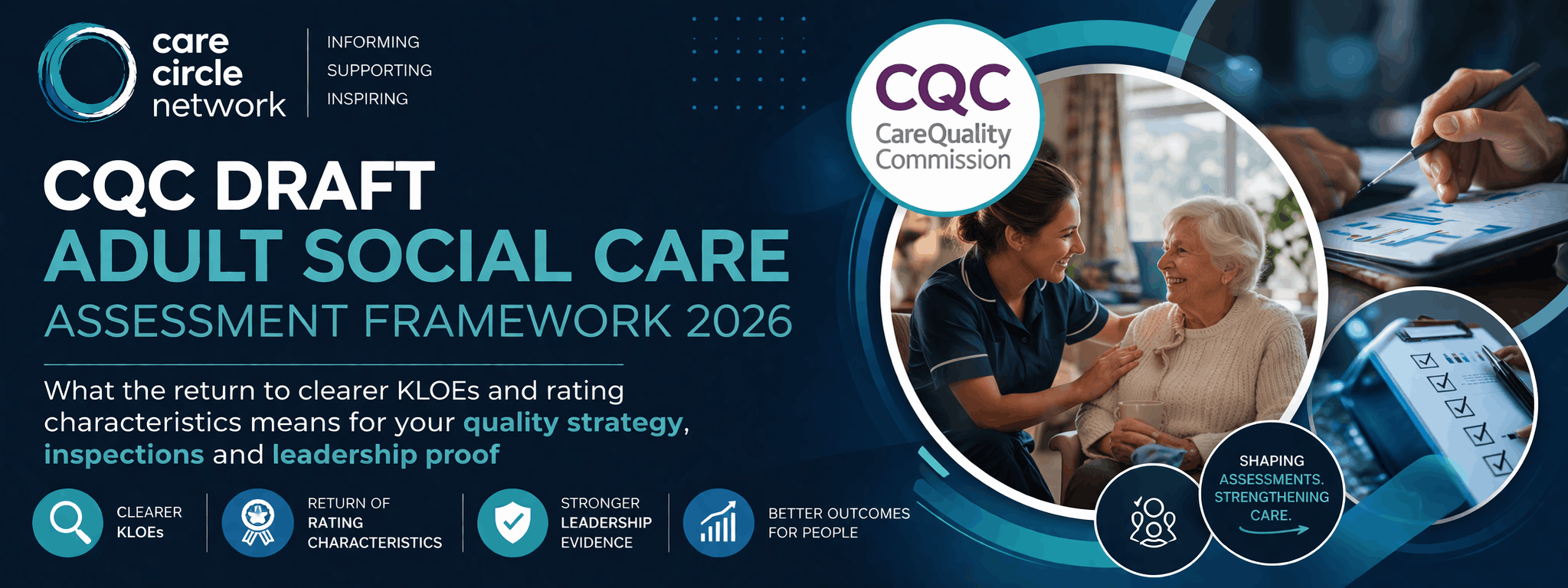
On 24 March 2026, the Care Quality Commission published its draft sector-specific assessment framework for adult social care. This is the next chapter — and it’s already generating active discussion across the sector.
The strongest leaders aren’t just reading the draft. They are mapping their current systems against it, identifying quick wins, and preparing informed feedback ahead of the consultation closing on 12 June 2026.
The Big Shift: From Framework Complexity to Practical Clarity
The five Key Questions — Safe, Effective, Caring, Responsive and Well-led — remain unchanged.
What is changing is how they are interpreted and evidenced in practice.
The draft replaces the previous 34 quality statements — often seen as overlapping and difficult to apply — with 24 clearer, adult social care-specific Key Lines of Enquiry (KLOEs).
Alongside this, the return of detailed rating characteristics is one of the most welcomed developments. Providers can now see, side by side, what Outstanding, Good, Requires Improvement and Inadequate look like in practice for each area.
Scoring has been removed. Instead, ratings will be based on professional judgement “in the round” at key question level.
This is more than a structural update.
It marks a shift back toward observable, evidence-based quality — where what happens day-to-day in your service is more clearly linked to how you are assessed and rated.
What This Will Feel Like in Practice
This change will be noticeable on the ground.
Inspectors are expected to place greater emphasis on:
- Conversations with staff and leaders
- Real-time observation of care delivery
- The lived experience of people using services
And less emphasis on:
- Static policies
- Retrospective documentation
- “Inspection-ready” folders
The implication for leaders is clear:
Inspection readiness is no longer about preparing evidence — it is about ensuring your everyday operations consistently demonstrate it.
Why This Matters for Providers Right Now
The draft directly responds to concerns raised across the sector — particularly around complexity, duplication, and administrative burden.
For providers already navigating:
- Workforce pressure following NLW increases
- Digital transformation through TEC
- Increasing focus on cyber resilience and governance
This framework offers alignment rather than additional pressure.
In practice:
- Well-led will increasingly reflect visible oversight of digital systems, data security and governance
- Workforce stability, training and reduced agency reliance will support multiple KLOEs
- Real-time data from TEC and digital care systems can demonstrate continuous improvement without creating additional paperwork
There is also a stronger emphasis on:
- Equity and inclusion
- Workforce culture
- Outcomes for people
- Clear boundaries between provider responsibility and commissioning context
Importantly, clearer rating characteristics will also sharpen how providers are viewed externally — making it easier to evidence quality, support commissioning conversations, and demonstrate value.
The Three Levers Smart Leaders Are Using This Month
1. Make Your Evidence Visible — Not Just Available
The 24 KLOEs are not a new burden — they are a practical lens.
What strong providers are doing now:
- Mapping existing systems, audits and dashboards against the KLOEs
- Identifying where real-world evidence already exists (resident feedback, continuity of care, TEC data)
- Ensuring that evidence is visible, accessible, and clearly linked to outcomes
The shift is simple:
It’s not about having the evidence — it’s about how easily it can be seen and understood.
2. Use Rating Characteristics to Define “Outstanding”
The return of clear descriptors removes ambiguity.
Leaders are using this to:
- Run short, focused briefings with registered managers
- Translate “Outstanding” characteristics into specific, measurable goals
- Align these with existing priorities such as:
- Staff retention and progression
- Personalised care
- Inclusive decision-making
This creates a more intentional path from “Good” to “Outstanding” — grounded in real delivery, not theory.
3. Strengthen Governance and Shape the Framework
The consultation window is a real opportunity to influence the final framework.
Practical steps:
- Gather input from frontline teams and managers
- Identify where clarity is strong — and where it could be improved
- Feedback through CQC channels or representative bodies
At the same time:
- Update governance summaries and quality dashboards to reflect the new structure
- Align cyber, digital and workforce reporting with the KLOEs
This strengthens both:
- Inspection readiness
- Commissioner and stakeholder confidence
The April–June 2026 CQC Draft Readiness Checklist
This Week
- Download and review the draft Adult Social Care Assessment Framework
- Add a “CQC Draft Review” item to your next leadership or board meeting
- Identify 2–3 KLOEs where you already have strong evidence
By End of April
- Complete a light gap analysis against the 24 KLOEs
- Brief registered managers on the rating characteristics
- Gather initial internal feedback
By 12 June (Consultation Close)
- Submit your response to CQC
- Update your quality improvement plan with early wins
- Baseline how your workforce and digital data support the framework
This Is the Moment to Strengthen — Not Rebuild
The draft framework is not an additional layer of complexity.
It is a more practical, sector-relevant structure — built on provider feedback — that brings clarity to what outstanding care looks like in practice.
The providers who engage now will not only be better prepared for future assessments and pilots, but will also:
- Strengthen their internal quality systems
- Improve visibility of the care they already deliver
- Be better positioned in commissioning and stakeholder conversations
Final thoughts…
The CQC 2026 draft framework signals a clear shift toward more transparent, evidence-based assessment grounded in real-world care delivery. While the changes bring greater clarity, they also place greater emphasis on how consistently providers can demonstrate quality through everyday practice. Providers who act now — mapping their evidence, aligning leadership and engaging with the consultation — will not only be inspection-ready but strategically stronger. This is not about preparing for the next inspection; it is about embedding a model of quality that stands up to continuous scrutiny and supports long-term, sustainable care.