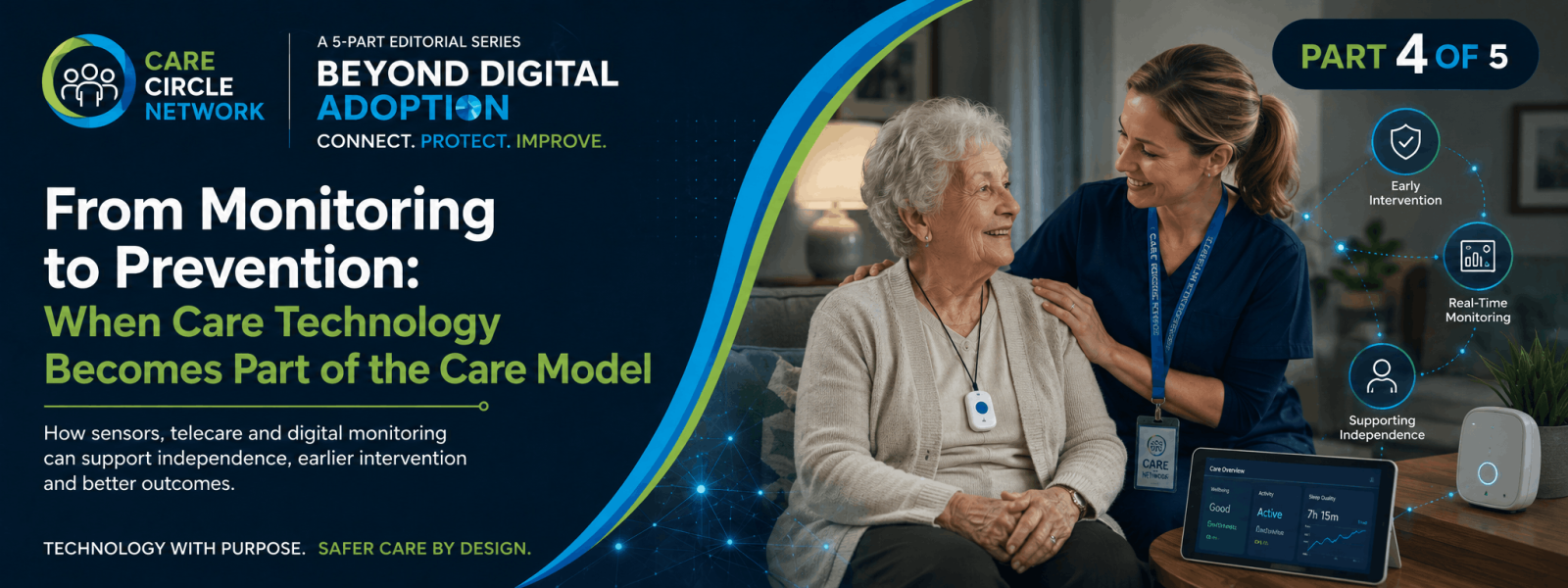
Care technology is moving rapidly into the mainstream of adult social care.
Among respondents to the government’s 2025 provider technology survey, 43% used monitoring equipment with sensors, making it the most commonly reported technology used directly to deliver care and support.
Personal alarms were used by 35%.
Video conferencing was used by 34%.
Health and wellbeing applications were used by 25%.
But the same survey found that 27% of respondents were not using any care technology to support care delivery. Among micro providers, that proportion rose to 40%.
Adoption also varied substantially by provider size. Monitoring equipment with sensors was used by 57% of responding large providers, compared with 20% of micro providers.
These figures show a sector moving forward—but not at the same speed.
Some providers are already using:
- falls detectors;
- movement sensors;
- acoustic monitoring;
- personal alarms;
- environmental sensors;
- medication prompts;
- wearable devices;
- remote health monitoring;
- and digitally connected response services.
Others remain at the earliest stage of considering what technology could contribute.
But adoption is no longer the most important dividing line.
A provider can install sensors throughout a service without creating a preventative model of care.
It can receive hundreds of alerts without responding to the right ones quickly enough.
It can collect detailed information about sleep, movement and activity without using that information to improve a person’s life.
And it can increase surveillance in the name of safety while unintentionally reducing privacy, autonomy and human contact.
The real question is therefore not:
What technology have we installed?
It is:
What has the technology enabled us to understand, prevent or improve?
Monitoring Is Not the Same as Prevention
Monitoring tells a provider that something has happened—or that something may be changing.
Prevention requires an effective response.
A sensor may detect:
- that someone has left their bed;
- that movement has reduced;
- that a door has opened;
- that the room temperature has changed;
- that a person has not followed their usual routine;
- or that an alarm has been activated.
That information can be valuable.
But the sensor does not, by itself:
- understand why the change occurred;
- determine what matters to the person;
- assess the complete risk;
- provide reassurance;
- revise the care plan;
- contact a clinician;
- or confirm that the issue has been resolved.
Those responsibilities remain within the care model surrounding the technology.
A monitoring device therefore becomes preventative only when five things happen:
- The information is meaningful.
- The right person receives it.
- They understand what it may indicate.
- They act within an appropriate timeframe.
- The action produces a safer or better outcome.
Without that pathway, the provider may simply have created a more sophisticated way of watching risk develop.
From Device to Care Pathway
Every care technology should sit within a defined pathway.
That pathway begins before installation and continues for as long as the equipment remains in use.
1. Begin with the person’s goal
The provider should understand what the individual wants to achieve.
That may be:
- remaining in their own home;
- moving around more independently;
- sleeping without unnecessary checks;
- feeling confident when alone;
- reducing the fear of falling;
- maintaining privacy;
- accessing help more quickly;
- or giving an unpaid carer greater reassurance.
The technology should follow the goal.
The goal should not be rewritten to justify the technology.
2. Understand the complete need and risk
A device should not be selected from one isolated issue.
The provider needs to consider:
- physical health;
- cognition;
- communication;
- mobility;
- home environment;
- emotional wellbeing;
- routines;
- relationships;
- existing support;
- and the person’s own view of risk.
3. Choose a proportionate solution
The provider should use the minimum level of monitoring capable of achieving the intended purpose.
A simple personal alarm may meet one person’s needs.
Another may benefit from passive movement monitoring.
A third may prefer increased human contact and no digital monitoring at all.
4. Define the response
Leaders must establish:
- what creates an alert;
- who receives it;
- what they are expected to do;
- how quickly they must act;
- how the response is recorded;
- and what happens if the first responder is unavailable.
5. Train the people using it
Employees, families and the person receiving support need enough understanding to use the equipment confidently.
6. Test the complete pathway
Testing should include more than confirming that the device switches on.
The provider should test:
- connectivity;
- alert transmission;
- response times;
- escalation;
- power or system failure;
- and whether the equipment works within the person’s normal life.
7. Review the outcome
The provider should ask:
- Is the technology still needed?
- Is it producing the intended benefit?
- Has the person’s view changed?
- Are alerts accurate and useful?
- Has risk reduced?
- Has independence increased?
- Is a less intrusive option now available?
This is how technology becomes part of care rather than an additional device sitting beside it.
Start With the Person—not the Sensor
Digital Care Hub’s July 2026 work on co-production reached a clear conclusion: successful digital change should happen with people, not to them.
People drawing on care, families, care workers and managers all hold expertise that should influence digital decisions from the beginning.
The webinar highlighted examples involving personal alarms, care-planning applications, digital audits and frontline advisory groups. It also demonstrated that technology is more likely to be trusted and used when it reflects people’s identities, preferences, communication and everyday circumstances.
This matters particularly with monitoring technology.
A provider may see:
- increased safety;
- earlier alerts;
- fewer checks;
- and better management information.
The person may see:
- a device in their bedroom;
- another system collecting information about them;
- a loss of privacy;
- an expectation that they comply;
- or less contact with staff.
Both perspectives need to be understood.
Co-production should include questions such as:
- What outcome would make this worthwhile for you?
- What information are you comfortable being collected?
- Where should the technology be located?
- Who should be able to see the information?
- What would feel intrusive?
- How would you like alerts to be handled?
- Would you prefer a different form of support?
- How will we know whether it is helping?
These conversations should take place before the provider or commissioner has already decided which product will be installed.
True involvement starts with the problem and the person—not the supplier catalogue.
The Different Roles Care Technology Can Play
Care technology covers a wide range of functions.
Providers need to be clear which role a particular device is intended to perform.
Immediate assistance
Personal alarms, call systems and wearable buttons can help a person request support.
The intended benefit is access to a timely response.
Event detection
Falls detectors, bed sensors, door sensors and acoustic systems may identify a particular event or movement.
The intended benefit is recognising something that might otherwise remain unseen.
Pattern identification
Connected sensors may establish a person’s usual patterns and highlight significant changes.
CQC has previously described sensor-based models that monitor activity, build an understanding of usual behaviour and identify signs that a person’s health or care needs may be changing.
Reminder and prompting
Technology may support:
- medication;
- appointments;
- hydration;
- daily routines;
- or task completion.
The intended benefit is supporting the person to retain greater control.
Environmental safety
Sensors may detect:
- smoke;
- carbon monoxide;
- flooding;
- extreme temperature;
- open doors;
- or appliances left on.
Remote clinical or wellbeing monitoring
Technology may gather selected information relating to:
- blood pressure;
- glucose;
- oxygen saturation;
- weight;
- sleep;
- activity;
- or other agreed indicators.
The intended benefit is supporting earlier review or intervention where appropriate.
These roles are different.
A device designed to detect an event should not automatically be treated as a reliable predictor of the person’s future risk.
A monitoring system should not be presented as clinical assessment where it is only identifying a pattern requiring further attention.
Clarity about the function protects the provider, the workforce and the person.
Falls Technology Must Sit Within a Complete Falls Strategy
Falls are one of the areas most commonly associated with care technology.
Sensors can help providers:
- identify that a fall may have occurred;
- understand the time or location;
- reduce delays before support arrives;
- monitor movement;
- or recognise a change requiring review.
But a sensor does not replace a comprehensive falls assessment.
NICE’s 2025 falls guideline recommends comprehensive falls assessment and management for people in residential care settings. It expects interventions to be tailored to the person’s individual risk factors and can include areas such as mobility, medication, cognition, continence, footwear, vision, nutrition and the environment.
NICE also advises against using falls-risk prediction tools as a standalone way of predicting whether an individual will fall.
This is an important distinction.
Technology may contribute evidence.
It should not reduce a complex human risk to one score or alert.
A provider using falls technology should still consider:
- recent falls and near misses;
- injury;
- gait and balance;
- strength;
- medicines;
- dizziness;
- postural blood pressure;
- footwear;
- vision;
- continence;
- cognition;
- hydration;
- pain;
- fear of falling;
- and environmental hazards.
The most effective solution may involve a combination of:
- technology;
- occupational therapy;
- medication review;
- exercise;
- environmental change;
- staff practice;
- and individual support.
The supplier should form part of that wider pathway—not present the device as the complete intervention.
The Alert Is Only as Strong as the Response
Every alert creates a responsibility.
Providers must be able to explain:
- who receives it;
- whether it is monitored continuously;
- what priority it carries;
- how the response is escalated;
- and what happens if technology, power or connectivity fails.
A sensor may send information to:
- a staff handset;
- a monitoring centre;
- a family member;
- a manager;
- or a digital dashboard.
Those arrangements create very different expectations.
A staff alert
Who is carrying the device?
Can they safely leave their current task?
What happens during breaks or handovers?
A monitoring-centre alert
What information does the operator receive?
Who attends?
How quickly?
What happens when the person cannot respond verbally?
A family alert
Has responsibility quietly shifted to an unpaid carer?
Do they understand what action is expected?
Are they available at all times?
A dashboard alert
Who reviews the dashboard?
How frequently?
Is it designed for real-time response or retrospective analysis?
The care model should never depend on assumptions such as:
Somebody will see it.
Responsibility must be explicit.
Alert Fatigue Can Hide the Most Important Warning
Technology can produce more alerts than staff can meaningfully process.
Alerts may be triggered by:
- expected night-time movement;
- a person temporarily changing routine;
- a device being moved;
- weak connectivity;
- low battery;
- environmental change;
- or overly sensitive default settings.
Where frequent alerts do not require meaningful action, employees may begin to:
- delay their response;
- silence notifications;
- work around the system;
- or treat every alert as low priority.
This is alert fatigue.
The risk is that the one warning requiring urgent attention becomes less visible among repeated low-value notifications.
Providers should monitor:
- the number of alerts;
- the reason for each alert;
- false or unnecessary alerts;
- response times;
- unresolved alerts;
- alerts occurring repeatedly for one person;
- and employee feedback about usability.
The supplier should help providers configure thresholds and escalation around individual needs.
Default settings are not personalised care.
False Positives and False Negatives Both Matter
A false positive occurs when the system indicates a problem that has not occurred.
A false negative occurs when the system fails to identify a genuine event or concern.
Both create risk.
Too many false positives can lead to:
- unnecessary interventions;
- disrupted sleep;
- reduced privacy;
- staff frustration;
- family anxiety;
- and lost confidence in the system.
False negatives can lead to:
- delayed support;
- false reassurance;
- an undetected fall;
- missed deterioration;
- and an incorrect belief that the person is safe.
Providers should ask suppliers for evidence on:
- sensitivity;
- accuracy;
- known limitations;
- environmental requirements;
- and which people or circumstances may affect performance.
Performance should also be reviewed after installation.
A system tested in one environment may behave differently in:
- a small bedroom;
- a shared room;
- a person’s home;
- a noisy service;
- or a setting with unreliable connectivity.
Technology needs to be validated in the context where it will be used.
Privacy Is Not an Obstacle to Safety
Monitoring can improve safety and independence.
It can also become intrusive.
Digital Care Hub’s March 2026 discussion on privacy and home sensors highlighted the central tension clearly: some people value the reassurance of remote support, while others do not want to feel monitored in their own home.
The discussion concluded that there is no one-size-fits-all answer. Providers should begin with the person’s goals, use the minimum monitoring necessary, explain clearly what is being collected and ensure the technology supports rather than replaces human relationships.
Privacy concerns are particularly significant where technology monitors:
- bedrooms;
- bathrooms;
- movement;
- audio;
- location;
- health information;
- visitors;
- or day-to-day routines.
Providers should understand:
- what information is collected;
- how often;
- where it is stored;
- who can access it;
- how long it is retained;
- what inferences are made;
- and whether the same purpose could be achieved in a less intrusive way.
CQC’s Regulation 15 guidance states that surveillance must be used in people’s best interests and that equipment must meet their needs without compromising privacy, dignity or confidentiality.
The question is not whether safety or privacy matters more.
Good care seeks a proportionate approach that protects both.
Consent Must Be Meaningful and Ongoing
Technology should not be introduced through a vague statement that the person has “agreed to sensors.”
Informed consent requires the person to understand enough information to make the decision.
CQC advises that providers may need consent from everyone affected by the technology and that people must receive the information needed to understand the decision.
A meaningful conversation should explain:
- what the technology does;
- what it does not do;
- what information it collects;
- where it will be placed;
- who receives alerts;
- who can access the data;
- the intended benefit;
- possible disadvantages;
- available alternatives;
- and how the person can change their mind.
Consent should also be revisited.
The person’s circumstances may change.
The technology may gain new functions.
The supplier may change how information is processed.
What once felt proportionate may later become unnecessary.
Digital Care Hub’s privacy work similarly emphasises that real choice must include the option to refuse and that consent should be informed, communicated clearly and reviewed over time.
When the Person May Lack Capacity
A diagnosis does not automatically mean the person lacks capacity to decide about technology.
Capacity is decision-specific and should be supported wherever possible.
The provider may need to:
- use accessible information;
- demonstrate the device;
- offer a trial;
- involve somebody the person trusts;
- choose an appropriate time;
- and explain the options in smaller steps.
Where the person lacks capacity to make the particular decision, the provider must follow the relevant legal framework and make a best-interests decision that considers the least restrictive effective option.
Even then, the person’s:
- wishes;
- feelings;
- behaviour;
- discomfort;
- and response to the equipment
remain important.
A formal decision does not justify ignoring signs that the person is distressed by the technology.
The arrangement should remain under review.
Family Reassurance Must Not Override the Person’s Rights
Families may understandably request more monitoring.
They may be worried about:
- falls;
- night-time movement;
- missed care;
- safety at home;
- or whether support has been delivered.
Technology can provide reassurance.
But the family’s preference is not automatically the same as the person’s preference.
Providers may need to balance:
- the individual’s right to privacy;
- family anxiety;
- staff safety;
- legal authority;
- and the level of risk.
A relative may request access to live information.
The person may not want their daily routines shared.
A family member may want constant monitoring.
The person may prefer scheduled contact and greater privacy.
The provider needs clear processes for resolving those tensions transparently and lawfully.
Technology should not become a shortcut around difficult conversations about risk, rights and family expectations.
Technology Should Reduce Unnecessary Restriction
One of care technology’s strongest potential benefits is enabling providers to support safety with less intrusive intervention.
For example, proportionate technology may allow a person to:
- move around without continuous staff observation;
- sleep without repeated physical checks;
- remain alone for agreed periods;
- access the community more independently;
- or continue living at home.
Digital Care Hub’s privacy discussion identified increased independence, reduced restriction and safer discharge as potential benefits when technology is used appropriately.
But the reverse is also possible.
Technology may create:
- more restrictions;
- constant observation;
- automatic escalation;
- or reduced tolerance for positive risk-taking.
Providers should therefore ask:
Is the technology increasing freedom—or merely making control easier?
The answer should be visible in the care plan and the person’s experience.
Technology Must Strengthen Human Care
A sensor can identify movement.
It cannot understand whether the person is frightened.
A dashboard can show reduced activity.
It cannot ask whether the person is grieving, in pain or simply choosing a quieter week.
A personal alarm can summon help.
It cannot replace the confidence created by knowing who will arrive.
Digital Care Hub’s privacy work warns against services becoming “data-rich and relationship-poor.” It argues that efficiency gains should enhance rather than reduce human support.
This should be a core procurement and workforce principle.
Technology should release staff time for:
- reassurance;
- conversation;
- observation;
- activity;
- relationship-building;
- and professional judgement.
It should not be used primarily to justify removing contact without examining what that contact contributes.
Some scheduled checks may be unnecessary and disruptive.
Others may be important opportunities to notice:
- pain;
- anxiety;
- confusion;
- loneliness;
- or changing need.
Providers need to understand the difference.
Care Workers Must Shape the Technology
Frontline employees know:
- which alerts are useful;
- which tasks create duplication;
- where devices interfere with care;
- how people respond;
- and which workarounds have developed.
The July co-production work highlighted care workers as everyday experts in how digital systems operate in practice. It found that involving them early can make technology safer, faster and more trusted, while poorly designed systems can increase pressure and take time away from people.
Care workers should therefore be involved in:
- identifying the need;
- supplier demonstrations;
- pilot design;
- risk assessment;
- configuration;
- training;
- and post-implementation review.
Their involvement should not begin after the contract has been signed.
A provider that ignores frontline experience may discover the real operational weaknesses only after the system has gone live.
Training Must Cover the Care Pathway—not Just the Device
Employees need to know how to:
- operate the equipment;
- test it;
- respond to an alert;
- record their action;
- recognise a fault;
- escalate a concern;
- protect information;
- support consent;
- and explain the technology to the person.
Training should include realistic scenarios.
For example:
- What happens if an alert arrives while you are supporting somebody else?
- What if the person says the sensor is making them uncomfortable?
- What if the device repeatedly generates false alerts?
- What if the broadband or power fails?
- What if the family asks for information they are not authorised to receive?
- What if the person’s routine changes and the system begins flagging normal behaviour?
Competence should be assessed in practice.
Watching a supplier demonstration is not enough to confirm that employees can manage the complete response safely.
Data Must Lead to Action—not Simply Accumulation
Monitoring systems can generate extensive data about:
- movement;
- activity;
- sleep;
- routine;
- alerts;
- response;
- and environmental conditions.
Providers should decide what information they genuinely need.
Collecting more data does not automatically create better care.
Every data point creates responsibilities relating to:
- accuracy;
- access;
- interpretation;
- security;
- retention;
- and response.
The provider should know:
- which information requires immediate action;
- which supports periodic review;
- which is shared with the person;
- which reaches families or clinicians;
- and which can be deleted when it no longer serves a purpose.
Monitoring should not continue indefinitely simply because the system is capable of it.
What Should Providers Measure?
Providers need to measure more than installation numbers and device uptime.
A meaningful outcome framework may include five areas.
1. Independence
- Is the person doing more for themselves?
- Are they remaining at home?
- Has unnecessary supervision reduced?
- Has confidence increased?
2. Safety
- Are alerts reaching the correct responder?
- Are response times appropriate?
- Have long lies or delayed assistance reduced?
- Are important changes identified sooner?
3. Experience
- Does the person feel safer?
- Do they feel watched?
- Do they understand the technology?
- Would they choose to continue using it?
4. Workforce
- Has technology reduced unnecessary checks?
- Are staff confident responding?
- Has administration increased or decreased?
- Are false alerts creating pressure?
5. Quality and outcomes
- Has the technology contributed to fewer incidents?
- Has it supported earlier clinical review?
- Has the person’s care plan improved?
- Are benefits sustained?
- Does the intervention remain proportionate?
The organisation should agree the intended outcome before installation.
Otherwise, it may have no reliable basis for deciding whether the technology is working.
What Should Boards and Nominated Individuals See?
Technology-enabled care should appear within provider governance.
Boards, owners and nominated individuals should understand:
- which technologies are in use;
- how many people are affected;
- what purposes they serve;
- whether consent and capacity decisions are current;
- what information is collected;
- who receives alerts;
- response performance;
- equipment failures;
- false alerts;
- incidents;
- complaints;
- cyber or data concerns;
- and evidence of outcomes.
Senior leaders should ask:
- Which technology carries the greatest current care risk?
- Are people genuinely choosing to use it?
- Does every alert have a defined response owner?
- What happens outside office hours?
- Are equipment and connectivity being tested?
- Are we collecting more information than we need?
- Has technology reduced or increased restriction?
- Which benefits have been measured?
- Are staff and people receiving care involved in reviews?
- What happens if the supplier or system becomes unavailable?
These are care-quality questions—not only technical ones.
What Should Providers Ask Before Buying Care Technology?
1. What person-centred outcome does this address?
The supplier should be able to connect the product to an identifiable need.
2. What does the system actually detect?
Avoid vague language such as “AI-powered prevention” without understanding the practical function.
3. What does it fail to detect?
Known limitations should be clear.
4. How accurate is it in the intended setting?
Ask for relevant evidence, not only general performance claims.
5. What creates an alert?
Understand thresholds, configuration and false-alert risk.
6. Who receives the alert?
Clarify whether responsibility sits with:
- the provider;
- a monitoring centre;
- the family;
- or another organisation.
7. What happens during failure?
Test:
- power loss;
- broadband loss;
- mobile-network loss;
- device fault;
- supplier outage;
- and monitoring-centre unavailability.
8. What information is collected?
Understand access, storage, retention, sharing and deletion.
9. Can the system be personalised?
The provider should be able to adapt the technology around the person rather than forcing the person into standard settings.
10. How will success be measured?
The supplier should be prepared to support outcome review after implementation.
What Should Providers Expect from Care-Technology Partners?
The strongest technology partners will not simply deliver and install equipment.
They will help providers develop a safe operating model around it.
That support may include:
- needs assessment;
- co-production;
- site and connectivity assessment;
- configuration;
- staff training;
- consent and information materials;
- response-pathway design;
- maintenance;
- outcome reporting;
- and post-implementation review.
A credible partner should be able to explain:
- what problem the solution addresses;
- which people are most likely to benefit;
- known limitations;
- how risk is managed;
- what responsibilities remain with the provider;
- and what measurable outcome should improve.
The product should not disappear from the supplier’s attention once the equipment has been installed.
Its real value—or weakness—will become visible only when it is used within daily care.
A 30-Day Care-Technology Review
Providers can review an existing technology deployment without replacing the entire system.
Week 1: Understand the purpose
Select one technology or service.
Review:
- why it was introduced;
- who uses it;
- the intended outcome;
- and whether the current arrangement still reflects the person’s goals.
Week 2: Follow the alert pathway
Test:
- device activation;
- transmission;
- receipt;
- response;
- escalation;
- and recording.
Run tests during different shifts and conditions.
Week 3: Listen to people and staff
Ask:
- Does the person feel safer?
- Does the technology feel intrusive?
- Are employees confident?
- Which alerts are unnecessary?
- Have workarounds developed?
- Has human contact changed?
Week 4: Review the outcome
Examine:
- incidents;
- response times;
- false alerts;
- complaints;
- care-plan changes;
- independence;
- and quality of life.
Agree whether the technology should be:
- continued;
- reconfigured;
- supported differently;
- replaced;
- reduced;
- or removed.
This turns review into active care planning rather than equipment administration.
Ten Questions Care Leaders Should Be Asking
- What person-centred goal is each technology supporting?
- Was the person involved before the solution was selected?
- Is the monitoring proportionate and least intrusive?
- Does the person understand what information is collected?
- Who owns each alert and escalation?
- Are staff trained in the complete response pathway?
- How many alerts are false, repeated or unresolved?
- Has technology reduced restriction or simply changed its form?
- What measurable outcome has improved?
- Would the person still choose this technology today?
That last question prevents consent and suitability from becoming assumptions made only at installation.
What Does Preventative Care Technology Look Like?
Preventative care technology is:
Purposeful
It responds to a defined need or personal goal.
Co-produced
People and frontline workers influence its design and use.
Proportionate
It uses the minimum monitoring necessary.
Responsive
Alerts lead reliably to appropriate action.
Personalised
Settings reflect the person’s routines, communication and preferences.
Integrated
Information reaches care planning, review and governance.
Secure
Sensitive information is protected and access is controlled.
Human
Technology strengthens relationships rather than replacing them.
Reviewed
Consent, capacity, need and effectiveness are reconsidered over time.
Outcome-led
The provider can demonstrate greater independence, safety or quality of life.
That is when technology becomes part of the care model.
From Watching Risk to Changing Outcomes
Adult social care does not need more technology for its own sake.
It needs better ways to support:
- independence;
- prevention;
- earlier intervention;
- continuity;
- and confident decision-making.
Sensors, personal alarms and remote monitoring can make a meaningful contribution.
They can reduce unnecessary checks.
They can help somebody remain at home.
They can identify a developing concern.
They can give a person the confidence to do more independently.
They can help care workers focus attention where it is most needed.
But those outcomes do not come from the device alone.
They come from the care model around it.
The person must remain central.
The purpose must be clear.
Monitoring must be proportionate.
The response must be reliable.
Staff must understand their role.
Privacy and consent must be protected.
Information must lead to action.
And the provider must check that life actually became better.
The sector is moving beyond digital adoption.
Its next challenge is to move beyond digital observation.
The future of technology-enabled care should not be a service that knows more about people while spending less time understanding them.
It should be care that uses information intelligently to support greater freedom, earlier help and stronger human relationships.
Monitoring tells us what may be happening.
Prevention begins with what we do next.
Frequently Asked Questions
What is technology-enabled care?
Technology-enabled care uses devices, software, sensors, alarms or remote services to support a person’s independence, safety, health, communication or care outcomes.
What are the most commonly used care technologies?
Among respondents to the 2025 adult social care provider technology survey, monitoring equipment with sensors was the most commonly reported care technology at 43%. Personal alarms were used by 35%, video conferencing by 34% and health and wellbeing applications by 25%.
Can sensors prevent falls?
Sensors may detect movement, changes or an event and can support a faster response. They should sit within a wider, individualised falls strategy. NICE recommends comprehensive falls assessment and tailored management in residential care rather than relying on a prediction tool alone.
Does a person need to consent to monitoring technology?
Providers may need informed consent from people affected by the technology. They should explain what it does, what information is collected, who can access it, the intended benefit and available alternatives. Consent should be reviewed as circumstances change.
What happens when someone lacks capacity to decide?
The provider must follow the relevant legal framework, support the person to participate as far as possible and consider their wishes, feelings and response. Any decision should be in the person’s best interests and use a proportionate, less restrictive effective option.
Can care technology replace routine staff checks?
It may allow some unnecessary or disruptive checks to be reduced where this is safe and consistent with the person’s wishes. Providers should consider what human interaction the check currently provides and ensure technology does not reduce essential contact.
What should providers measure after installing sensors?
Measures can include response time, false alerts, incidents, independence, restrictions, staff workload, the person’s experience, hospital use where relevant and whether the intended care outcome was achieved.
What should happen if the technology fails?
Providers need tested contingency arrangements covering device faults, connectivity loss, power outages, monitoring-centre failure and supplier disruption. Employees should understand how care will continue safely.
Editorial sources
This feature has been developed using evidence available by 24 July 2026, preserving the integrity of its backdated publication position.
- Department of Health and Social Care, Findings from the 2025 Adult Social Care Provider Technology Survey, published 6 March 2026.
- Digital Care Hub, Co-production in Digital Care, webinar held 9 July 2026.
- Digital Care Hub, Difficult Conversations: Privacy Versus Home Sensors, webinar held 11 March 2026.
- Care Quality Commission, Artificial Intelligence in Health and Social Care: CQC’s Role, Expectations and Plans, published 21 May 2026.
- Care Quality Commission, Sensors in the Home.
- Care Quality Commission, Technology Integrated Health Management for Dementia.
- Care Quality Commission, Find Out if You Need Consent to Use Technology as Part of Someone’s Care.
- Care Quality Commission, Regulation 15: Premises and Equipment.
- NICE, Falls: Assessment and Prevention in Older People and in People 50 and Over at Higher Risk, published 29 April 2025.