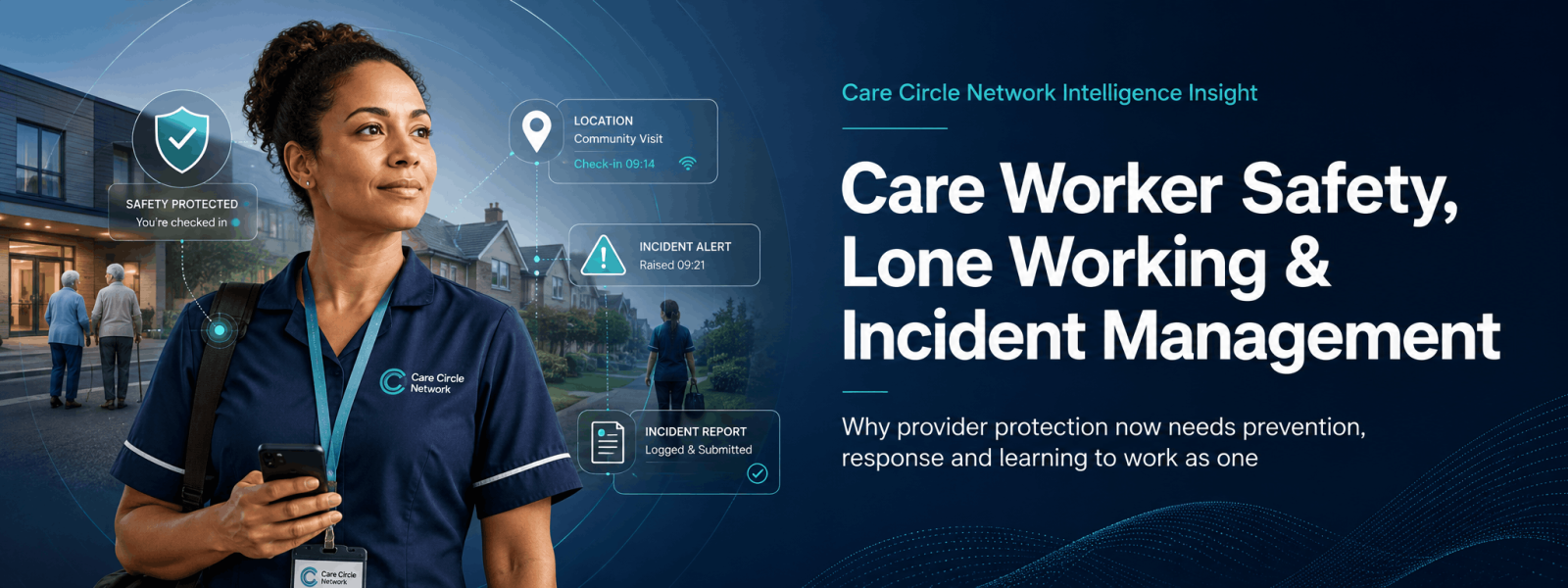
A Panic Button Is Not a Safety System: The Care Worker Protection Gap Providers Need to Close
Why violence prevention, lone-worker protection, incident response and organisational learning now need to operate as one connected system
Care Circle Network has already challenged one of the most damaging assumptions in adult social care: that violence, threats and aggression are simply part of the job.
The next question is harder.
When a provider says it takes staff safety seriously, what does that mean in practice?
Does it mean there is a policy in a folder?
Does it mean workers have completed an annual training module?
Does it mean some employees have an alarm, app or panic button?
Or can the organisation demonstrate a connected system that anticipates foreseeable risks, protects staff when circumstances change, responds quickly when an incident occurs and learns enough to prevent the same event happening again?
The weakest arrangements are not always those with no policy or technology. Often, they are the ones with a policy, an alarm and an incident form, but no reliable chain joining them together.
That is the care worker protection gap.
The national figures should stop this being treated as a marginal issue
The Health and Safety Executive estimates that there were 689,000 incidents of violence at work in England and Wales during 2024/25, comprising approximately 370,000 assaults and 319,000 threats. Around 329,000 working adults experienced violence at work during the year.
For the combined 2023/24 and 2024/25 period, the estimated rate among health and social care associate professionals was 2.7%, compared with 1.2% across all occupations. That occupational category does not represent the whole adult social care workforce, but it reinforces the level of exposure within care-related work.
HSE also says violent and aggressive incidents are the third largest cause of injuries reported under RIDDOR within health and social care.
Yet the official picture is almost certainly incomplete. HSE identifies a high level of under-reporting in the sector, with workers sometimes accepting abusive, threatening or aggressive behaviour as an unavoidable part of their role.
This creates an immediate governance problem.
An organisation with few recorded incidents may be operating safely.
It may also have a workforce that has stopped reporting.
Those are very different realities, but the management information can look exactly the same.
Violence is broader than physical assault
Care providers should be careful not to define the issue too narrowly.
Work-related violence includes situations in which somebody is abused, threatened or assaulted in circumstances connected with their work. It can include physical attacks, verbal threats, intimidation, sexual harassment, repeated abusive calls, online abuse and behaviour that leaves a worker feeling unable to leave safely.
Within care, the potential sources are varied.
An incident may involve a person receiving care, a relative, a visitor, a member of the public, a colleague or somebody encountered while travelling between visits.
The circumstances can also be complex. Behaviour may be connected to pain, distress, dementia, communication needs, mental ill health, learning disability, medication, fear or confusion.
Understanding that context is essential to providing safe and person-centred care.
But understanding the reason for behaviour does not remove the need to protect staff from foreseeable harm.
Providers must be able to hold both principles at once:
People receiving care should be understood and supported without blame or unnecessary restriction. Staff should not be expected to absorb repeated abuse, threats or injury without effective protection.
A person may have no intention to cause harm. The risk to the worker may still be real.
Under-reporting is not simply a data-quality problem
HSE identifies several reasons workers may not report violence or aggression.
They may believe it is part of the job, fear they will be blamed, find the reporting process difficult, assume nothing will happen or worry that reporting could damage the organisation’s reputation.
In care services, other pressures may be involved.
A worker may not want a person receiving care to be labelled unfairly. They may think an incident was too minor to justify a report. They may finish a difficult visit and immediately move on to the next person. Agency workers may not know the reporting route. Night staff may not want to disturb a manager. A registered manager may know something happened but never receive a formal record.
Each individual decision can feel understandable.
Collectively, they can leave the provider blind.
HSE specifically warns that incidents such as hair pulling, pinching and verbal abuse may go unreported, despite the possibility that repeated lower-level events can escalate into a serious incident.
A reporting system therefore needs to capture more than injuries.
Threats, near misses, blocked exits, escalating language, unwanted sexual behaviour, repeated intimidation, damage to property, unsafe visitors and failed attempts to obtain assistance can all provide early warning.
The purpose is not to create paperwork around every difficult interaction.
It is to identify patterns before those patterns become injuries.
Lone working is an operating condition, not a job title
The phrase “lone worker” often brings domiciliary care immediately to mind.
That is understandable. Homecare workers travel alone, enter private homes, work at different times of day and may have limited information about who else will be present.
But lone-working exposure runs much further through adult social care.
It can include:
- a supported-living worker moving between individual properties;
- a night worker covering one part of a residential service;
- a staff member carrying out medication rounds away from colleagues;
- a worker escorting somebody into the community;
- a manager responding to an out-of-hours concern;
- a cleaner, maintenance worker or driver working away from the main team;
- and a bank or agency worker who is technically surrounded by people but has little knowledge of the service, its risks or its escalation procedures.
A worker can be physically inside a busy service and still be functionally alone if nobody can hear them, reach them or recognise that help is needed.
HSE says lone working does not automatically create a higher risk of violence, but it can make a worker more vulnerable because nearby support is unavailable. Employers must manage lone-working risks, provide appropriate training and supervision, monitor workers, maintain contact and have arrangements to respond when something goes wrong.
This means the assessment cannot stop at the question:
“Does this employee work alone?”
The better questions are:
Where might they become isolated? How quickly could they summon help? Who would respond? What information would the responder receive? What happens if the worker loses signal, cannot speak or is unable to reach a phone?
The care worker safety chain
Effective worker protection can be understood through three connected stages:
before the incident, during the incident and after the incident.
Weakness at any stage can undermine the rest.
Before: anticipating the risk
Prevention begins with a realistic understanding of the work.
HSE says organisations may need both general risk assessments covering the wider working environment and individual assessments where a person receiving care may present a known risk. Relevant information should be reflected in care planning and understood by staff who could be exposed.
For a care provider, the practical picture may include:
- known triggers and early warning signs;
- previous incidents and near misses;
- communication needs;
- changes in health, medication, pain or emotional state;
- household members, visitors or relatives who may be present;
- the physical environment and possible exit routes;
- mobile coverage and connectivity;
- tasks that should not be completed by one worker;
- staffing levels and staff experience;
- late, cancelled or unexpectedly extended visits;
- and what authority a worker has to pause, withdraw or request additional support.
Information must also reach the person who needs it.
A detailed risk assessment held centrally has limited protective value if the visiting worker cannot access it, an agency employee has not been briefed or a change in circumstances has not reached the next shift.
The same principle applies across multi-site groups.
A strong central policy cannot compensate for a local service that does not translate it into rotas, handovers, visit planning, supervision and daily decision-making.
During: securing an effective response
This is where technology is often introduced.
A lone-worker app, wearable alarm, staff-attack system, panic button, body-worn camera or monitored device can materially improve protection.
But the device itself is only one part of the control.
The real test begins after it is activated.
Who receives the alert?
Do they know the worker’s identity and location?
Can they hear what is happening?
Are they authorised to contact emergency services?
Can they reach a manager or nearby colleague?
What happens when mobile coverage is poor?
How quickly is a missed check-in investigated?
Are staff confident they will be supported if they activate an alarm and the situation later proves less serious than feared?
A worker who worries about being criticised for a false alarm may delay using the system until it is too late.
HSE says response procedures should match the level of risk, workers should understand when to initiate them and staffing arrangements should be sufficient to manage foreseeable violence.
An alarm that nobody owns, tests or responds to is not a functioning safety control.
It is an unverified assumption.
After: supporting, recording and learning
The immediate response following an incident matters.
The worker may need medical attention, time away from duties, contact with the police, emotional support or a confidential conversation away from the service.
They may also need reassurance that reporting the incident will not lead to blame.
HSE advises employers to provide suitable support, record and report incidents and review whether further controls are needed. Certain injuries resulting from work-related violence are reportable under RIDDOR, depending on the outcome and circumstances. HSE also recognises the value of post-incident debriefing for establishing what happened and providing emotional support, sometimes supplemented by counselling.
But the process should not end when the incident form is marked complete.
The provider may need to reconsider:
- the individual care plan;
- staffing arrangements;
- lone-working decisions;
- visit timing;
- environmental controls;
- information shared at handover;
- training or supervision;
- family and visitor boundaries;
- the availability and performance of safety technology;
- and whether similar incidents have occurred elsewhere.
An incident can be administratively closed while the underlying risk remains open.
Incident management is the organisation’s memory
Incident systems are sometimes treated as repositories: somewhere to place a record after something has gone wrong.
Their greater value lies in what the organisation can learn across time.
A useful incident record should help establish not only what happened, but the conditions around it.
Was the worker alone?
Was the person receiving care known to be distressed?
Had there been previous warning signs?
Was an agency or newly appointed worker involved?
Did staffing differ from the planned level?
Was an alarm available?
Was it used?
How quickly did somebody respond?
What happened after the report?
Did a previous action remain incomplete?
HSE says recording incidents helps organisations build a true picture of risks and triggers, examine whether controls are working and demonstrate to employees that violence is being taken seriously. Reporting systems should be straightforward enough for workers to use promptly, including through mobile or online routes where appropriate.
This is where incident management becomes a leadership issue.
One isolated event may be difficult to predict.
Five similar events on late visits, involving the same task, location or missing control, are a pattern.
The provider should be able to see that pattern before somebody is seriously injured.
The October 2026 employment-law change adds urgency
From 30 October 2026, employers will be required to take all reasonable steps to prevent sexual harassment of their employees. The government’s implementation timetable also introduces an obligation on employers not to permit harassment of their employees by third parties.
In adult social care, third parties can include people receiving services, relatives, visitors, contractors and members of the public encountered during community work.
This does not make every difficult interaction identical.
A provider will still need to consider capacity, health, communication, distress, safeguarding, proportionality and the circumstances of the individual.
However, it makes it increasingly difficult to leave third-party behaviour outside the main workforce-safety system.
A harassment policy held by HR will not, by itself, show how risk is being managed during a home visit, within supported living, on a night shift or when a relative repeatedly targets a particular employee.
The practical questions become much more specific:
Was the risk anticipated?
Could staff report it safely?
Were repeated lower-level incidents recognised?
Were reasonable controls considered?
Was the worker supported?
Did the provider act when the pattern became clear?
The October change should therefore be viewed alongside lone working, violence prevention and incident management—not as a separate policy exercise.
Staff safety and care quality are connected
Worker protection is sometimes discussed as though it sits outside care quality.
It does not.
Staff who feel unsafe, unheard or unsupported may become reluctant to attend certain visits, work particular shifts, report concerns or remain with the organisation.
Repeated exposure can affect confidence, wellbeing, sickness absence, retention and the consistency of care.
Poor incident learning can also leave risks to people receiving care unresolved. A violent or aggressive incident may reveal pain, unmet communication needs, environmental stress, inappropriate staffing, a medication issue, deteriorating health or a care plan that no longer reflects the person’s circumstances.
The objective is not simply to prevent another staff injury.
It is to understand what the incident is telling the organisation.
CQC’s learning-culture quality statement describes safety as a priority involving staff as well as people using services, supported by openness, learning and improvement. Regulation 12 guidance also expects information from incidents to be shared with involved staff and others so that learning can improve safety.
A provider that routes every worker-safety incident only through HR may miss the implications for care planning, safeguarding, staffing, clinical oversight and quality governance.
A provider that routes everything only through care planning may miss the employment, health-and-safety and workforce consequences.
The strongest systems connect them.
Technology can strengthen the chain, but it cannot replace it
Care providers now have access to a growing range of worker-safety technology:
- monitored lone-worker applications;
- wearable SOS and duress devices;
- automatic fall or man-down detection;
- timed check-ins;
- GPS or location sharing;
- staff-attack alarm systems;
- body-worn cameras;
- emergency communications;
- mobile incident reporting;
- and dashboards capable of identifying recurring patterns.
These tools can shorten response times, provide evidence and make reporting easier.
They can also fail if implementation is weak.
Before selecting any system, providers need to understand the environments in which it will operate.
Does it work inside the buildings staff regularly enter?
What happens when there is no mobile signal?
Can the worker activate it discreetly?
Who monitors it outside normal office hours?
How are temporary and agency workers included?
How often is the system tested?
What data is collected, who can access it and how long is it retained?
How do alerts and incident records connect to care planning and quality governance?
Would body-worn technology be proportionate within a person’s home or during intimate care?
The point is not that one type of technology is right or wrong.
It is that the product must fit the provider’s risks, operating model, workforce and response arrangements.
The question is not:
“Do we have a lone-worker app?”
It is:
“Can we demonstrate that our staff can obtain effective help, in the places they actually work, at the times they actually work?”
Care Circle Network Intelligence Insight
The same national issue creates very different operational risks
Care Circle Network’s Provider Intelligence Observatory spans more than 30,000 care-related locations across residential, nursing, domiciliary and supported-living services.
That breadth matters because care worker safety cannot be reduced to one national risk score.
A domiciliary provider may be most concerned about travel, private homes, mobile coverage, late visits and workers moving between appointments without direct supervision.
A care home may have many employees on site but still face isolated work on night shifts, within individual wings, during personal care or while responding to distressed behaviour.
A supported-living provider may manage staff across several properties, each with different environments, household dynamics and support arrangements.
A multi-site group may have sophisticated central systems but inconsistent local adoption.
A small independent service may know its workforce and residents closely but lack the reporting technology or analytical capacity to identify patterns formally.
The Observatory is not used to infer that a provider, service type, diagnosis or population group presents a violence risk.
A dementia specialism does not establish violent behaviour. Neither does a learning-disability, autism or mental-health registration.
Provider-specific risk requires direct evidence and proper qualification.
What the intelligence does show is where operating models differ, where workforces are dispersed and where the practical safety questions are likely to require different answers.
Six questions provider boards should be able to answer
A provider does not need to promise that no worker will ever face aggression.
It should be able to explain how foreseeable risks are managed.
Leadership teams should be able to answer six questions clearly:
- Which roles, shifts, services and activities expose staff to the greatest risk?
- Are verbal abuse, threats, harassment and near misses being recorded—or only incidents that cause injury?
- When a lone worker requests help, who responds, how quickly and with what information?
- What changed after the last serious incident or repeated pattern of lower-level incidents?
- Can temporary, bank and agency workers access the same risk information, reporting routes and safety systems as permanent staff?
- Is workforce-safety information visible across HR, operations, quality, safeguarding and board governance—or trapped within separate systems?
An inability to answer does not automatically mean the service is unsafe.
It does indicate where assurance remains weak.
The next standard is a connected protection system
Care worker safety will not be secured by one policy, one training course, one device or one incident form.
It depends on the connection between them.
Risk assessment should shape care planning.
Care planning should inform staffing and visit decisions.
Workers should have a reliable way to obtain help.
Every alert should lead to a defined response.
Every incident should create support, evidence and learning.
And leadership should be able to see whether the organisation is safer as a result.
That is the standard providers are now being asked to move towards.
Not an organisation in which nothing difficult ever happens.
An organisation in which risk is recognised early, workers are protected properly, incidents are taken seriously and learning changes what happens next.
Taking the conversation forward
Care Circle Network is now extending its provider engagement into a focused Care Worker Safety, Lone Working & Incident Management Programme.
Care Circle will continue to lead the editorial, sector intelligence and provider conversation.
The next stage is to bring specialist expertise into the areas where providers need to move from awareness into practical action—including worker-safety reviews, lone-worker protection, panic and duress systems, monitored response, staff-attack technology, incident-management platforms and implementation support.
Because a panic button is not a safety system.
The system is everything that happens before it is pressed, while help is being requested and after the incident is over.
This feature provides general editorial information and does not constitute legal, employment, health-and-safety, safeguarding or regulatory advice. Provider-specific risks and obligations should be considered with appropriately qualified advisers.