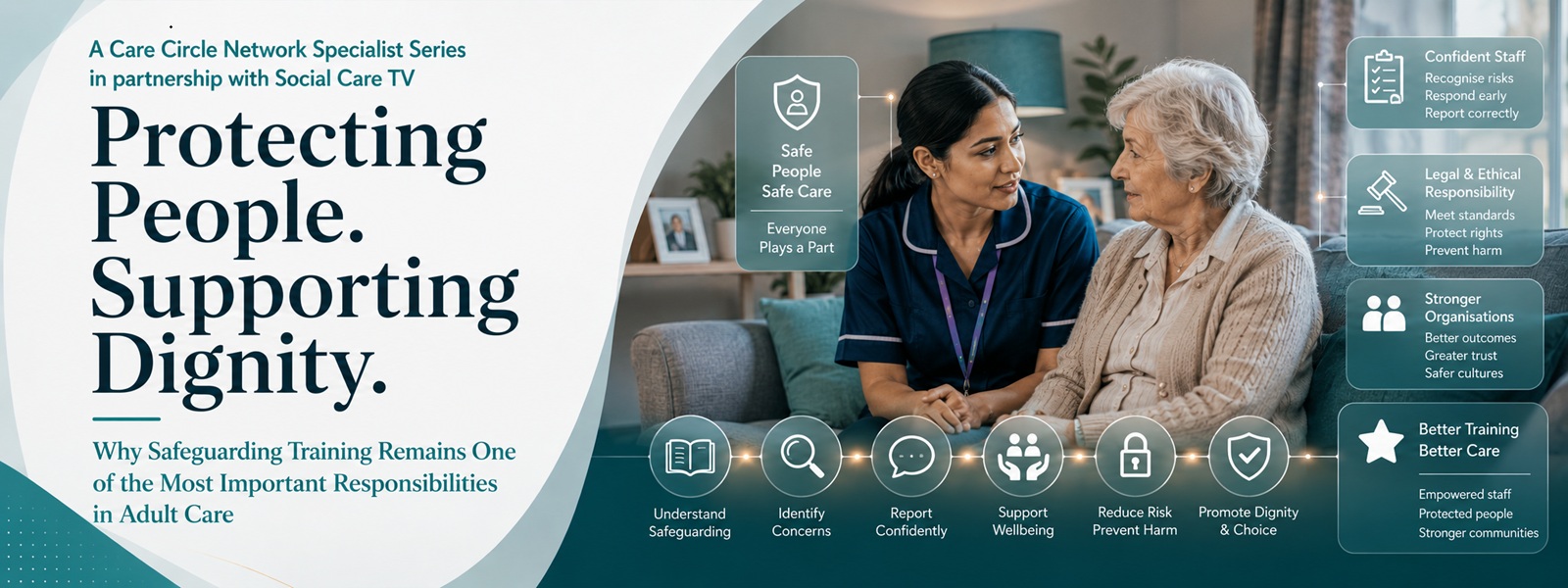
Why Safeguarding Training Remains One of the Most Important Responsibilities in Adult Care
Safeguarding sits at the heart of safe, person-centred care — protecting vulnerable adults from abuse, neglect and harm while supporting dignity, independence and respect.
For care providers, safeguarding is no longer simply a compliance obligation. It is a core part of organisational culture, shaping how teams communicate, assess risk and respond to concerns.
Safeguarding is one of the defining responsibilities within health and social care. While policies, inspections and compliance frameworks continue to evolve, the central principle remains unchanged: vulnerable adults must be protected from abuse, neglect and harm, while being supported to live with dignity, independence and respect.
For care providers, safeguarding is no longer viewed simply as a compliance obligation or induction requirement. Increasingly, it is recognised as a core part of organisational culture — shaping how care staff communicate, respond to concerns, assess risk and advocate for the people they support.
The scale and complexity of safeguarding responsibilities have grown significantly in recent years. Modern care settings are expected to respond not only to physical abuse and neglect, but also to financial exploitation, psychological abuse, discriminatory behaviour, domestic abuse, coercion, self-neglect and emerging risks such as modern slavery and radicalisation.
Safeguarding cannot be approached as a one-off exercise. It requires continual reinforcement and confident frontline practice.
Why Training Needs to Be Ongoing
The challenge for providers is that safeguarding cannot be approached as a one-off exercise. It requires continual reinforcement, regular refresher training and a workforce that understands both the legal framework and the practical realities of identifying and reporting concerns.
This is particularly important because safeguarding issues are not always obvious. Abuse can often be subtle, gradual or hidden within routine interactions. Staff working on the front line are therefore expected to recognise behavioural indicators, understand reporting pathways and respond appropriately when concerns arise.
According to Social Care TV, safeguarding training must extend beyond definitions and procedures. Effective learning should help care workers understand why safeguarding matters, how vulnerability can manifest in different individuals, and how care environments can either reduce or increase risk.
From Compliance to Culture
The topic is also closely connected to wider regulatory expectations. Safeguarding forms part of the Care Certificate framework and contributes directly to Care Certificate Standard 10, which applies to workers entering the health and social care sector.
Training providers are increasingly expected to demonstrate not only that learning has been completed, but that staff are able to apply safeguarding principles confidently within real-world care situations.
One of the major shifts within adult safeguarding over the last decade has been the emphasis on person-centred practice. Historically, safeguarding procedures often focused primarily on organisational protection and incident reporting. Today, there is far greater recognition that safeguarding should also preserve individual choice, independence and wellbeing wherever possible.
Person-centred practice
Safeguarding should protect people while preserving choice, independence and wellbeing wherever possible.
Professional judgement
Staff need confidence when autonomy and safety appear to conflict in complex care situations.
Shared responsibility
Safeguarding often requires collaboration between providers, NHS services, local authorities and safeguarding boards.
Clear reporting pathways
Teams must understand internal procedures, external processes and where accountability sits.
This balance can be difficult to achieve in practice. Care staff may encounter situations where autonomy and safety appear to conflict, particularly when supporting adults with complex needs, cognitive impairment or mental health conditions.
The Role of Digital Learning
Technology is also changing the way safeguarding training is delivered. Online learning platforms have become widely adopted across the sector, particularly as providers look for more flexible ways to train dispersed workforces operating across multiple sites and shift patterns.
Digital learning offers practical advantages for employers managing large teams. Courses can be completed remotely, progress can be monitored centrally and refresher training can be delivered more consistently.
For care workers, online delivery allows learning to take place at a more manageable pace and can reduce some of the operational disruption associated with traditional classroom-based training.
However, there remains ongoing debate across the sector about the balance between digital learning and practical supervision.
Social Care TV’s Safeguarding Focus
Social Care TV, one of the UK’s established online training providers for the care sector, has developed a safeguarding course covering areas including abuse indicators, safeguarding legislation, whistleblowing, restrictive practices, information sharing and safeguarding investigations.
The course also addresses issues such as domestic abuse, organisational abuse, self-neglect and modern slavery — areas which have become increasingly prominent within adult safeguarding discussions.
Importantly, safeguarding training is not solely about protecting service users. It also provides protection for care staff and organisations themselves.
The Core Message
As pressures on the health and social care sector continue to increase, safeguarding will remain one of the most scrutinised and essential areas of workforce development.
Against that backdrop, safeguarding training is no longer simply part of induction. It has become a critical operational discipline — one that underpins trust, professionalism and the delivery of safe, person-centred care across the sector.
Specialist Series Insight
This feature forms part of a care-sector editorial series focused on practical training, safer frontline practice and stronger care quality.
Find out more about safeguarding training
Social Care TV provides online care-sector training designed to support compliance, staff development and safer frontline practice.