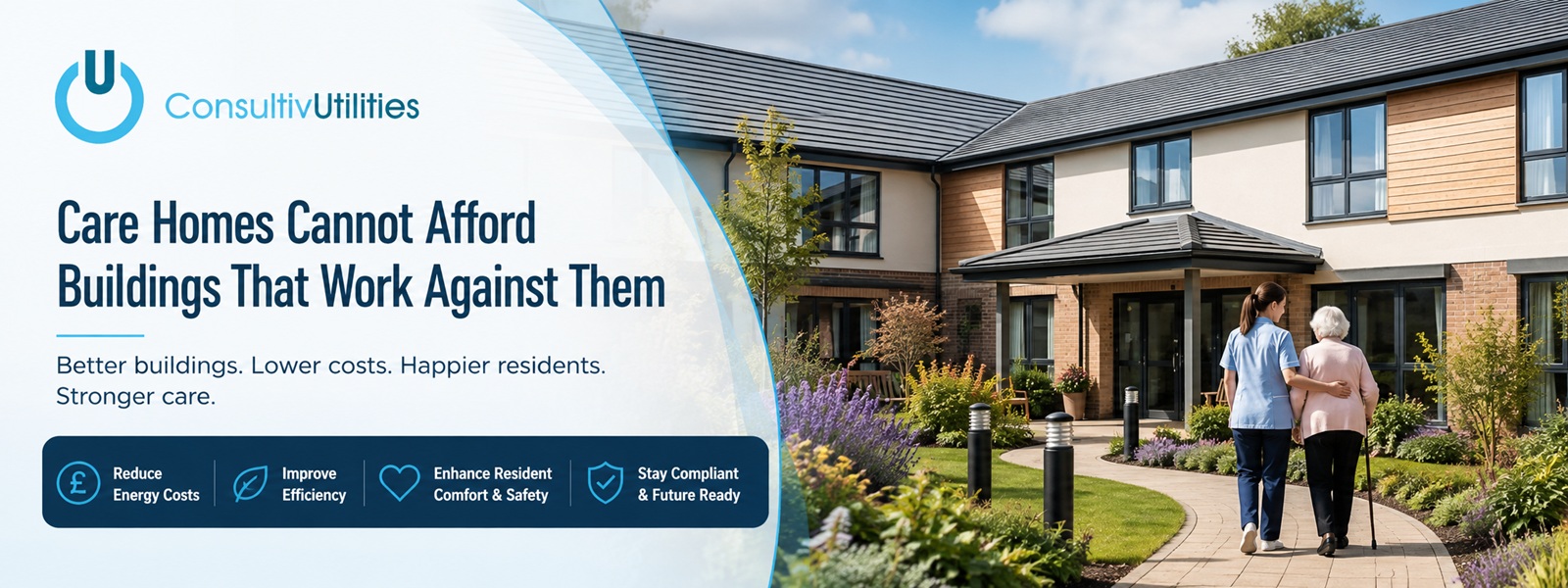
Care Homes Cannot Afford Buildings That Work Against Them
The condition and performance of a care home affect far more than its appearance. They influence resident comfort, staff wellbeing, regulatory compliance, energy expenditure and the long-term sustainability of the service.
For care home operators, a building is not simply the physical setting in which care is delivered. It is a continuously operating environment that must remain safe, comfortable, efficient and dependable every hour of every day.
Heating, ventilation, lighting and building controls all operate behind the scenes, yet they influence almost every aspect of daily life within a care environment.
When these systems become inefficient, ageing or poorly integrated, the consequences are felt through rising operational costs, increased maintenance requirements and a poorer experience for residents and staff alike.
With utility expenditure remaining a significant pressure on care providers, building performance has become a strategic issue rather than simply a maintenance concern.
Looking Beyond Energy Procurement
Many organisations begin by reviewing their energy contracts, but procurement is only one part of the picture. The real opportunity often lies within the building itself.
Poorly performing heating systems, inefficient ventilation, outdated lighting, ineffective controls and ageing plant can all increase utility consumption without operators fully realising where the losses are occurring.
A comprehensive building services review helps an organisation understand how its estate actually performs, where energy is being wasted and which practical improvements could deliver measurable savings over time.
Rather than focusing on isolated upgrades, the objective is to develop a coordinated strategy that improves operational efficiency while supporting compliance, resident comfort and future sustainability objectives.
The question is no longer simply, “What are we paying for energy?” It is also, “How effectively is our building using it?”
Why Building Performance Matters in Care Homes
Care homes present an operational challenge unlike most conventional commercial buildings: they never truly close.
Residents require stable indoor temperatures throughout the year. Domestic hot water systems must remain reliable. Ventilation is essential for infection control, comfort and indoor air quality. Lighting must support safety, mobility and wellbeing throughout the day and night.
At the same time, many providers continue to operate older estates containing equipment that is inefficient, difficult to control or approaching the end of its operational life.
Temperature
Stable and appropriately controlled temperatures are central to resident comfort, particularly for older and more vulnerable people.
Hot Water
Reliable hot water provision supports personal care, cleaning, catering and infection-prevention procedures across the service.
Ventilation
Effective ventilation helps manage humidity, air quality, odours and infection-control risks while maintaining a comfortable environment.
Lighting
Well-designed lighting supports visibility, orientation, safety and a healthier day-to-night experience for residents and employees.
Every inefficient system contributes to unnecessary expenditure. Small improvements across several building systems can collectively produce meaningful reductions in operating costs while improving comfort for residents and working conditions for staff.
Compliance Is Becoming Increasingly Important
Care providers must also plan for an evolving regulatory and environmental landscape affecting the performance of their buildings.
Understanding applicable obligations early allows organisations to plan investment sensibly, prioritise the right improvements and avoid being forced into reactive decisions as future requirements develop.
Consultiv Utilities’ building services support is designed to help organisations understand these considerations while identifying opportunities to improve both compliance and operational performance.
Smarter Buildings Can Support Better Care
Modern building technology is no longer simply about reducing utility bills. It can provide managers with far greater control over the environment in which care is delivered.
Smart controls can optimise heating schedules, improve temperature zoning, monitor energy consumption in real time and give building managers much greater visibility over the performance of individual systems.
When combined with detailed energy data and ongoing monitoring, operators gain the evidence needed to make informed investment decisions rather than relying on assumptions or responding only when equipment fails.
The result is a building that can be more efficient, easier to manage and better suited to delivering high-quality, person-centred care.
A Joined-Up Approach to the Estate
Building performance is most effective when it forms part of a wider utility, sustainability and estates strategy rather than being addressed through disconnected projects.
Consultiv Utilities supports organisations across a broad range of utility management, energy performance and sustainability disciplines.
This integrated approach can help care providers address multiple operational priorities through one coordinated strategy rather than attempting to manage numerous disconnected suppliers, systems and recommendations.
Supporting Long-Term Operational Performance
For care home operators, every pound unnecessarily spent operating a building is a pound that cannot be directed towards residents, staffing or service improvement.
Building services should therefore be viewed not simply as a maintenance expense, but as a long-term investment in operational resilience.
By understanding how buildings consume energy, identifying inefficiencies and implementing practical improvements, providers can reduce costs, strengthen compliance, support sustainability objectives and create more comfortable environments for residents and employees alike.
The benefits of building improvement extend beyond a single utility bill or maintenance budget.
They can contribute to resident comfort, staff wellbeing, compliance planning, financial control and the long-term resilience of the care service.
In today’s operating environment, building performance has become an essential component of sustainable, high-quality care.
Discover How Your Care Estate Could Perform Better
Consultiv Utilities and Care Circle Network are working in partnership to help care providers reduce energy consumption, control costs and plan practical improvements across their estates. Use the dedicated Care Circle Network enquiry page to select the services you are interested in and request support from the Consultiv Utilities team.